Saturday, November 18, 2023

Eulogy for a horse with a perfect attendance record

This is the seasonal illustration that greeted subscribers to The Humeston New Era when they opened their newspapers on Wednesday, Nov. 26, 1913, as Thanksgiving approached.

But there was sad news, too, on the front page of this edition --- a short story headlined, "Horse Dies From Fright," a eulogy to Topsy, a venerable and much-loved driving mare who had been scared to death by Charles Humeston's automobile.

+++

Topsy, a 16-year-old family driving mare owned by E. S. Evans, dropped dead in the shafts from fright Thursday evening. Miss Hattie Evans was driving home from her school Thursday when she met Charles Humeston in his car. The horse became frightened. The animal fell to the ground and died almost instantly.

Topsy was kept tied in the school yard, and Wednesday she became badly scared at a passing auto and broke loose. The second shock was too much for her.

Mr. Evans had owned Topsy 13 years. She started to school at an early age. She had never been tardy or missed a day because of bad weather. During the past six years, Miss Hattie had driven her to school. Topsy was a good, kind, gentle animal and will be sadly missed by Mr. Evans and his family.

+++

Topsy's owner was Evan S. Evans, an honored Civil War veteran, school teacher and farmer who had just recently retired due to failing health and moved his family into Humeston from a farm in the Green Bay neighborhood.

A year and a half after Topsy's death, Evan died, too --- while sitting on a bench in the yard after enjoying a hearty lunch on April 15, 1915. And thus were man and faithful horse reunited.

Friday, November 17, 2023

Chariton's venerable Fire Department banquet


So here are the particulars for this year's version of Chariton's annual Firemen's Banquet, surely one of the most venerable events of its type in the south of Iowa. As you can see, serving at Carpenters Hall will be from 4:30 until 7 p.m. Saturday; the cost, a very reasonable $10 with oysters available as an add-on.

And at left, from the Lucas County Historical Society collection, is an invitation to the first anniversary banquet, held on Dec. 4, 1878, at Mallory's Opera Hall. 

The department was organized formally on Dec. 7, 1877, in the aftermath of a fire on Oct. 29, 1877, that destroyed the first of three big buildings to stand on what we now call the Columbus School hill. Without proper organization and equipment, the residents of Chariton could do little more than stand by and watch as a source of great community pride was gutted by flames. Organization of the department filled that major hole in Chariton's defenses.

For many years, the banquet coincided more or less with the early December anniversary, but has advanced by now into November.

Files of Chariton newspapers for November and December of 1878 have been lost, so there's no telling what the menu or the price of admission for that banquet was.

+++

But here, from 80 years ago, is The Chariton Leader's promotional story for that year's banquet, published on Nov. 30. So we know what was on the menu --- and how much it cost: 75 cents a head.

That big Thanksgiving dinner was just a preliminary. The main bout is coming up Thursday at the Methodist church when the Chariton Volunteer Fire Department serves its 66th annual banquet to all comers.

Mrs. James Baker, who heads the staff of chefs and cooks in charge of preparations for the meal, checked over her grocery list this morning.

It included 250 chickens. The second item on the list was: Oysters --- 19 gallons."

And here are some of the others: Eight bushels of Irish potatoes, four bushels of sweet potatoes, 48 pounds of cranberries, 100 pounds of cabbage, 40 pounds of crackers, 100 pounds of sugar, 65 pounds of butter, 30 gallons of milk, 30 pounds of coffee, eight gallons of cream plus ...

... 30 gallons of ice cream.

For the city's elderly people, the banquet will begin at 4:30 p.m. The price is 75 cents.

A dance at the American Legion home will follow the banquet. 

Thursday, November 16, 2023

Mrs. Smith's house of bad repute

One of the sorrows of a researcher's life is the fact that so many issues of Chariton's early newspapers are missing, including those for the opening months of 1878.

So I turned to the Weekly Pella Blade of Feb. 19, 1878, for the following report concerning Mrs. Smith, her house of bad repute and the penitent patrons who paid her fine. Sadly, no more information is available.

+++

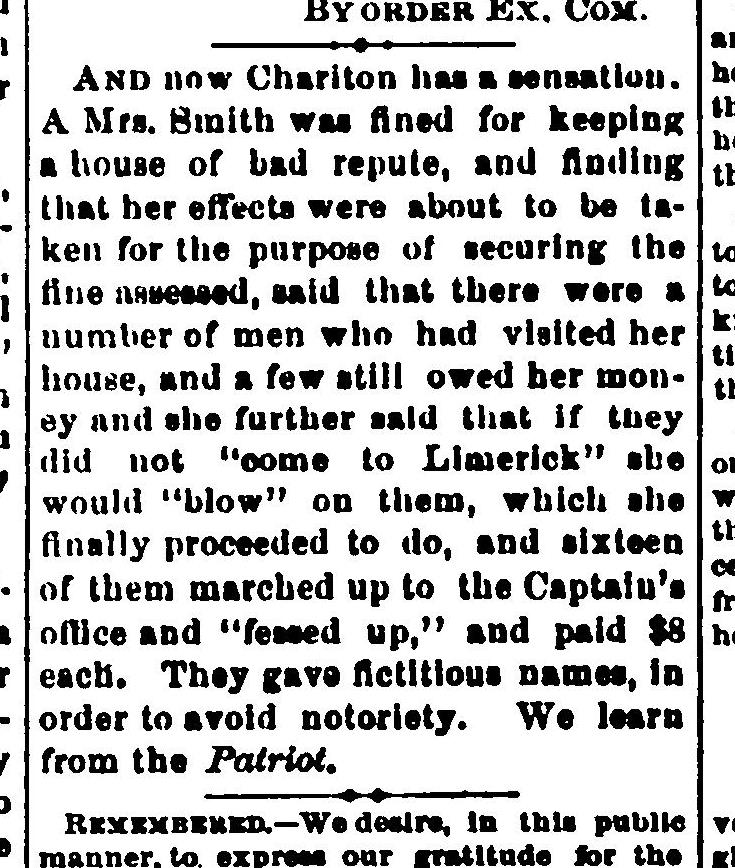
And now Chariton has a sensation. A Mrs. Smith was fined for keeping a house of bad repute, and finding that her effects were about to be taken for the purpose of securing the fine assessed, said that there were a number of men who had visited her house, and a still few owed her money and she further said that if they did not "come to Limerick" she would "blow" on them, which she finally proceeded to do, and sixteen of them marched up to the Captain's office and "fessed up," and paid $8 each. They gave fictitious names, in order to avoid notoriety. We learn from the Patriot.

Wednesday, November 15, 2023

On the watch for monsters ...

It's seemed to me lately that some days we're having collectively what used to be called a nervous breakdown, what with one thing and another.

So it was reassuring to find this cartoon by Tara Shannon, part of her Bear & Rabbit series, in my social media feed this morning.

With it comes the reminder that there are monsters out there and in most instances its evident who they are. And they are, almost without exception, fully human.


Tuesday, November 14, 2023

An "unmotherly sort" from Lucas County

I came across this sad little story involving a young woman reportedly from Lucas County in The Red Oak Express of Sept. 13, 1877. Yes, there was a Lock family living in Lucas County during both 1870 and 1880, but no --- there's no way to link it to the woman and her brother, mentioned here.

Whatever the case, the hope is that there was a positive outcome for both mother and child.

The Montgomery County map is taken from the Andreas Atlas of Iowa, 1875.

+++

One of the Unmotherly Sort --- A prominent citizen of this place, on returning home Friday night, found an interesting looking package on his doorstep; on examination it was discovered to be nothing less than a child, some five or six weeks old, that had been left there in the absence of the family.

The proper authorities were notified, and in the morning a woman by the name of Lock, some 25 years old from appearance, was arrested on suspicion and upon investigation of the case, she was found to be the mother of the child.

According to her story, her parents live in Lucas county, and to escape disgrace she left home early in July and went to Fremont county, where the child was born. She came up on the branch road and was met, by previous arrangement, at the depot at this place, by a brother who lives in this county, some six or eight miles northeast of Red Oak. It seems to have been the brother that engineered the affair.

Taking her statement the parents knew nothing of her condition when she left home, and she was to return as if she had been on a visit to her brother during the summer.

She was finally released --- took the child, and was glad to get away.

Monday, November 13, 2023

Hooch, choctaw and the legendary Tipperary

Tipperary, that legendary coal mine and related village deep in Lucas County's Pleasant Township hills, also was command central for a leading cottage industry --- homebrew --- back in the good old days. 

Prohibition had been law of the land since 1920, but Lucas County miners (and many others) still had a thirst and there were plenty of creative cooks out there to meet that need.

The little industry also kept law enforcement busy --- raiding homes and searching the hills for homemade hooch (whiskey) and choctaw (high-octane beer) and the paraphernalia needed to produce it.

Here's a report from The Herald-Patriot of March 16, 1922, about the biggest raid to date. Note the list at the end --- I know several folks who will find the names of their ancestors there (although quite possibly misspelled).

+++

One of the biggest liquor raids in the history of southern Iowa was staged Friday by a band of nine local, state and federal officers when they entered and searched 18 homes in Tipperary and Olmitz, mining centers in the northwestern part of Lucas County.

The officers participating in the raid were Sheriff C.C. Lyman, Deputy Sheriff W. A. Knotts, Constable W. C. Milthorpe, Marshal T. A. Norman, County Attorney C. F. Wennerstrum, D.F. Wilson, federal prohibition agent; C. M. Hanson, state agent; H. M. Stoner, state agent; and H. C. Gibson, of the Iowa Anti-Saloon League.

Of the 18 homes raided, all but four were found to contain stores of liquor and materials for manufacturing it. The goods were all confiscated. Samples of each lot of liquor were taken for analyzing and as evidence, and the remainder was destroyed. The stills and manufacturing devices seized were brought to Chariton and stored in the county jail.

State chemists have analyzed the samples seized and report each of alcoholic content, varying from 3 to 55 per cent. As of yet, no arrests have been made. It was at first planned to issue warrants for the 14 people in whose homes liquor was found, but County Attorney C.F. Wennerstrum announced Wednesday that since the grand jury will convene almost within a week he we will dispense with preliminary hearings and lay the cases directly before the grand jury. This action will save the county the expense of preliminary hearings for each of the accused.

March 22 has been set as the date for the hearing on the goods that were confiscated, when the former owners may appear before the court and set forth their claims of possession.

In spite of the territory embraced and the number of houses marked for search, the raid was planned and carried out without a single hitch. The local officers had been contemplating it for some time, while awaiting the assistance of the state and federal agents. They had reconnoitered and laid complete plans for each detail and the outside men, veterans of dozens of such raids, were able to ferret out the hiding places of the hootch and stills until the most cleverly concealed jug was brought to light.

The day was auspicious for the officers' plans. It was the day before pay day at the mines, and the bootleggers had full stores on hand to be ready for the heavy rush of business that would come when the miners received their wages. Moreover, it was such a disagreeable day that all who were not working would be sure to be found at home.

The party of nine men set out from Chariton early in the morning in the face of a snowstorm that became nearly a blizzard in the hilly mining country. The roads were almost impassable in spots and it took nearly two hours to reach Tipperary. One car, with Officers Lyman and Stoner, remained at Olmitz, where a few homes were marked for search, but the others spent the entire day at Tipperary.

Arriving at Tipperary, the officers split into two groups to work on opposite sides of the railroad tracks. These groups proceeded as rapidly as possible from one house to another, searching and seizing, and carrying the confiscated goods back to the cars, where they were guarded from recapture by two men.

Most of the homes visited were owned by foreigners, some of them miners and others evidently without any visible means of support. One was a woman. There were Italians, Slavs, and some whose nationality defied classification. Some of them welcomed the officers with smiles, and some with curses, in broken English. Some were frightened while others appeared calm and unconcerned, sure that their liquor was hidden in a secure spot. None of them attempted to offer any resistance to the officers, some of whom were not even armed, and every one of them protested volubly that he was a law-abiding citizen and would not think of keeping liquor on his premises, much less of manufacturing it.

Ingenious hiding places were uncovered by the officers. In some cases the liquor was found in caves in the hills near the homes, and in others jugs were found hidden away in cellars and other remote spots.

After the search had been made and the damaging evidence brought to light, many were the excuses offered. It some cases, it seems, over a hundred gallons of choctaw or moonshine were kept on hand because the doctor had prescribed whiskey for a bad cold, or as a tonic. others professed ignorance of the stores and wonder as to its source.

In the homes, officers found parts of stills, but never a complete still. A coil was found here, a boiler there, and other parts in other places which, when assembled, would be a distilling outfit. But no complete still was found. The copper coil and the metal parts --- only some junk that had been lying around the house, the officers were told. But the raiders were incredulous, and the "junk" is now in the hands of the sheriff to be used as evidence.

At some homes officers reported having been offered bribes varying from $10 to $100 for leaving some of the hootch undestroyed, or for forgetting entirely that they had found any contraband.

At each home the visit of the raiders was a complete surprise. The officers worked so rapidly and systematically that those who were visited first were unable to warn the others of the raid and give them opportunity to destroy the evidence.

Aside from being the biggest in the history of the county, the raid was unique in the degree of cooperation shown between the local and outside officers. The state and federal men, with their experience in such raids, and the local officers, with their knowledge of the ground to be covered, worked together so efficiently that their net caught even more offenders than had been hoped.

The following places were raided and seizures made as noted:

1. Mrs. Wren Gailey (Tipperary): 7-1/2 gallon white moonshine whiskey, one 10-gallon copper boiler cooker with top soldered on with neck; 18 gallons choctaw found, sample taken, remainder destroyed; 80 gallons fruit and grain mash, samples taken, remainder destroyed.

2. Matt Vidas (Tipperary): 3-1/2 quarts colored moonshine whiskey found in grip; 3 gallons corn and rye mash, samples taken, remainder destroyed.

3. Dominic Vernetti (Tipperary): 35 gallons finished choctaw, samples taken, remainder destroyed; 62 gallons fruit and grain mash, samples taken, remainder destroyed.

4. Andy Doolin (Tipperary): 15 gallons colored moonshine whiskey, 1 copper coil, 1 copper-top elbow for cooker, all seized.

5. Pete Cheri (Tipperary): copper coil (been used), brand new copper coil in original box as shipped, 1 copper top for cooker, copper tubing, lead tubing, roll of sheet copper, copper spouts, 2 copper necks for cooker, 12 pieces of copper sheets; bar of solder, soldering iron, pair tin snips, mallet, copper chimney for cooker, quart bottle bond whiskey, all seized; 100 gallons of fruit and grain mash, samples taken and remainder destroyed.

6. Alex Claro (Tipperary): found in Pete Cheri home, said to be a roomer --- 2 quarts white moonshine whiskey, seized;

7. Wat Davis (Tipperary): 1 brass blow torch, 1 funnel filler, 1 rubber hose, 1 top of boiler cooker with neck soldered on, three 50-gallon empty barrels with odor of moonshine whiskey therein, all seized but the barrels.

8. Tony Kauzlich (Tipperary): 100 gallons of peach and pruine mash, sample taken and balance destroyed; 16 gallons of choctaw, sample taken and balance destroyed.

9. Pete Viero (Tipperary): 110 gallons of choctaw, samples taken and balance destroyed; 5 gallons raisin mash, destroyed.

10. August Dunovich (Tipperary): 32 gallons choctaw, samples taken and remainder destroyed.

11. Tony Gurgovich (Tipperary): 20 gallons choctaw, samples taken and balance destroyed.

12. Marko Vudkovich (Tipperary): 16 gallons choctaw, samples taken and balance destroyed.

13. Robert Brown (Olmitz): 30 gallons peach and prune mash, destroyed.

14. Levi Zimmerman (Olmitz): 30 gallon copper cooker seized.


Sunday, November 12, 2023

A few lines from Dr. Caleb J. Lines


I'm a fan on several social media fronts of Dr. Caleb J. Lines, senior minister of University Christian Church (Disciples of Christ) in San Diego.

So here are a few thoughts for a Sunday morning from Dr. Lines, aimed at those of us who still go to church but sometimes are asked (or wonder) why. 

The most straightforward advertisement I've seen on a sign outside a Chariton church popped up many years ago, promoting a congregation's offering to the public as "fire insurance."

That congregation's denomination (and I'm not going to tell you which one it was) has mellowed considerably as the years have passed --- and I doubt anyone there would think of posting it today.

But many churches we call "fundamentalist" continue to maintain that their paths represent the "gospel" --- or the "good news" --- a prescribed formula to avoid hellfire and damnation.

The Lines list incorporates a more accurate representation of the good news and an invitation to get on with the work of proclaiming and promoting it. Much more could be added. 

One way to do that is in collaboration with others in a progressive congregation where radical hospitality is fundamental. So there's one reason for rising up on a Sunday morning --- when you'd really rather nap --- and heading to church.


Saturday, November 11, 2023

Out and about on Veterans Day

So there I was yesterday morning, jammed shoulder to shoulder just inside the Hy-Vee entrance and looking I guess a little dazed. The parking lot had been full and a big flag was waving from the boom of a fire truck parked nearby.

The goal had been to pick up a few groceries --- overlooked was the fact Hy-Vee's annual Veterans Day breakfast had been scheduled for Nov. 10 rather than Nov. 11.

This guy with a big grin spotted me and asked, "Are you a veteran?" I allowed that I was. Where did you serve: Vietnam; what did you do: it's complicated.

After turning down a free calendar and an invite to an anti-fraud seminar, the next stop was the end of the food line --- cinnamon rolls, bacon, sausage, biscuits, gravy, hash browns, scrambled eggs, drink of choice. Good stuff.

Then I sat down across the table from Amy Sinclair, rural Allerton, who is our state senator. Sen. Sinclair led the charge this year for Iowa's new school voucher plan --- channeling public dollars into private education.

She has an engaging personality and a firm handshake. I introduced myself as a gay Democrat who would never under any circumstances vote for her --- but welcome to Chariton anyhow.

I may have embarrassed Earl Comstock, who was sitting there, too. I hope not. But a guy's gotta do what a guy's gotta do.

+++

The illustration here is intended to honor all of our LGBTQ+ veterans who had to fight the prejudices of their fellow countrymen in order to serve and, in many cases, die for them.

You're my heroes this Veterans Day --- and always.

And thanks, Hy-Vee, for the breakfast!

Friday, November 10, 2023

City marshal goes underground, nails a horse thief

Fort Fetterman

John H. Cole was Chariton's city marshal for 10 years, from 1878-1888, but I found this account of what probably was his most widely known exploit in The Beatrice (Nebraska) Republican of June 19, 1886.

The back story is a little garbled in the report, so in order to clarify: A Lucas County horse trader named Victor Cavallin made a deal during 1885 with another Lucas Countyan, Jim McCoy, who was anxious to move west. McCoy was to drive a team owned by Cavallin to Norfolk, Nebraska, where the horse market was hot, then sell it and forward the cash to Cavallin.

McCoy sold the team instead at Burnett, Nebraska, then held onto the cash and high-tailed it for Wyoming, coming to rest in the neighborhood of Fort Fetterman. Marshal Cole took on the case and tracked Mr. McCoy down. Here's the report:

+++

Fort Fetterman (Wyoming), special to the Omaha Herald: An important arrest was made at the new town of Fetterman some miles southeast of this place, Saturday, by John H. Cole, marshal of Chariton,  Ia., and Charles Trumbull, deputy sheriff of Laramie county, Wyo.

It seems that a year or so ago a team valued at $400 was stolen at Norfolk, Neb., by one Jim McCoy, who subsequently disposed of it for about that figure at Burnett, Neb. McCoy was for some four years a resident of Lucas county, Iowa, before coming west, and was well known by Officer Cole, who has served eight years as marshal of Chariton, and some three months ago the latter began to work up the case.

He soon got track of McCoy and finally traced him as far as Lusk, Wyo., where he fell in with a former pal of McCoy's, who was suspected of knowing all about the theft. Marshall Cole represented himself to be a "tough," and proceeded to work himself into the good graces of the fellow by taking in the town and getting on a tear, taking care, however, to see that the man did most of the drinking.

The result was that the officer was soon in full  possession of the entire facts about McCoy stealing the team, and also learned that he had but a day or two before gone to the new town of Fetterman. Taking Deputy Sheriff Trumbull with him, the two procured a livery team and pulled  out for Fetterman, where they arrived Saturday about noon.

Leaving the driver and team some distance from the present town of tents, the officers proceeded to skirmish around among the campers. They soon spied their man, and before he was aware of it he was in irons.

+++

The rest of the story?

Jim McCoy was tried for thievery in Nebraska and sentenced to two years in the state penitentiary. 

John Cole returned to his job as Chariton city marshal, but two years later --- in the fall of 1888 --- succumbed to what was described as a case of "California fever," loaded up his family and headed for Westminster in western Orange County where the remainder of his life was spent.

The Cavallin family moved on, too, but Victor remained short some $400 --- the value of the team he had entrusted to Mr. McCoy.

Thursday, November 09, 2023

Pella rises from southern Iowa prairie

Image: Pella Convention & Visitors Bureau

So back in the summer of 1847, 800 or so Dutch immigrants led by Hendrik "Henry" P. Scholte, an affluent Dutch Reformed minister and leader of a secessionist faction within that denomination, arrived at the site of a town they named Pella --- just up the road and across the Red Rock Dam from Lucas County.

Today, we think of Pella in terms of tulips, Central College, Vermeer, Pella Windows, extreme neatness --- and more Reformed churches than you can shake a stick at. Those Dutch are still going strong.

About all that has to do with Lucas County is the fact that William McDermott and his family, first settlers in our Cedar Township, had settled near what became Pella first, but sold their claim to Mr. Scholte for $1,000 that long-ago summer and headed south and west to Lucas County.

Here's how Dan Baker describes McDermott's arrival in his 1881 history of Lucas County: "He (McDermott) came from Illinois and first settled near Pella, Marion county, but the Dutch were crowding too closely, and he sold his claim there for $1,000, and pushed out to a new locality. With his capital thus acquired, two yoke of cattle, a wagon, his household effects and family, he started for Monroe county, where he reached the house of Henry Harter, in August, 1847, with whom he left his family while he made a prospecting tour for a new home. He came into Lucas county, some fifteen miles distant, and he was so pleased with the country that he laid claim to one hundred and sixty acres in section 16 (Cedar Township) of its virgin soil upon which to make his future home and rear his family."

+++

Mr. Scholte (left) and his party had regrouped in St. Louis during the spring and early summer of 1847 after arriving in the United States and made arrangements to have cabins built on their newly acquired land in Marion County before moving there during August --- or so they thought. As it turned out, the cabins hadn't been  built and the new arrivals found themselves camped out on the prairie.

A correspondent for The Church Intelligencer visited Pella during late winter 1847-48 and a bit of his report was published as follows in The Davenport Gazette of Thursday morning, April 6, 1848:

Interesting Dutch Colony --- The Holland immigrants recently settled in Iowa have named their new settlement "Pella," from Pella beyond the Jordan, to which the early Christians fled upon the destruction of Jerusalem by the Romans. It is two or three months old, and numbers 800 inhabitants. Large numbers are to join them in the spring, when their Pella will suddenly become a populous prairie town.

It is a singular sight, says a correspondent of the Church Intelligencer, the velvet jackets and wooden shoes of the Puritans of the 16th Century in the midst of the prairies of the New Purchase, that stretch from the Des Moines to the Cheeaque, in Iowa. They are living in camps covered with tent cloth, or grass and bushes --- the sides barricaded with all sorts of odd-looking boxes and chests from the Netherlands.

These people are respectable and intelligent. When they took the oath of allegiance to the United States a few weeks since but two made their marks. Many of the leading men possess unusual refinement and education.

+++

Progress had been made a year later when the following dispatch was published in the Weekly Miners' Express, Dubuque, on Jan. 9, 1849:

PELLA --- This village, the site of the Holland settlement in Iowa, we learn presents a thriving appearance. A saw mill lately constructed by Mr. Scholte has commenced operations and cuts on an average four thousand feet of oak timber daily. It is intended to put in operation by means of the same  power several run of stone next spring.

During the coming season, a considerable body of emigrants, it is expected, will be added to their number.

Habits of industry are gathering around them the elements of comfort and wealth, and the traveler in a few years will find in the wilderness of the prairie a populous and highly cultivated district --- Holland in miniature.

+++

By 1851, Pella was beginning to take shape and some of the traits that still mark it were coming to the fore. Here's a final report for this morning from The Iowa Democratic Enquirer, Muscatine, of Saturday, Sept., 13 1851.

Pella: Our recent visit to this town has convinced us that the untiring industry and commendable economy of our Holland neighbors will eventually build up a town and country that for wealth, beauty and convenience will be second to none in the State of the same population and advantages. We noticed a number of substantial and ornamental improvements since our last visit a little over a year since.

The heavy crops of corn, potatoes, garden vegetables, &c, all testify that the husbandman has not been idle, and give the further assurance that industry directed by a proper knowledge of practical farming will be rewarded by a profitable yield, even through the season may have been an extraordinary one.

The comparatively good state of the roads also show that while our people have generally been grumbling about mud, mud-holes and bad roads generally, they have been industriously engaged in a sensible way in repairing them. In this particular we are sure there are many communities in this State that might learn an important lesson.

The public square in Pella, instead of being a noisome dust-hole, and a common resort for horses, cattle, sheep, hogs and other animals, is neatly enclosed with a plain fence. The inside is partly devoted to horticultural purposes and partly to shrubbery.

On the outside, and entirely surrounding the square, is a paved walk for the accommodation of pedestrians in muddy weather. The principal streets are also improved on each side with stone pavements.

We have not visited a village for a long time that has made so many valuable, substantial and ornamental improvements in the same space of time.

The traveler will find a good hotel, and an accommodation landlord at the Pella House, where he can obtain food and rest, and all the necessary accommodations to make a short stay agreeable.

Wednesday, November 08, 2023

That was the election that was ....

Well, I was happy to see this morning that Steve Fenton --- a former neighbor, actually since we were kids if you broaden the "south of Russell" neighborhood enough --- has been re-elected to another term on the Chariton City Council. 

Gary Shutt, a newcomer, took the other open seat --- which is fine. I voted instead for Carl Tubbs because he had previous experience as council member and mayor at his former home, Brooklyn (Iowa). 

So far as school board was concerned, Sarah Willis (incumbent), Jarid Howell and Ryan Dachenbach were the winners in a field of seven. I preferred Alesha Urich and Jamie Aulwes, but so be it.

Whatever the case, I hope Alesha, Carl and others who demonstrated commitment to their community by running in the first place won't be too discouraged --- and will stay involved.

+++

In general, it appears that progressive candidates dominated the field in Iowa's larger school districts --- and that's a positive.

Over at Pella, a non-binding resolution that would have encouraged City Council to wrest control of the public library from the independent board it appoints in order to assume control of book buying failed. That's encouraging, too.

The resolution grew out of an effort to ban or restrict access to Maia Kobabe's LGBTQ+ memoir "Gender Queer" at the library. The failed effort was led by an on-air personality at Pella's Christian radio station.

+++

Elsewhere in the country, response to Republican efforts to eliminate or restrict reproductive healthcare rights for women produced results encouraging to Democrats.

In Ohio, a ballot measure establishing a right to abortion in the State Constitution won by a double-digit margin in a decidedly conservative state; down in Kentucky, Andy Beshear, Democratic governor, won a second term after a campaign fueled by the abortion issue; and in Virginia, Democrats won control of both chambers after campaigns focused largely on abortion, too.

Tuesday, November 07, 2023

Election Day: Now go forth and vote


One of the things I miss about being knee-deep in old-fashioned newspaper work is the depth of knowledge I used to have about candidates in local elections. That came initially from covering countless meetings (and elected officials), then editing the work of others who did the actual leg work.

So I went to the polls for years knowing who had a broad-based concern for the best interests of the city or school district, who was a one-issue candidate with little depth and whose name belonged on the loon list.

It's more complicated now, but I think I'm ready. Polls are open from 7 a.m. to 8 p.m. My polling place is City Hall.

If you still have general questions about the election, here's a link to the county auditor's "Lucas County, Iowa, Elections" web page. Now go forth and vote --- and make good decisions.

Monday, November 06, 2023

The tragedy of Joseph C. Hornbach's death


U.S. Army Tec. 5 Joseph C. Hornbach, 28, was another of those young men who gave up their lives while in service to their country during World War II --- but in a way that must have seemed especially tragic (and perhaps shameful) to his family: suicide.

Joseph had no connection to Lucas County --- except for the fact his death occurred aboard an east-bound Burlington Northern passenger train as it approached Chariton on July 8,1944.

Here's the text of the story reporting his death, published in The Chariton Leader of July 11:

+++

Joseph C. Hornbach, 28, home address unknown, took his life by hanging Saturday about 10 a.m. on an east-bound Burlington train. Coroner Brittell was called and removed the body to the Beardsley funeral home where it awaits orders from the government.

According to train companions, Hornbach, a sergeant in the Army, has been some 27 months in the Pacific area in the thick of the fighting. He had been sent back to the United States with a group of other soldiers being returned for rest. He boarded the train at Oakland, California, at 5 p.m. July 5 and was being shipped to a reconstruction camp at Fort Benjamin Harrison, Indiana.

He had, according to men on the train with whom he was riding, been rather despondent. His seat companion said he went to the wash room as the train left Creston and he was found hanging from a hook with his belt tied around his neck about the time the  train came into Chariton. He had been dead, said Dr. Brittell, about 10 or 15 minutes when the train stopped at the station.

His home address is not known and instructions are being awaited as to disposition of the  body.

+++

Born March 16, 1916, near Yorkville in Dearborn County, Indiana, Joseph was among the six children of John F. and Helen Hornbach and at the time of his enlistment during November of 1941 at Louisville, Kentucky, was employed by the Seagram Distilling Co.

Assigned to Headquarters Company, 1st Battalion, 147th Infantry, at the time of his death, he would indeed have been in the "thick of the fighting" in the Pacific Theater of operations. 

Joseph's remains were returned to his family in Indiana and a funeral Mass was held at St. Martin's Church in Yorkville on July 17 --- followed by burial in the church cemetery.

Neither then nor now do we know why the young soldier decided to take his own life. We do know more about PTSD and other hazards of war that in the past have been dismissed, however, and that suicide, too, can be a fatal wound of war.

Sunday, November 05, 2023

In memory of Conrad Francis McDonald

It's difficult to imagine in this day and age a time when every Lucas Countyan lived on edge --- not only because of concern about the great world war then raging but also because practically every household was related to someone in harm's way, serving in either the European or Pacific theater of operations.

So there were sighs of relief on May 8, 1945, when Germany surrendered, and more on Sept. 2, 1945, when Japan surrendered after the bombings of Hiroshima and Nagasaki.

But just two days later, on Sept. 4, 1945, Conrad Francis McDonald, U.S. Navy aviation radioman 3rd class, age 20, of Williamson, was killed in a plane crash "somewhere over the pacific."

Conrad's parents were my childhood barber, Francis McDonald (1903-1987), and Rosa (1904-1994), his wife. Francis worked as a barber in both Williamson and Chariton.

Conrad was born in Lucas County on April 12, 1925, and graduated from Williamson High School with the class of 1943 before enlisting in the U.S. Navy, inducted Aug. 23, 1943.

As noted Friday in a post headlined "The valor of U.S. Marine Corps PFC Franklin W. McDonald," Conrad's first-cousin, Franklin W. McDonald, had been killed in action a year earlier, on June 15, 1944; and the text that had accompanied his posthumous Silver Star Medal was published on the front page of the Chariton Leader of Sept. 18, 1945, which also reported Conrad's death.

Details of the crash that claimed Conrad's life are frustratingly scarce, but an article published in The Herald-Patriot of June 21, 1945, about his unit provides a good deal of information:

+++

Utility Squadron Seven is a jack-of-all trades outfit "somewhere west," a roving group which performs many tasks for the vast Pacific Fleet. Its pilots and aircrewmen fly single-engine aircraft today and twin-engine jobs tomorrow. They go early, fly long, come home late and do the same thing the next day.

Officially, Squadron VJ-7 performs these tasks, among other things: 1. Towing targets, "dragging rags" for warship gun crew practice; 2. Helping to train shore batteries in anti-aircraft fire; 3. Giving technical aid in various kinds of new developments, working with every outfit from submarines to jet-assisted aircraft; 4. Providing fighter, dive bomber and torpedo groups with gunnery facilities.

In addition, there is the Fleet Air Photographic Laboratory, now assigned to VJ-7. It is the central clearing house for combat photography for the entire Pacific air command. Its photographers fly long, over-water missions and participate in every phase of the squadron's varied duties.  Most of their work cannot be told, but one of their most important assignments is reconnaissance photography.

+++

Conrad's remains were not recovered. He is commemorated on Tablets of the Missing, Honolulu Memorial, Honolulu, Hawaii, and on a cenotaph in the Chariton Cemetery.

Saturday, November 04, 2023

Standard time marches onward ....

Just a friendly reminder that daylight saving time ends early tomorrow (Sunday). You know how it goes: "Spring forward, fall back."

Those of us who go to church will be on the lookout for fellow parishioners who have forgotten --- and have been sitting around for an hour, waiting.

The New York Times has an article this morning that covers all the ins and outs of this time-keeping oddity. Here's the link: "Why Do We Change the Clocks, Anyway?"

Many will be able to slip behind the paywall to read it; I've "gifted" the article on my Facebook timeline for those who can't.


Friday, November 03, 2023

The valor of Marine Corps PFC Franklin W. McDonald

George and Artie McDonald, of rural Lucas, learned via telegram on July 5, 1944, that their 19-year-old son, U.S. Marine PFC Franklin W. McDonald, had been killed in action three weeks earlier --- on June 15, sometimes referred to as the Pacific D-Day.

Chief crew operator of an amphibious tractor, he had been mortally wounded while moving his vehicle onto the beach at Saipan in the Marianas as that great and costly battle against Japanese forces was launched.

Born Sept. 24, 1924, in Lucas County, Frank was a 1942 Lucas High School graduate and had enlisted in the U.S. Marine Corps Oct. 31, 1943.

More than a year after his death, on Sept. 18, 1945, The Chariton Leader published the citation text for the Silver Star Medal that had been awarded to him posthumously for valor on that far-away island. Here's the text:

+++

The Silver Star Medal has been awarded posthumously at Lucas to Frank W. McDonald, USMCR, for "conspicious gallantry and intrepidity" during the assault on Jap-held Saipan in June, 1944.

The medal was presented to Pfc. McDonald's parents, Mr. and Mrs. George W. McDonald, RFD 1, Lucas, in the name of the President for the Commandant of the Marine Corps by Major Robert S. Stone, USMCR, who commands the Marine aviation detachment at the Naval Air Station, Ottumwa.

The citation accompanying the medal set forth the Lucas Marine's bravery during the savage fighting by the Marines attempting to gain a foothold on the most formidable of the Jap fortresses in the Marianas. It said:

"For conspicuous gallantry and intrepidity while serving with the Fifth Amphibian Tractor Battalion, Fifth Amphibious Corps, Fleet Machine Force, during assault operations against enemy Japanese-held Saipan Island in the Marianas on 15 June 1944. Undaunted by the terrific opposition encountered while moving his tractor in on the beach during landing operations on D-Day, Private First Class McDonald advanced indomitably under the powerful barrage of shattering mortar fire from concealed Japanese weapons. Although mortally wounded when the enemy scored a direct hit on his vehicle, he continued to push relentlessly forward and succeeded in reaching the beach, before he collapsed and was evacuated to a hospital ship offshore where he ultimately succumbed to his wounds. His determined aggressiveness, unyielding fortitude and valiant devotion to duty in the face of extreme peril reflect the highest credit upon Private First Class McDonald and upon the United States Naval Service. He gallantly gave his life for his country."

+++

PFC McDonald's remains had been buried initially at the 4th Marine Division Cemetery on Saipan, but were repatriated to the United States during late 1948. Funeral services were held on Sunday, Jan. 2, 1949, at First Nazarene Church; burial followed in the Chariton Cemetery, where his grave is marked by a simple GI tombstone.


+++

The text of Frank's Silver Star Medal citation was published, as noted earlier, in The Chariton Leader of Sept. 18, 1945. A separate column on the same page of that edition was headlined, "Another County Lad Apparent War Casualty." It reported the death of Conrad Francis McDonald, of Williamson, first-cousin of Franklin W. McDonald.

The dreaded finger of war has apparently struck another Lucas county home this week when word was received Monday  by Mr. and Mrs. Francis A. McDonald, Williamson, that their son, Conrad Francis McDonald, 20, aviation radio man 3-C, was missing following a plane crash in the sea somewhere in the Pacific on September 4.

Full details have not been received by the family, outside the above facts, but a full report was promised later by the navy department.

McDonald entered the service in August, 1943. He is the second serviceman in the McDonald family from this county to become a casualty. Earlier in the war his cousin, Franklin W. McDonald, was killed in action.


Thursday, November 02, 2023

Outrageous. but entertaining

My blogging plans for the morning were upset by the realization that more research was required, so that set me scrambling again for the meaning of  life as reflected in the social media.

This, from Tiny Buddha, was the best I could come up with on short notice.

So enjoy yourself. Do something outrageous (but harmless). And thereby give others something to talk about. Have a great day causing trouble in a productive way.

Wednesday, November 01, 2023

Chariton's paving anniversaries ....

Driving across the south side of the square Sunday morning, I noticed that the last two light poles of Chariton's two-year sidewalk revolution have been placed. Although two of three pocket parks and other details remain, this two-year project in the Courthouse Square Historic District now is for the most part complete, as of Nov. 1, 2023.

Think back two years and you'll remember broken sidewalks, some in place for more than a century, street lights from the 1960s, overhead wiring and more --- now swept away. Commencing on the north side of the square and working around clockwise to the west, old sidewalk was taken away, voids under some of those sidewalks filled, new sidewalks with decorative brick, bump-outs to slow traffic and landscaping installed. And, of course the new lights.

But go back 120 years --- to Nov. 1, 1903 --- and Chariton was celebrating paving of another sort: Completion of brand new brick all around the square --- previously a dust bowl when it was dry and a mudhole when it wasn't.

The Chariton Patriot of Nov. 19 reported, "The paving on the public square has been completed and the streets are all now opened for traffic except one block on Main street, which is rapidly nearing completion.

"The opening of the square will cause our merchants to rejoice, for it is well known that business in Chariton has suffered much this fall because the farmers would not  come here to trade while they could not hitch on the square or drive up to the front doors of the stores."

+++

Before those bricks started going down, every street in Chariton had been dirt. City Council finally approved during the spring of 1903 the city's first paving project --- a street-width stretch of brick all around the square, two blocks of brick paving on North Main from the square to its intersection with Auburn Avenue and a block and a quarter of pavers west on Auburn to the railroad tracks.

Before authorizing the project, the city obtained a commitment from Lucas County Supervisors to spend $5,000 to expand the paving around the square --- widening the city-financed bricked surface as far inward toward the courthouse as $5,000 would take it. The gap between new brick and the old courthouse grounds was filled by extending the grounds.

The image at the top here was taken as paving --- completed during November --- commenced during August of 1903. 

That brick has long since been buried in asphalt or hauled away and replaced by concrete, but November remains a month to celebrate not only new sidewalks, but Chariton's general rise from mud to pavement, too.

Tuesday, October 31, 2023

The day Chariton firefighters saved Albia

Chariton firefighters have a long history of offering mutual aid when another department runs into trouble. But the mode of transportation has changed.

Today's equipment, which would seem miraculous to firefighters a century ago, is self-propelled. Back then, horses were required --- and that was a major problem during the early morning hours of Nov. 12, 1903, when fire broke out on the southwest corner of the Albia square --- and both of Albia's fire engines broke down.

When the call for aid reached Chariton at 4 a.m., firefighters rounded up a rail car and locomotive, loaded Old Betsy, themselves and related equipment, and headed east down the C.B.&Q. tracks --- arriving in time to stop the flames at the westside alley and control them elsewhere.

The post card image here shows the north part of Albia's west side, spared because of Chariton's prompt arrival. Buildings at the south end of the block were either gutted or destroyed entirely. Old Betsy, of course, is still Old Betsy.

Here's how The Chariton Patriot of November 12 reported the story:

+++

Our sister city of Albia came near being wiped out by fire at an early hour this morning. The loss is estimated at $400,000. But for the aid given by the Chariton fire department, which responded promptly to a call for help, there would have been little of the town left. The south half of the west side of the square was burned and residences west of the square, including Frank Cramer's home.  Northwest of the business portion of the town the large lumber shed of the Hawkeye Lumber Company, a livery stable and several residences were consumed.

The fire originated in the basement of Love's dry goods store on the southwest corner of the square. It gained rapid headway and fanned by the wind, which was blowing a gale, swept northward, destroying the handsome row of brick buildings, among which was the Masonic Temple. The two fire engines of Albia broke down and the people were left powerless to combat the fire fiend, which threatened to wipe their town off the  map. Burning brands, carried by the strong wing, were flying in all directions. A livery stable a block north of the square was set afire by one of these flying embers and this fire was quickly communicated to the large lumber shed which stood near. Dwelling houses were on fire. Families all about were moving from their homes.

This was the scene which met the eyes of the Chariton fire boys when their train pulled into the town after a run of 29 minutes. The engine was quickly unloaded and taken about 100 feet from the depot to a cistern. The hose was laid to the square, the men working under great difficulties in the face of almost overpowering heat. By this time the flames had destroyed the south half of the west side of the square and was devouring the opera house block across the alley. Our boys saved this building and prevented the fire from continuing its work of destruction among the business blocks. They then turned their attention to the burning lumber shed and by good work prevented further spread of the flames. In addition to this work, they saved several residences.

After the arrival of the Chariton firemen the work of fighting the fire devolved entirely upon them. Albia's engines were out of commission; Knoxville did not respond to the call for aid; Ottumwa sent chemical engines but they could not be used because of the extreme heat. Chariton's engine pumped water for five hours.

Our men were cheered by the people of what seemed to be a town doomed to destruction when the train bearing our engine pulled into town. They were showered with praise from the thankful people for their untiring work. The mayor said, "But for the aid rendered by Chariton our town would have burned to the ground."

The call for help reached Chariton about four o'clock. The high wind deadened the sound of the fire bell and it was some time before the firemen were roused from their beds. The engine left the fire house at 4:30. It was quickly loaded and after a wait of some minutes for a locomotive, the train started for Albia at 5:10. They run was made in 29 minutes, including a delay of three minutes at Tower 810 because of a hot box.

We are devoutly thankful that our firemen were on the spot in time to render the valuable aid they did in saving our neighboring county seat from destruction. We are proud of them for the spirit which prompted them to respond so quickly and willingly to the call for help and we are proud of them for their effective work. Our fire boys have always responded to such calls for assistance and on more than one occasion have done themselves proud.

+++

As it turned out, the final damage tally proved to be about $160,000, rather than $400,000 as originally estimated, but there's no doubt that it would have been much worse had Chariton's fire department not saved the day.

Monday, October 30, 2023

October 31, Halloween & depravity in Newbern

Just a friendly reminder that Tuesday, Oct. 31, still is Halloween officially --- even though Chariton picked up beggar's night and moved it to Saturday this year.  No complaints. It makes perfect sense to move a sugar-fueled evening as far away as possible from the school day that would follow if the calendar were observed strictly.

The photo, taken a couple of years ago at the Chariton Cemetery, is a reminder that Halloween, or All Hallows Eve, precedes All Saints Day, Nov. 1, and both occasions were designed by designers of the Christian church to recognize those who have gone on before --- saints, if you like.

Most likely the timing reflected an attempt to baptize pagan celebrations, which is where all the merriment and deviltry comes from.

Halloween seems to have calmed down a lot when compared to the goings on when I was a kid. I grew up in the country, so was not an active participant, but do remember that Russell's main street sometimes was so littered after a night of pranks and vandalism that detours were necessary.

One of the earliest references to Halloween that I found in Chariton newspapers appeared in the Newbern News column of Nov. 6, 1889:

"The usual unhallowed observances of Halloween took place here. Some of the acts were of a very vicious and deeply depraved nature."

My goodness.