Saturday, August 31, 2013

Evening prayer


The Praying Mantids I usually come across in the garden here --- one or two a year --- are considerably larger than this little guy, enjoying the evening light on a just-watered geranium yesterday. So I figure this is a juvenile. 

There are supposed to be two varieties in southern Iowa --- Chinese (larger) and Carolina (smaller). I'm figuring that what I usually find, three inches long or larger, are Chinese. I like them (some don't). It's  hard to spook a Mantis, so it's often possible to sit down and take a good look, Mantis meditation maybe.

They seem not to roam far from home, and once located get to be a little like pets. A Praying Mantis will not survive an Iowa winter, however, so its life span is relatively short. Don't get too attached. Eggs are left behind to hatch the next year.

The conventional Iowa State University wisdom is that Praying Mantids used to be common only in southeast Iowa, but have spread gradually west and north during the last decade, perhaps because of our moderating winters. A Facebook friend found one in Mason City the other day.

Mantids are not vegetarian, but they're not especially good at discriminating human foe from friend either and will chow down on anything they're large enough to capture, usually by ambush, and chop into bite-size pieces. That could be a butterfly or it could be a beetle. Youngsters will cold-heartedly consume siblings, too.

I've decided to name my new friend Marsha. Hopefully, she'll stick around.

Friday, August 30, 2013

All is well, all is well ...


Helen at Garden Grove during her last solo visit to Iowa.

My cousin, Helen Bollen, hit the road again at midafternoon yesterday, departing from the nursing home in Orem, Utah, where she had been cared for since a stroke felled her, age 91, during July at home in Delta. It was a cruel stroke that deprived her of the ability to communicate.

It's tough to be orphaned when you get to be as old as we are, her daughter, Marilyn, and I agreed while visting by phone a little later. But Helen had given every sign during the last few days that she was anxious to be on her way, so hospice had been called in to leaven the instincts of a medical staff geared to conserve life, no matter the quality.

The spirit is free now, but most likely the remains will make one more trek --- to the spot reserved for them in Portland's Willamette National Cemetery beside those of her husband, Howard, who died way too young in 1957 leaving her a widow with two young daughters to raise.

+++

It was Helen's practice during later years to leave home --- most recently Alamogordo, New Mexico, and  Delta --- as summer was approaching and remain on the road until late fall, traveling in a van that had been equipped for independent living. Some years it was the West and Pacific Northwest circuit; other years, the rest of the country.

She grew up a Washington state farm girl, but married a career military man and their travels in this country and elsewhere may have been a factor in her unwillingness to settle down and behave as more conventional great-grandmothers were expected to.

Devoted to family and friends and intensely interested in family history --- nearly all of her trips had substantial genealogical components --- she developed a vast network of relationship and aquaintance that stretched from the Pacific Northwest to the Caribbean island of St. Eustatius.

She visited most of us now and then. My neighbors here came to expect the big van with New Mexico or Utah plates to appear, parked beside the driveway, every couple of years. Except in the most extreme counditions, Helen always slept in the van and emerged from it ready to face each new day. She favored Wal-Mart parking lots when friendly driveways were unavailable.

+++

Helen was last here as an independent traveler during May of 2010, when she was 88. We made it a point to visit Mormon points of interest in Wayne County and at Garden Grove because her next stop was Nauvoo, where she met up with her Delta-based grandson, Steve, and his family, and she wanted to be able to tell him that she'd been to those spots.


That fall, headed homeward from Indiana and deep in the heart of Texas, she was involved in a bit of vehicular unpleasantness. After holing up in a motel while getting the van back on its wheels, she limped back to Utah. But daughters Sylvia and Marilyn, quite rightly worried, put their feet down --- and the van was not replaced.

That did not end her travels, however. She made brief stops here during 2011 and 2012 with Marilyn at the wheel and effortlessly managed a solo trek to St. Eustatius, while staying with Marilyn in Indiana, to visit a nephew. Earlier this year, again courtesy of Marilyn, she completed the Pacific Northwest circuit for the last time, visiting something like 40 friends and relatives in a two-week period.

+++

Did I mention that Helen's great-grandfather, Solomon Kelley Brown (brother of my great-grandfather, Joseph Brown), made the trek west to the Willamette Valley on the Oregon Trail during the 1840s?


I'll always think of Helen as a pioneer woman, hitching up her contemporary version of a covered wagon whenever the spirit moved, full of faith, then heading out. 

So here's a little traveling music, written by William Clayton in Wayne County, Iowa, but more familiar perhaps in Utah, where this phase of her journey ended. Although her vast Utah family is indeed Mormon, Helen was a Baptist. But I don't think she'll mind.

Thursday, August 29, 2013

A couple of breakfast links


Watering (in progress); unloading mulch (done).

One of the gardeners is waking up in Germany this morning, another is headed for an overnighter in Hannibal --- so I'm going to go water the garden at first light. This may be wasted effort, unless it rains soon, but it never hurts to try.

Then there's all that mulch. We got a very special deal on 70 jumbo sacks of it yesterday, some of it still in the back of the pickup.

I would complain about the heat, but Danelle out south of town at Stamps Family Farm already has done that. So go read her account of life on the farm with animals on what was, to date, the hottest day of the year.

Brenda, down in Wayne County, has been canning and preserving --- something I like to think about on high summer days, but not do. Plum jelly and jam. Beautiful photos, too

If you want to cool off, John Pearson has reappeared in the blogosphere after two months off with an account of a trip earlier in August to Apostle Islands National Lakeshore. This will help.

And it turns out half the world is related to Jones Cemetery, including my friend Jo Porter. Here's a blog I happened onto earlier in the week by an Iowa expat now living in the Rockies. The author of Musings of MidwestAncesTree is related to the Jones and Morlans, too.


A beautiful morning!

Wednesday, August 28, 2013

From Jones to Jones with Friends: Part Four


Jones Cemetery, located about four miles northeast of Promise City in Section 1 of South Fork Township, was our final stop on last Thursday's tombstone tour of northeast Wayne County.

This is a cemetery that has special meaning for Cary DeVore (left), since much of his family is buried here, and for Dianne (Vincent) Mitchell and Jacob Vincent (above) whose great-great-great-grandfather, Matthew Barker, was the first to be buried here --- at age 50 during August of 1848. Hopefully, I've got the number of "greats" right.

Jacob is reading from a collection of his mother's, Pauline (Barker) Vincent's, writings about the cemetery and other topics. That's Jones Cemetery Church in the background.

Jones is not the easiest cemetery to find, in part because the creation of Rathbun Lake by the Army Corps of Engineers during the 1960s badly disrupted both traffic patterns and the historic community around it. It now lies within the Rathbun Wildlife Area and just south of Woodpecker Marsh, shown on the map below --- which also shows how to get there. Jones Cemetery Church also is called "Woodpecker Church" sometimes, a name that predates the marsh and gave it its name. Woodpecker Bridge used to cross the South Chariton west of the church and cemetery.


This is a lovely, peaceful place --- and has a reputation as one of southern Iowa's top spot for "birders" to gather. It is a little remote, however. It was, if I'm not mistaken, Elzan (Vincent) and Roger McMurry's children, who upon being told that their parents were considering this as a burial place, argued against it by saying they'd never be able to find it again without a hearse to follow. It's not nearly that bad.

+++

Jacob, basing his account on stories remembered by his grandfather, John Milton Barker, and recorded by his mother, told us that Matthew and Tamar (Davis) Barker brought their family to a place along the South Chariton River about a quarter mile north of the cemetery from farther east in the south of Iowa during 1847. They built the first grist and saw mill in Wayne County there and a small pioneer community, astraddle the South Chariton, grew up around it.

The Barkers were a Quaker family, originating in North Carolina, and had been married there in Cane Creek Monthly Meeting, Orange County. The family then had moved to Indiana and during 1840 or 1841, farther west into southeast Iowa.

One day during 1847, Jacob said, Matthew Barker and others had been chasing their livestock in the vicinity of what now is the cemetery. Tired, he lay down to rest under a big oak tree. Should he die, he told others, this was where he would wish to be buried. A year later, he did die --- too young --- and his instructions were carried out.

The mill and the little settlement around it continued until the spring of 1851 --- Iowa's great flood year (an account of that year's flooding elsewhere in Iowa is here) --- when the mill and the settlement were washed away. The Barkers remained, however, and flourished.

The property where the cemetery is located was claimed by a Jones family, according to late local historian Ortha Green, and deeded to the public by Jonathan Jones. Many members of the Jones family are buried here, too, as are a number of Barkers and their kin --- including Matthew's wife, Tamar. who died April 19, 1872.

I wish I'd had the presence of mind to take a photo of Tamar's tombstone because its inscription is phrased in the traditional Quaker way, substituting "4th month" for the worldly "April."


Marilyn Vincent (practicing her grave-locating skills), Harold Mitchell and Cary are standing here near the middle of the cemetery's oldest section. Between them and the church in the background is a mounded area with no markers (Jacob is standing very near it in the top photo).

This is the site of a mass grave, according to both Pauline's stories and those of Ortha Green. According to Pauline, those buried here were residents of the Barker's Mill community who died during a harsh winter when the little community was entirely cut off from the outside world, then buried together here. Ortha, in her account of the cemetery, identifies those buried as members of a party traveling through who were felled by an epidemic. Whatever the case, their identities are long lost.

+++

Jones Cemetery Church, just north across the road, was built during 1899 using funds collected in the neighborhood. It was intended primarily for funerals since no other churches were located nearby, but also was open to congregations of any denomination that wished to hold services there. It was not, however, intended to become any congregation's church home, and never has been.

Over the years, it has been the site of funerals, occasional church services, a wedding now and then and various family reunions, including giant Jones family reunions, held annually from 1921 until 1941 when the start of World War II intervened.

The church remains in fairly good repair, but --- as Jacob said --- is in need of a little love. Thieves have plagued it over the years --- the original chairs and stove disappeared many years ago; the most recent wood stove, in place the last time I visited, has been stolen more recently.


I took these black and white photos of Jones Church about 1971 before the chairs had vanished and when a beautiful wood stove still was in place.


Sorry about the dust specks. I was too lazy to find the negatives and just enlarged images from a contact sheet --- and obviously I had not bothered to dust the negatives before making that sheet.

+++

Jones Cemetery also is the site of the biggest catalpa tree I've ever seen ---  it dwarfs all of those scattered around Chariton, and some of ours are quite large. It would be interesting to know just how old it is.


I really like this tree (as you can probably tell). Marilyn, Doris (Cottrell) Christensen and Jacob are grouped around a small tombstone at its base in the final photograph.

+++


Finally, after driving away from the cemetery and church, we stopped at a Woodpecker Marsh access just up the road to look out across the water toward the old South Chariton embankment, where Barker's Mill had been located more than 160 years ago. The area is beyond Dianne (Vincent) Michell and Cary in the lower photo.


It was a peaceful way to end a lovely day.

Tuesday, August 27, 2013

Complaints --- but progress, too


About all a guy can do after getting up late (after 5 a.m. for heaven's sake) and not having time to write what was planned before a self-imposed 7 a.m. deadline --- is post the weather map. And complain.

That big orange splotch in the middle of the map is us. It's hot and looks like it will stay that way --- highs in the upper 90s and dry --- into the weekend.

It always seems to get hot here after school starts, but this is ridiculous, or so it seems.

I'll finish up the tombstone tour at big Jones Cemetery tomorrow. We lucked out on weather for that one. It was overcast and cool: No sweat.

+++

I spent a little time yesterday scrambling for the answers to questions about a couple of historic buildings downtown as architectural historian Molly Myers Naumann wraps up phase one of Chariton's National Historic District application for the town square.

This is a long and complicated process, but Molly plans to submit her first draft of the application to the State Historic Preservation Office later this week for review. It most likely will bounce back and forth a few times before it's presented to the state advisory panel in the spring (that group meets just twice a year), then if it clears the panel --- off to Washington, D.C., for final consideration.

We're also expecting fairly soon formal announcements from the Iowa Economic Development Authority regarding facade improvement grants that would help to change the face of several Iowa cities, including Chariton. The outlook is good --- but it's the IEDA's prerogative to make the announcements and fill in the details.

In addition, grant-funded construction (with owner match) also is likely to begin soon on the upper levels of three buildings on the square, converting unused space into classy apartments. 

The grant was awarded months ago, but because both grant funds and historic buildings are involved planning must conform to Department of the Interior and State Historic Preservation Office guidelines --- and that's a complicated back-and-forth process. 

Windows continue to be added, as they're restored and shipped back to Chariton, to the Hotel Charitone as that project moves toward hoped-for completion before the end of the year.

And meetings have begun to explore the intricacies and expense of developing a comprehensive "streetscape" plan for the square. This is a complicated (and expensive) process, too, since it involves a lot more than hiring someone to draw pretty pictures of what we'd like the square to look like in 10, 20 or more years.

It also involves pulling together all there is to know about infrastructure --- aging and outdated underground and above-ground utilities, lighting, streets, sidewalks and more. A resulting streetscape plan then would provide a detailed and firm foundation as plans are made for construction and reconstruction.

So these continue to be fairly exciting times in Chariton --- even though it's too darned hot at the moment and progress seems some days to advance at a crawl.

As you might imagine, everyone complains now and then about how long it takes to get projects like this off the ground. We play the complain game at the museum, too, when dealing with far smaller grants that in order to be utilized require extensive state-approved planning and conformance to guidelines.

On the other hand, tax money is involved in all of this. And there would be a lot more justifiable complaining if it were expended carelessly.

+++

Now I've got to make sure the planters are watered before the day heats up --- and pick tomatoes.


Monday, August 26, 2013

From Jones to Jones With Friends: Part 3


Paula and Kari Spinler and Dianne and Harold Mitchell along McDaniel's east fence.

The friends are Dianne (Vincent) and Harold Mitchell, Jacob and Marilyn Vincent, Doris (Cottrell) Christensen, Kari and Paula Spinler and Cary DeVore. We spent much of Thursday visiting six pioneer burial places in northeast Wayne County, commencing at 9 a.m. with "little" Jones Cemetery and ending up at "big" Jones Cemetery during the afternoon.

This was going to be the final post about that, but I got so tangled up in McDaniel Cemetery, our next-to-the-last stop --- big Jones will have to wait for another day.

McDaniel is located in Section 23 of Union Township, about eight miles due west of our previous stop, Squire Wadlington's grave just over the line in Appanoose County --- and conveniently on the road to lunch at the Millerton Cafe. Great food. The Millerton Cafe causes my vegetarian friends to regret their lifestyle choices.

McDaniel is not that far off the road, but it's one of those you-can't-get-there-from-here places. If you look to your left (south) about half way down the big hill west of Bethlehem toward the bridge over Jordan Creek and the New York Cemetery just beyond, you'll see a pond tucked into the woods with an old trailer house beside it. The cemetery is slightly to the southwest atop the wooded hill beyond the pond.

Don't rely on Google Maps if you're trying to find it. Google has planted the cemetery on the wrong side of the creek.


Marilyn and Jacob Vincent walk toward the cemetery's south fence.


And then look for tombstones in knee-high undergrowth.

But to get there, you have to enter the farm driveway of what I've always known as the Fetters place at the top of the hill, then cut west through pastures. We had planned to drive in, but our escort didn't appear --- so we hiked in rather than forming a motorcade across private property. Follow the ridge west, through a gate into a second pasture, then off northwest to the timber's edge.

The long, narrow cemetery slopes downhill from the edge of the timber and is fenced, but overgrown --- and that made locating the small tombstones difficult. Then there was the poison ivy.


The downslope from north of the cemetery toward the pond below.

According to the Wayne County Genealogical Society's 1979 cemetery book, the Wright Go-Getters 4-H club took the then-abandoned cemetery on as a project during the spring and summer of 1976, cleared it, fenced it, set up fallen stones and maintained it for a time. So we have those girls (and their parents) to thank for conserving it.

According to the cemetery book, there were 14 tombstones here during 1976, but we didn't find that many. The Find-A-Grave McDaniel Cemetery site confuses the issue by throwing a few others into the mix, some of whom may not be buried here at all, and concluding that there are 18 burials. Who knows?

+++

What we do know, courtesy of the genealogical society, is that Henry McDaniel purchased the land on which the cemetery is located during 1851. The first burials here probably were members of his family.  It was deeded to the public as a burial place during September of 1859.

The Peter Ruark family came along soon thereafter and also buried their dead here --- a majority of the burials are Ruarks. In addition, there is a single Hancock --- William H., son of T.S. & N., who died Feb. 29, 1856, age 1 year, 8 months and 17 days.

This little cemetery predates the very large New York Cemetery, just across the creek, and that cemetery's establishment probably caused McDaniel to fade into obscurity. 

William H. Hancock's parents, Thomas Squires and Nancy (Torr) Hancock, for example, are buried in the New York Cemetery. Thomas came to Wayne County in 1849 to stake a claim and then returned to Indiana, returned behind a yoke of oxen in 1851 to establish a home and then returned to Indiana in 1853 to marry Nancy.

+++

Henry McDaniel, 44, a native of Tennessee, and his first wife, Eliza, 39, a native of Kentucky, were enumerated on Nov. 9, 1850, in the federal census of that year along with children Frances, 19; Barnett, 15; Catharine, 13; David, 11; Henry, 6; Greene, 5; and Joseph 1. All of the children except Joseph (born in Iowa) had been born in Missouri.

Various sources identify Henry and Eliza and their family as the first settlers of Union Township, arriving in the spring of 1849. It seems likely that their cabin was located in the immediate vicinity of the cemetery that bears their name. Keep in mind that there usually was a lag between the date pioneers made pre-emption claims on their land and the date they got around to traveling to the nearest land office (at Fairfield during 1851) and filing it.

According to the "William Edward Zintz Family Tree," found online at Ancestry.com, Henry had married Eliza (or Elisa) Gowin (or Cowin) on 18 August 1828 in Howard County, Missouri. Seven of their surviving children were born in Missouri. The eighth, a son named Ananias, was born in Wayne County during 1851.

At some point between 1851 and 1856, Eliza McDaniel and perhaps one of her children died --- the Zintz family tree does not account for Catharine. These may have been the first burials in the cemetery, one or more most likely during 1853 or earlier. 

By 1856, when a special state census was taken, Henry had married as his second wife Rachel, some 10 years his junior. They were enumerated in Union Township with his younger children, David, Henry, Greene, Joseph and Ananias. By 1860, the McDaniel household consisted of Henry and Rachel and his four youngest sons. 

There reportedly is a tombstone at McDaniel marking Henry's grave and stating that he died April 29, 1862, age 57, although we did not find it. It seems likely that he was buried beside Eliza.

Rachel McDaniel may be buried in the family cemetery, too. When the 1870 census was taken, she still lived in Union Township and owned real estate valued at $500 plus personal property valued at $335. She was living with Arthur Stritchfield, 66, his wife, Louisa, 44, and their son, James H., 11. The Stritchfields seemed to have nothing at all --- and both Arthur and James were listed as day-laborers.

Rachel does not seem to appear in subsequent census records, although she might well have remarried. But it also is possible that she died between 1870 and 1880 and is buried near Henry and Eliza.

At least two of Henry and Eliza McDaniel's sons served in the Civil War. Henry died during the war; Greene, apparently soon thereafter and he, apparently, is buried here, too.

Greene enlisted 23 March 1864 in Co. I, 4th Iowa Volunteer Infantry, and was mustered out on 24 July 1865 due to disability at Louisville, Kentucky. WPA tombstone transcriptions for Wayne County, made during the 1930s, state that he is buried at McDaniel Cemetery. The record implies that a stone was found but that it bore no dates. 

Henry Jr. also enlisted in Co. I, 4th Iowa Volunteer Infantry --- on 19 February 1864 --- but he died of "chronic bronchitis" at Rome, Georgia on 28 July 1864. He is buried in Marietta National Cemetery.

There also is some possibility that David McDaniel served during the Civil War and died soon thereafter of its effects, too, but the evidence is insufficient to link to the Wayne County family a David A. McDaniel, of the right age but residing in Clay County, who enlisted in Co. K, 24th Iowa Infantry, during 1862,  and was discharged for disability on Feb. 24, 1865, shortly before the war ended.

So the most likely McDaniel burials in McDaniel Cemetery are Henry, his wives Eliza and Rachel, son Greene and perhaps another child who died young.

+++

It's unclear why the Ruarks, who outnumber the McDaniels, are buried here. The most logical explanation is that Peter Ruark, born 12 April 1810 in Kentucky, and his first wife, Jane Herron (or Herrin), settled near here first when they arrived in Iowa from Indiana in 1851. They had been married in Kentucky, then moved to Indiana.


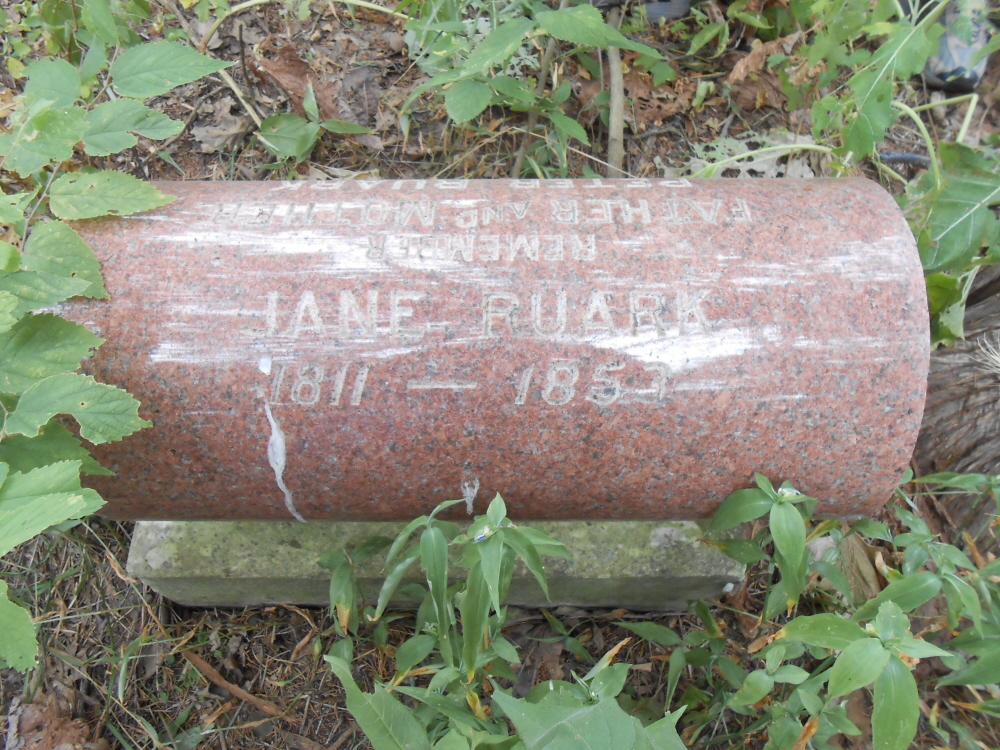
Cary DeVore uncovers the tombstone of Jane and Peter Ruark


All of the Ruark stones seem to have been installed long after the deaths of those whose graves they mark.

Jane died during 1853, according to her tombstone, as did a daughter, Patsy, age 7, and an infant named Mary.


Little Mary Ruark also died during 1853 as did a sister named Patsy.

Peter married as his second wife Frances M. (Smith) Morgan, a widow with two sons, during July of 1854 in Princeton, Missouri, and they were living in South Fork Township during 1860, then moved to the Confidence neighborhood of Wright Township.

Frances became the mother of 10 children by Peter, four of whom died --- and some at least were brought to the McDaniel Cemetery for burial. Ruark grandchildren also seem to be buried here. When Peter died at age 63 on April 14, 1874, his remains were brought to McDaniel for burial with Jane and his children by both marriages. Frances lived until 18 October 1911, but chose to be buried instead in the Confidence Cemetery.

Joseph Ruark, son of Peter and Jane, like the McDaniel boys, served during the Civil War. He enlisted in Co. I, 4th Iowa Volunteer Infantry, on 2 September 1861 and served until 28 June 1865, when he was mustered out at Louisville, Kentucky. He returned home, but died soon thereafter and was buried near his mother and siblings at McDaniel Cemetery.

+++

Find-a-Grave mistakenly locates the grave of Joseph A Johnson (1851-1931/2) at McDaniel because of an obituary reference that states he was buried in McDaniel's Cemetery --- although it specifies that the cemetery is located "two-and-one-half miles east of Confidence." Joseph actually is buried at Fairview Cemetery, also known as Main Station Cemetery and occasionally as McDaniel Cemetery --- north of the Rathbun dam. This is east of Confidence (Lake Rathbun intervened long after 1931/2), but quite a bit farther than two and a half miles.
Sunday, August 25, 2013

Moon & stars ...


Barring critters (four- and two-legged) and cantankerous weather, it looks like we're going to have a good crop of Moon & Stars melons in the heirloom garden later on. 

I took time to admire these Saturday morning after standing on my head in the tomato patch for half an hour  gathering a sackful to take up to the museum office for distribution later on to anyone who wanted them. My favorite tiny yellow pear-shaped variety is the trickiest to locate in the mounds of unstaked foliage. Clusters  ripen way down at ground level and finding them is a treasure hunt.


It's kind of obvious why these melons are called Moon & Stars. The dark green skin of each is decorated by at least one big yellow patch surrounded by dozens of smaller ones. They'll average 20-50 pounds when mature. These are old-fashioned sweet seeded melons and the seeds reportedly are big ones. So those partial to new-fangled seedless varieties may not care for them. The foliage is speckled, too, adding interest even before melons set on.

The variety is not an ancient one, however. It was introduced in 1926 by Peter Henderson & Co. and widely grown, but eventually disappeared from commerical markets and by 1981 was thought to be extinct, according to Amy Goldman ("Melons for the Passionate Grower," Artisan: 2002).

Then Merle Van Doren of Macon, Missouri, who was still growing them, shared seed with Kent Whealy, co-founder of Seed Savers Exchange --- and the rest is history.


Although heating up, it was a beautiful morning in the garden. Here are a couple of other photos.


Critters sampled the Indian corn overnight Friday, but we're hoping this doesn't become a habit. So far, the three-sisters plantings --- corn surrounded by squash and providing support for beans --- have flourished.


And yes, I know, there are those who color-coordinate their gardens. I know the colors clash. But who the heck cares?

Saturday, August 24, 2013

From Jones to Jones with Friends: Part 2


The next stop on Thursday's tombstone trail, after leaving the Brown farm, was the Adcock family cemetery, which has hidden for years in plain sight a mile east of Sunnyslope Church of Christ in Section 26 of Wright Township. Tombstone tourists included (from left) Jacob Vincent, Doris (Cottrell) Christensen, Harold Mitchell, Dianne (Vincent) Mitchell, Cary DeVore and Kari Spinler. Paula Spinler and Marilyn Vincent dodged the camera this time.

I've known the cemetery was here for a long time, but have driven past many times without knowing where. It was not marked and trees and brush had grown up to screen the tombstones, located some distance into the small plot.

The cemetery is on the south side of the road just before a "T" intersection that presents the options of continuing straight east or turning left and coming out just east of Confidence.


There's been a recent and remarkable change here. Brush has been removed and crowded trees thinned, the graveyard has been refenced (sturdy woven wire with osage orange posts to the east, south and west and vinyl to the north) and it is now neatly mown, clearly visible and easily accessible. A sign will be coming. Although some stumps still need to be pulled and the stones have not been restored yet, it's been quite a transformation.


Charles and Jane Ann (Faulkner) Adcock, several of their children and perhaps three grandchildren are buried here. If there are unrelated burials, the graves are not marked. Here's Paula trying to read one of the tombstone inscriptions. Many are badly weathered.

Charles, born during 1807 in New York, married Jane Ann ca. 1829 and arrived in Iowa about 1849, perhaps settling first in Wayne County, perhaps living for a time elsewhere. The cemetery probably was located on a part of their original claim, but by 1897 --- when their son, Charles Adcock Jr., still owned land in the neighborhood --- the tract surrounding it had changed hands. According to Orpha Green's history of Wright Township, Charles Sr. and Jane Adcock deeded the cemetery to the public on May 2, 1870.


The earliest marked graves seem to be those of the Adcocks' daughter, Elizabeth Ann Bland, and her infant son. She is identified on the stone as the wife of I.L. Bland, or perhaps J.L. Bland. The inscriptions are very difficult to read. She died March 18, 1854, age 23.

The next of the Adcock children to die was son Mordecai, on April 19, 1867, age 20.


Daughter Mary Jane (Adcock) Rissler, wife of George, died on June 21, 1872, age 33. Margaret, who left two young sons, Charles J. and James, was George Rissler's second wife. His first wife, Martha Jane Morlan, had died Aug. 14, 1863, leaving three young daughters, and is buried at Jones Cemetery, which we visited later on Thursday.

One of George and Martha (Morlan) Rissler's daughters was Elzan Rissler, who married James F. Yocum. These were the great-grandparents of Jacob and Dianne; their sister, Elzan (Vincent) McMurry, shares her great-grandmother's name.

Jane Ann Adcock, wife and mother, died on April 26, 1873, age 69. Charles, who was about four years Jane's junior, survived until July 2, 1883, when he died at age 76 and was buried here with his with his wife and children.


Two of the Adcock children, Richard and Mary Jane, died not marry. Richard died Nov. 27, 1882, age 52; and Mary Jane, on Feb. 14, 1886, age 56. Both are buried here. Marilyn and Doris are attempting to decipher Richard's inscription here.

Only two of the Adcock children lived longer lives. Harriet E., born during 1841, married Daniel Butts and moved to Kellerton in Ringgold County, where she died on May 10, 1907. One of her sons, Charley, who died in 1889, is buried in a marked grave at Adcock Cemetery and two other children --- Fanny and David --- reportedly are buried here in unmarked graves.

Charles Adcock Jr., born 1834, married Josephine Burns at Confidence during 1876 and they lived in the area until 1895 when, concerned for his health, they moved to New Mexico. That move seems to have paid off. The couple moved to Hiwasse, Arkansas, during 1901 and he died there on Nov. 9, 1926, age 92.

+++

After leaving Adcock, we drove due east a couple of miles --- just across the Wayne-Appanoose county line --- to "Squire" Spencer F. Wadlington's gravesite. Doris and Dianne are deciphering the inscription on his tombstone here.


I've written before about this place, and Wadlington, so go here for details.

The short version is that Wadlington --- a significant character in Centerville's earliest history --- moved out here to the northwest corner of Appanoose County during the late 1850s or early 1860s and, in 1866, constructed a fine brick house for himself of bricks burned on the site with limestone foundation blocks quarried nearby. When he died here on Nov. 4, 1878, he was buried just north of the house.


The house is now a ruin, overrun by brush and trees with only a gable end or two and some other elements visible. That's the front gable above and brick and stonework at the southeast corner below. Cary and Marilyn climbed into the brush so that they could look into the ruin through what once was the front door.


Jacob was able to add more information Thursday, including the fact that Squire Wadlington is not buried alone here, but shares the grave enclosure with an infant child of the land's first owners.

The late Pauline (Barker) Vincent, his mother, identified the Wadlington farmstead in her writings as "the old home site of Robert and Susan Davis ..., where they settled when they came to Iowa in 1851. The grave of their baby is inside the fence alongside (the) Wadlington grave." (Robert and Susan Davis were great-grandparents of Pauline's father, J. Milton Barker.)

Jacob also remembered that his father, Howard Vincent, had wired the old brick and stone house for electricity --- quite a task because of its fort-like structure --- when R.E.A. lines first reached it during the 1950s.


He shared these snapshots, taken during 1972. Howard and Jacob are standing here on the front steps of the old house, abandoned already, but still intact.


And here's J.M. Barker standing beside Squire Wadlington's then-fallen tombstone with his grandson, J.M. Vincent. Note that the fence here is the original. The current fence around in the gravesite is a replacement.

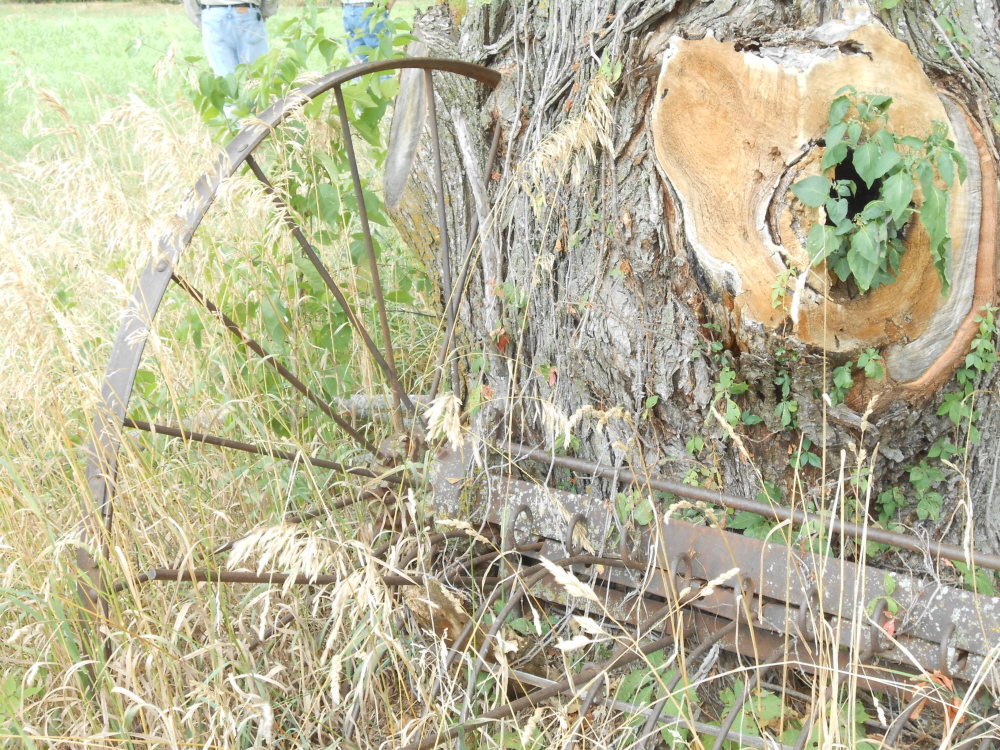
Before we left the Wadlington site, Jake pointed us toward something I'd never noticed before. At some time in the past, a farmer has parked his hay rake near a small tree, then never moved it --- probably because he'd replaced it with newer equipment.


As years passed, the tree began to absorb the rake and one of its wheels now is firmly incorporated into the tree trunk. There's probably a lesson here about the ability of nature to prevail, but others are going to have to expand upon it.


The next (and final) installment --- McDaniel and Jones cemeteries --- will follow in a day or two. I'm off now to the heirloom garden to pick tomatoes and see how the Moon and Stars are doing.

Friday, August 23, 2013

From Jones to Jones with friends: Part 1


Getting together with old friends and visiting old cemeteries are two of my favorite things to do, so Thursday was a darned good day. And lunch at the Millerton Cafe was the bonus.

This was an expedition to five of Wayne County's pioneer cemeteries, plus a grave site, put together by Dianne (Vincent) Mitchell and her husband, Harold, and Dianne's brother, Jacob, and his wife, Marilyn.

Dianne, Jacob, Doris (Cottrell) Christensen and myself are alumni of Dry Flat country school. We were joined by Cary DeVore (plus his wife, Brenda, for lunch --- she manages the Wayne County Historical Society's Prairie Trails Museum in Corydon) and Confidence-area neighbors Kari and Paula Spinler.

Our itinerary started at 9 a.m. at the tiny Jones Cemetery and ended midafternoon at the big Jones Cemetery. In between we visited Brown Cemetery, Adcock Cemetery, Squire Wadlington's grave and McDaniel Cemetery. Brown and McDaniel cemeteries are so remote and challenging to reach that only the Vincents had visited them previously.

The photo at the top here shows the group (from left) gathered around the single standing tombstone at little Jones --- Kari, Jacob, Doris, Marilyn, Paula, Dianne, Harold and Cary. Both Harold and Jacob are Church of Christ preachers --- Harold at Sunnyslope in the old neighborhood; Jake, recently retired from a church in south Texas. We caught Harold standing behind a pulpit-shaped tombstone at Big Jones looking hopeful, but settled for a rousing verse of The Old Rugged Cross inside Jones Cemetery Chapel.

Little Jones is located in the northwest corner of Section 10, Wright Township --- in an open field some distance east of the former site of Rabbit Hill country school. The school stood in the oak grove visible beyond the vehicles parked along the road in the distance. Big bales of hay now are parked in the former school yard.


Little Jones was in the worst shape of any of the cemeteries we visited and looks especially tough here because herbicide had been applied to kill weeds that had grown up in the staked cemetery area. Wayne County has formed a Pioneer Cemetery Commission recently that has begun to deal with situations like this, but its road is going to be a long and hard one.

According to Wayne County Genealogical Society research, the first burial here was made prior to 1860 and it was first mentioned when it was exempted as a burial place in a deed executed by owner Nathan Jones during 1866.


Although there are a few field stone markers on the site, the only visible tombstone marks the grave of Sarah, Nathan Jones' wife, who died Dec. 29, 1861, age 55 years, 3 months and 9 days.


We spent quite a bit of time trying to read the "fine print" --- an inscription running across the bottom of the stone. The first part is 1st Corinthians 15:49: "And as we have borne the image of the earthy, we shall also bear the image of the heavenly." Deciphering the second line is a work in progress.

When I walked back to this cemetery with my parents many years ago, there was a tree or two here and the graves were covered by grass --- not bare earth. Hopefully order will be restored one of these days.

+++


Our next stop was the Brown family farm two miles south --- among the oldest farms in the county still owned by the same family. Benjamin Brown settled here during 1846, the first year Wayne County was open to Euro-American settlers.

Allison Brown (third from left) met us in front of the family home. Although the farm itself is owned by other family members, she purchased the 1911 house during 2010 and during the last three years has entirely renovated and restored it. Her ancestors would be proud.

The Browns settled first --- before there were roads --- a half mile west, where their small family cemetery remains. So Allison led us through three gates, across several fields and a farm pond dam and finally on a short hike down to a point of timber along the Walker branch of South Fork Creek where the cemetery is located. The first Brown home, a cabin dug into the hillside, was just to the northwest, Allison said.


There are six marked graves in the little cemetery, all in a single row on the downslope. The oldest of these graves is that of little Ralph, son of Benjamin and Carrie, who died Sept. 18, 1857, age 10 months and 3 days.


He was joined in the little cemetery by May, who died Sept. 30, 1864, age 4 years; Rosa, who died Aug. 30, 1866, age 7 years; father Benjamin, who died Sept. 25, 1872, age 75; and Frank, died Feb. 3, 1873, age 20. Mother Carolyn died June 2, 1905, and hers is the latest marked burial in the cemetery.


Her tombstone incorporated a small mystery --- a metal box wired to barbed wire wrapped around it. There was a note inside the box (yes, I'm nothing if not snoopy). Unfortunately, it had been written by a felt-tip pen and moisture had caused the ink to smear, making it indecipherable. Allison said she would work on figuring this out.


Doris is among the most prolific takers of photographs and creators of memorials for the Find-a-Grave Web site. So she was busy at Brown --- and all the other cemeteries we visited --- taking tombstone photographs and notes. Having conquered Lucas County's cemeteries, she's moving into Wayne.


Doris also introduced Marilyn to the fine art of grave-witching --- she got in a little practice both at Brown and the other cemeteries we visited.

After making our way back to the main road and thanking Allison for her hospitality, we were on our way to Adcock Cemetery, which has been hiding in plain sight east of Sunnyslope Church of Christ for many years until just recently when it was cleared of brush and refenced. More about that another time.