Showing posts sorted by relevance for query Wadlington. Sort by date Show all posts

Monday, August 29, 2011

A Sunday call on Squire Wadlington


I’d been meaning to pay Squire Wadlington another visit, but hadn’t gotten around to it even through he’s not far away --- down yonder from Sunny Slope Church of Christ just over the line from Wayne into Appanoose County. And there wasn’t much need to hurry anyway --- he’s been dead since 1878.

But Squire (whose given name was Spencer F.) was an interesting guy and his gravesite is an interesting place, buried as he is all by his lonesome under a big red cedar just north of the ruins of the fine brick house he built in 1866.

I finally got around to heading that way Sunday afternoon on a day that started out clear, then turned to rain and finally to a mix of clouds and sunshine. But cool.

To get there from here (Chariton), drive south on Highway 14 to the Millerton turn-off. Head east through Millerton to New York, cross the Jordan River, pass by Bethlehem and finally the pavement will come to a “T” with the Confidence-Promise City road at Sunny Slope.

Drive straight on east past the church, now on gravel instead of pavement, and keep going in that direction. If you go too far, you’ll drive into Lake Rathbun. Don’t do that. But you’ll know you’ve gone too far if see the lake and the long bridge downstream on the Plano road.

As you’re approaching the lake, you’ll enter a broad “S” curve. Keep your eyes focused on brush along the south side of the road just before you turn into the first part of the curve and you may catch a glimpse through a gap of the the tombstone surrounded by an iron fence and under its tree back in the pasture. Continue on around the curve and watch on the right for the gated entrance to the pasture driveway.

The folks who own the land don’t mind if you visit Squire and even mow access trails to his grave and around the ruins. Just make sure you close and chain the gate when you leave --- and stay out of the ruins, they could be dangerous and if there was anything there worth stealing it would have been stolen years ago.


This is the view of the house you’ll see down a short avenue of trees as you enter the gate. As you can see, it’s been eaten alive by brush and volunteer trees. All that's visible is the east gable end.


Swing to the northwest rather than heading straight for the house and you’ll come to the gravesite under the huge cedar that was planted more than 130 years ago to mark it. You'll be approaching from the southeast, but this photo was taken looking in that direction.


Here’s the grave in relationship to the house, its ruined north gable end just poking above the trees.


And here’s a close-up of the inscription, partly obscured by something I had no intention of getting anywhere near.

I’m indebted to Bill Heusinkveld’s excellent 1999 “Cemeteries of Appanoose County, Iowa,” in which he summarizes historical accounts of Wadlington. This way, I don’t have to go through my notes and do the work myself.

Wadlington was born Feb. 6, 1807, in Kentucky and arrived in Appanoose County during 1845, when he was about 38. The old Appanoose County history books maintain he’d married in Kentucky, secured a divorce after his wife cheated on him and after that did his best to avoid women entirely.

There is no proof, however, that he ever was married --- or that he was mad at women at all --- so he may just have been, as they say, a confirmed bachelor. By all accounts he was honest and genial, although considered a little peculiar.

Anyhow, he opened a primitive store in his cabin just northeast of where Centerville now stands in 1845, and the two commissioners appointed by the territorial legislature to locate the county seat met at that cabin before beginning their work. The first Appanoose County Board of Commissioners met in Wadlington’s cabin, too.

He eventually moved his store to the west side of the Centerville square and built a brick house in town. He served as probate judge, justice of the peace and as Centerville’s first mayor.

He also was a charter member of First Baptist Church and, according to Heusinkveld, gave the congregation its first bell. Because he was dissatisfied with its sound, he chipped in 25 silver dollars to be recast into it after it had been hauled by wagon to St. Louis for that purpose. Wadlington also was a devoted Mason.

As the 1850s ended, Wadlington shifted his interests from commerce and city life to farming and stock raising --- and life in the country. According to current owners of the property, Arthur and Mary Lemley, Squire bought his 250-acre farm in Independence Township from Joseph Delay during January of 1859.

The house on it was constructed in 1866, according to Heusinkveld, of brick burned where the house was built set atop a high basement of limestone quarried from a nearby outcrop. There also was a buggy and harness shed and a large brick barn, according to Heusinkveld.

On my last visit, the ruins of the house were entirely visible and it was possible to get a better idea of what it might once have looked like. There appeared to be four large rooms on the first floor on either side of a central stair hall. Each room had a fireplace served by a chimney stack that, unusual in Iowa, protruded from the exterior walls of the house.

Actually, I don’t know that there were that many fireplaces --- although the chimney stacks are of fireplace size, some may have served only stoves.


Here's the southwest chimney stack. Notice the fine brickwork and how well the bricks have endured the passage of time.

In addition to the north and south gable ends, gables roughly the size of the end gables were centered on the east and west facades and bedrooms were located in this half-story.


This is a view from the northwest toward the interior of the east gable, showing the upstairs window that would have faced the road.

By 1870, Wadlington had welcomed into his home the Martin Elam family. According to the Lemleys, the Elams were “traveling west to seek their fortune and happened upon Squire Wadlington’s farm to rest for the night. The Elams were a welcome addition to Squire’s life and he invited them to stay.” This information is included on a sign attached to the cedar tree guarding Wadlington’s grave.


In addition to the Elams, Squire’s younger brother, James Wadlington, was sharing his home during 1870, according to census records.

Wadlington died here on Nov. 4, 1878, reportedly of the effects of a harrowing trip home from Centerville in a snowstorm and infection in a leg caused by a kick from a mule. At his request, the Elams buried him just north of the house and the big red cedar now standing sentinel was planted to mark the spot.

Wadlington had willed his farm to Martin Elam, who farmed it until his own death in 1911. It was then purchased by Elam’s daughter, Dora, and her husband, Cal Teater, who farmed it until 1945. Their son, Martin M. Teater, farmed the place until 1961, when Lesley F. Lemley purchased it. Arthur and Mary Lemley inherited the farm from Lesley, according to the sign. They were responsible for restoring Wadlington’s gravesite.

Very little of the house can be seen now, although more will be evident during winter when leaves have fallen. The brick shell seems to be largely intact although at least one gable has fallen --- and the brickwork and stonework is fine. The roof and the frame interior, however, have collapsed.

Anyhow, that’s the story of my Sunday afternoon visit to Squire Wadlington. It’s an interesting place, worth the visit just to say you’ve been there. There’s nothing else quite like it around here.

Saturday, August 24, 2013

From Jones to Jones with Friends: Part 2


The next stop on Thursday's tombstone trail, after leaving the Brown farm, was the Adcock family cemetery, which has hidden for years in plain sight a mile east of Sunnyslope Church of Christ in Section 26 of Wright Township. Tombstone tourists included (from left) Jacob Vincent, Doris (Cottrell) Christensen, Harold Mitchell, Dianne (Vincent) Mitchell, Cary DeVore and Kari Spinler. Paula Spinler and Marilyn Vincent dodged the camera this time.

I've known the cemetery was here for a long time, but have driven past many times without knowing where. It was not marked and trees and brush had grown up to screen the tombstones, located some distance into the small plot.

The cemetery is on the south side of the road just before a "T" intersection that presents the options of continuing straight east or turning left and coming out just east of Confidence.


There's been a recent and remarkable change here. Brush has been removed and crowded trees thinned, the graveyard has been refenced (sturdy woven wire with osage orange posts to the east, south and west and vinyl to the north) and it is now neatly mown, clearly visible and easily accessible. A sign will be coming. Although some stumps still need to be pulled and the stones have not been restored yet, it's been quite a transformation.


Charles and Jane Ann (Faulkner) Adcock, several of their children and perhaps three grandchildren are buried here. If there are unrelated burials, the graves are not marked. Here's Paula trying to read one of the tombstone inscriptions. Many are badly weathered.

Charles, born during 1807 in New York, married Jane Ann ca. 1829 and arrived in Iowa about 1849, perhaps settling first in Wayne County, perhaps living for a time elsewhere. The cemetery probably was located on a part of their original claim, but by 1897 --- when their son, Charles Adcock Jr., still owned land in the neighborhood --- the tract surrounding it had changed hands. According to Orpha Green's history of Wright Township, Charles Sr. and Jane Adcock deeded the cemetery to the public on May 2, 1870.


The earliest marked graves seem to be those of the Adcocks' daughter, Elizabeth Ann Bland, and her infant son. She is identified on the stone as the wife of I.L. Bland, or perhaps J.L. Bland. The inscriptions are very difficult to read. She died March 18, 1854, age 23.

The next of the Adcock children to die was son Mordecai, on April 19, 1867, age 20.


Daughter Mary Jane (Adcock) Rissler, wife of George, died on June 21, 1872, age 33. Margaret, who left two young sons, Charles J. and James, was George Rissler's second wife. His first wife, Martha Jane Morlan, had died Aug. 14, 1863, leaving three young daughters, and is buried at Jones Cemetery, which we visited later on Thursday.

One of George and Martha (Morlan) Rissler's daughters was Elzan Rissler, who married James F. Yocum. These were the great-grandparents of Jacob and Dianne; their sister, Elzan (Vincent) McMurry, shares her great-grandmother's name.

Jane Ann Adcock, wife and mother, died on April 26, 1873, age 69. Charles, who was about four years Jane's junior, survived until July 2, 1883, when he died at age 76 and was buried here with his with his wife and children.


Two of the Adcock children, Richard and Mary Jane, died not marry. Richard died Nov. 27, 1882, age 52; and Mary Jane, on Feb. 14, 1886, age 56. Both are buried here. Marilyn and Doris are attempting to decipher Richard's inscription here.

Only two of the Adcock children lived longer lives. Harriet E., born during 1841, married Daniel Butts and moved to Kellerton in Ringgold County, where she died on May 10, 1907. One of her sons, Charley, who died in 1889, is buried in a marked grave at Adcock Cemetery and two other children --- Fanny and David --- reportedly are buried here in unmarked graves.

Charles Adcock Jr., born 1834, married Josephine Burns at Confidence during 1876 and they lived in the area until 1895 when, concerned for his health, they moved to New Mexico. That move seems to have paid off. The couple moved to Hiwasse, Arkansas, during 1901 and he died there on Nov. 9, 1926, age 92.

+++

After leaving Adcock, we drove due east a couple of miles --- just across the Wayne-Appanoose county line --- to "Squire" Spencer F. Wadlington's gravesite. Doris and Dianne are deciphering the inscription on his tombstone here.


I've written before about this place, and Wadlington, so go here for details.

The short version is that Wadlington --- a significant character in Centerville's earliest history --- moved out here to the northwest corner of Appanoose County during the late 1850s or early 1860s and, in 1866, constructed a fine brick house for himself of bricks burned on the site with limestone foundation blocks quarried nearby. When he died here on Nov. 4, 1878, he was buried just north of the house.


The house is now a ruin, overrun by brush and trees with only a gable end or two and some other elements visible. That's the front gable above and brick and stonework at the southeast corner below. Cary and Marilyn climbed into the brush so that they could look into the ruin through what once was the front door.


Jacob was able to add more information Thursday, including the fact that Squire Wadlington is not buried alone here, but shares the grave enclosure with an infant child of the land's first owners.

The late Pauline (Barker) Vincent, his mother, identified the Wadlington farmstead in her writings as "the old home site of Robert and Susan Davis ..., where they settled when they came to Iowa in 1851. The grave of their baby is inside the fence alongside (the) Wadlington grave." (Robert and Susan Davis were great-grandparents of Pauline's father, J. Milton Barker.)

Jacob also remembered that his father, Howard Vincent, had wired the old brick and stone house for electricity --- quite a task because of its fort-like structure --- when R.E.A. lines first reached it during the 1950s.


He shared these snapshots, taken during 1972. Howard and Jacob are standing here on the front steps of the old house, abandoned already, but still intact.


And here's J.M. Barker standing beside Squire Wadlington's then-fallen tombstone with his grandson, J.M. Vincent. Note that the fence here is the original. The current fence around in the gravesite is a replacement.

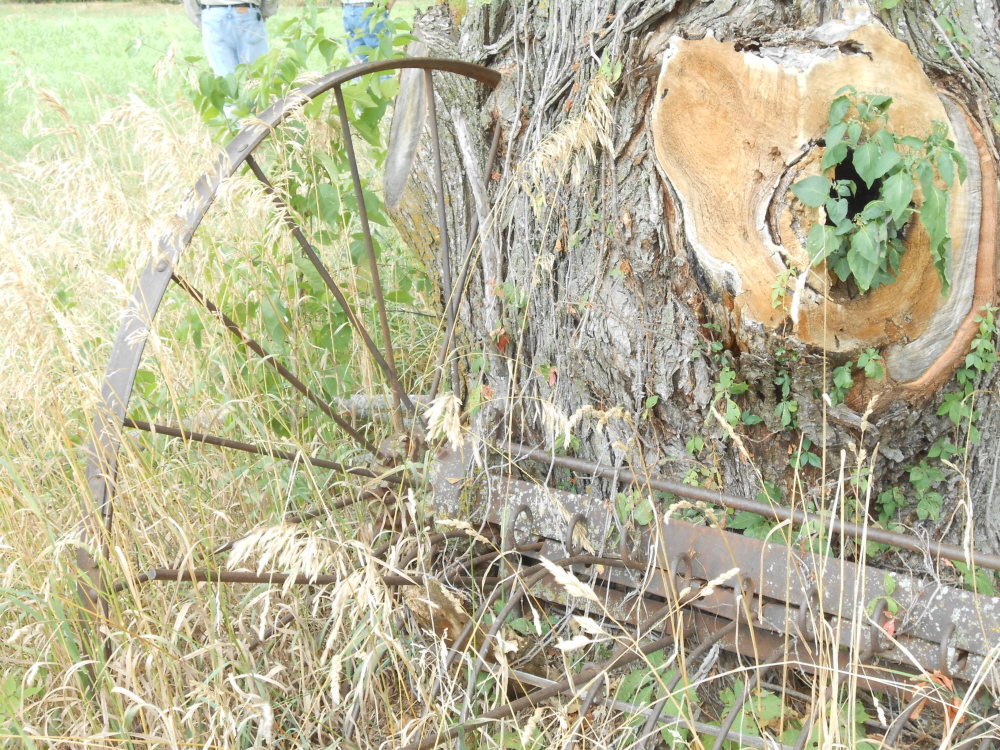
Before we left the Wadlington site, Jake pointed us toward something I'd never noticed before. At some time in the past, a farmer has parked his hay rake near a small tree, then never moved it --- probably because he'd replaced it with newer equipment.


As years passed, the tree began to absorb the rake and one of its wheels now is firmly incorporated into the tree trunk. There's probably a lesson here about the ability of nature to prevail, but others are going to have to expand upon it.


The next (and final) installment --- McDaniel and Jones cemeteries --- will follow in a day or two. I'm off now to the heirloom garden to pick tomatoes and see how the Moon and Stars are doing.

Tuesday, December 15, 2020

A Christmas bacchanal at Spence Wadlington's store

I crossed the county line into Appanoose yesterday in search of pre-Christmas inspiration and found a story that while not especially uplifting is at least amusing. Although repeated many times in many places as the years have passed, the original telling in print was in the 1878 history of Appanoose County, published during the same year the host for this pioneer bacchanal, Spencer F. Wadlington, died at his fine brick home in Independence Township, close to the point where Lucas, Wayne, Appanoose and Monroe counties join. 

Born Feb. 6, 1807, in Caldwell County, Kentucky, Spencer took a bride named Eliza D. Cooksey on Sept. 18, 1840, county records show, but the union did not endure. Approaching 40, he arrived single in the south of Iowa during 1846 with a small stock of goods and began storekeeping just outside the Appanoose County seat, called Chaldea initially, soon Centerville. By the time this story transpired, he had moved his cabin and his stock of goods to a point near the town square --- now recognized as Iowa's largest.

Wadlington went on to become a successful merchant, civic leader, farmer and dealer in livestock. He's generally referred to as an "eccentric" bachelor, but there really is no sign of eccentricity, other than the fact he remained single after his initial marital adventure and that in those times was considered eccentric. Whatever the case, here's the story:

+++

In 1846, Spencer F. Wadlington erected a cabin a little northeast of where Centerville now stands, and proceeded to "keep store" in the wilderness. It is stated that the first year's sales of our pioneer merchant were a dozen pairs of coarse shoes, half a dozen calico dress patterns, as many bolts of brown muslin and a few coarse casinets. These, with a sack of coffee and a few other groceries, constituted his stock in trade. In order to reduce his expenses to the measure of his profits, he did his own cooking. Most of the settlers at this early day were without families. Mr. Wadlington slept on a bed made of deer and bear skins, with a bundle of coon skins for a pillow. He subsequently became an extensive farmer and stock dealer. He was the first Mayor of Centerville, and had also been Probate Judge, Justice of the Peace and Deputy Clerk.

On the afternoon of Christmas, 1847, a party of the "boys" living in the northeast part of the county, some of them belonging in the vicinity of Unionville, agreed that it would hardly be right to let the day pass without a suitable observance. They accordingly wended their way to the county seat, and to Wadlington's store --- who had transferred his place of business to Chaldea --- arriving at the store about dark.

They began their celebration with an internal application of "su'thin,' " and to neutralize any subsequent bad effect took another horn. These potations were repeated at suitable intervals till midnight. The young pioneers indulged in various amusements during their hours of celebration. They would frequently issue from the store door, whoop loud enough to scare the wolf cubs in their dens between the forks of the Chariton, and then return to warm their throats.

The first half of the night was quite warm, as a damp snow was falling, and, the store having no floor yet, their heavy boots tramped the interior of the cabin into considerable of a mud-hole. About midnight, the spirits had done their perfect work, and each fellow selected a buffalo-robe or deer-skin and lay down to rest on the natural floor, damp as it was, although it is more than likely that Wadlington tucked them in as they became insensible.

The weather turned very frosty toward morning. Shortly after daylight, Mr. Stratton, who was the nearest neighbor, visited the store to learn the cause of the noises heard by him, and found each reveler snugly frozen to his earthen bed, and the edges of the skins frozen tight, also. It was an amusing spectacle, and a modern teetotaler could hardly have avoided a show of laughter at their situation. They were thawed out after and hour or two and returned to their homes none the worse for their night's frolic.

+++

As noted earlier, the host here eventually turned to farming and dealing in livestock and located on a farm some distance northwest of Centerville in Independence Township. He built a fine brick home there, now in ruins, of limestone quarried nearby and bricks burned on the site.

An infected leg injury complicated by pneumonia claimed his life on Nov. 4, 1878, and he was buried as he wished in the side yard of his home, the spot marked now by a red cedar tree and his iron-fenced tombstone.

It's not that difficult to find him, if you're interested in a visit (although it does help to know the territory). Just drive south out of Russell on County Road S56 for several miles until you make another turn south at Confidence and then watch for Sunnyslope Church of Christ on your left. Turn left (east) there and just follow the gravel road as it meanders east. You'll know you've gone too far if you drive into Lake Rathbun, where the road now ends a short distance southeast of Spencer's grave.


Monday, August 26, 2013

From Jones to Jones With Friends: Part 3


Paula and Kari Spinler and Dianne and Harold Mitchell along McDaniel's east fence.

The friends are Dianne (Vincent) and Harold Mitchell, Jacob and Marilyn Vincent, Doris (Cottrell) Christensen, Kari and Paula Spinler and Cary DeVore. We spent much of Thursday visiting six pioneer burial places in northeast Wayne County, commencing at 9 a.m. with "little" Jones Cemetery and ending up at "big" Jones Cemetery during the afternoon.

This was going to be the final post about that, but I got so tangled up in McDaniel Cemetery, our next-to-the-last stop --- big Jones will have to wait for another day.

McDaniel is located in Section 23 of Union Township, about eight miles due west of our previous stop, Squire Wadlington's grave just over the line in Appanoose County --- and conveniently on the road to lunch at the Millerton Cafe. Great food. The Millerton Cafe causes my vegetarian friends to regret their lifestyle choices.

McDaniel is not that far off the road, but it's one of those you-can't-get-there-from-here places. If you look to your left (south) about half way down the big hill west of Bethlehem toward the bridge over Jordan Creek and the New York Cemetery just beyond, you'll see a pond tucked into the woods with an old trailer house beside it. The cemetery is slightly to the southwest atop the wooded hill beyond the pond.

Don't rely on Google Maps if you're trying to find it. Google has planted the cemetery on the wrong side of the creek.


Marilyn and Jacob Vincent walk toward the cemetery's south fence.


And then look for tombstones in knee-high undergrowth.

But to get there, you have to enter the farm driveway of what I've always known as the Fetters place at the top of the hill, then cut west through pastures. We had planned to drive in, but our escort didn't appear --- so we hiked in rather than forming a motorcade across private property. Follow the ridge west, through a gate into a second pasture, then off northwest to the timber's edge.

The long, narrow cemetery slopes downhill from the edge of the timber and is fenced, but overgrown --- and that made locating the small tombstones difficult. Then there was the poison ivy.


The downslope from north of the cemetery toward the pond below.

According to the Wayne County Genealogical Society's 1979 cemetery book, the Wright Go-Getters 4-H club took the then-abandoned cemetery on as a project during the spring and summer of 1976, cleared it, fenced it, set up fallen stones and maintained it for a time. So we have those girls (and their parents) to thank for conserving it.

According to the cemetery book, there were 14 tombstones here during 1976, but we didn't find that many. The Find-A-Grave McDaniel Cemetery site confuses the issue by throwing a few others into the mix, some of whom may not be buried here at all, and concluding that there are 18 burials. Who knows?

+++

What we do know, courtesy of the genealogical society, is that Henry McDaniel purchased the land on which the cemetery is located during 1851. The first burials here probably were members of his family.  It was deeded to the public as a burial place during September of 1859.

The Peter Ruark family came along soon thereafter and also buried their dead here --- a majority of the burials are Ruarks. In addition, there is a single Hancock --- William H., son of T.S. & N., who died Feb. 29, 1856, age 1 year, 8 months and 17 days.

This little cemetery predates the very large New York Cemetery, just across the creek, and that cemetery's establishment probably caused McDaniel to fade into obscurity. 

William H. Hancock's parents, Thomas Squires and Nancy (Torr) Hancock, for example, are buried in the New York Cemetery. Thomas came to Wayne County in 1849 to stake a claim and then returned to Indiana, returned behind a yoke of oxen in 1851 to establish a home and then returned to Indiana in 1853 to marry Nancy.

+++

Henry McDaniel, 44, a native of Tennessee, and his first wife, Eliza, 39, a native of Kentucky, were enumerated on Nov. 9, 1850, in the federal census of that year along with children Frances, 19; Barnett, 15; Catharine, 13; David, 11; Henry, 6; Greene, 5; and Joseph 1. All of the children except Joseph (born in Iowa) had been born in Missouri.

Various sources identify Henry and Eliza and their family as the first settlers of Union Township, arriving in the spring of 1849. It seems likely that their cabin was located in the immediate vicinity of the cemetery that bears their name. Keep in mind that there usually was a lag between the date pioneers made pre-emption claims on their land and the date they got around to traveling to the nearest land office (at Fairfield during 1851) and filing it.

According to the "William Edward Zintz Family Tree," found online at Ancestry.com, Henry had married Eliza (or Elisa) Gowin (or Cowin) on 18 August 1828 in Howard County, Missouri. Seven of their surviving children were born in Missouri. The eighth, a son named Ananias, was born in Wayne County during 1851.

At some point between 1851 and 1856, Eliza McDaniel and perhaps one of her children died --- the Zintz family tree does not account for Catharine. These may have been the first burials in the cemetery, one or more most likely during 1853 or earlier. 

By 1856, when a special state census was taken, Henry had married as his second wife Rachel, some 10 years his junior. They were enumerated in Union Township with his younger children, David, Henry, Greene, Joseph and Ananias. By 1860, the McDaniel household consisted of Henry and Rachel and his four youngest sons. 

There reportedly is a tombstone at McDaniel marking Henry's grave and stating that he died April 29, 1862, age 57, although we did not find it. It seems likely that he was buried beside Eliza.

Rachel McDaniel may be buried in the family cemetery, too. When the 1870 census was taken, she still lived in Union Township and owned real estate valued at $500 plus personal property valued at $335. She was living with Arthur Stritchfield, 66, his wife, Louisa, 44, and their son, James H., 11. The Stritchfields seemed to have nothing at all --- and both Arthur and James were listed as day-laborers.

Rachel does not seem to appear in subsequent census records, although she might well have remarried. But it also is possible that she died between 1870 and 1880 and is buried near Henry and Eliza.

At least two of Henry and Eliza McDaniel's sons served in the Civil War. Henry died during the war; Greene, apparently soon thereafter and he, apparently, is buried here, too.

Greene enlisted 23 March 1864 in Co. I, 4th Iowa Volunteer Infantry, and was mustered out on 24 July 1865 due to disability at Louisville, Kentucky. WPA tombstone transcriptions for Wayne County, made during the 1930s, state that he is buried at McDaniel Cemetery. The record implies that a stone was found but that it bore no dates. 

Henry Jr. also enlisted in Co. I, 4th Iowa Volunteer Infantry --- on 19 February 1864 --- but he died of "chronic bronchitis" at Rome, Georgia on 28 July 1864. He is buried in Marietta National Cemetery.

There also is some possibility that David McDaniel served during the Civil War and died soon thereafter of its effects, too, but the evidence is insufficient to link to the Wayne County family a David A. McDaniel, of the right age but residing in Clay County, who enlisted in Co. K, 24th Iowa Infantry, during 1862,  and was discharged for disability on Feb. 24, 1865, shortly before the war ended.

So the most likely McDaniel burials in McDaniel Cemetery are Henry, his wives Eliza and Rachel, son Greene and perhaps another child who died young.

+++

It's unclear why the Ruarks, who outnumber the McDaniels, are buried here. The most logical explanation is that Peter Ruark, born 12 April 1810 in Kentucky, and his first wife, Jane Herron (or Herrin), settled near here first when they arrived in Iowa from Indiana in 1851. They had been married in Kentucky, then moved to Indiana.


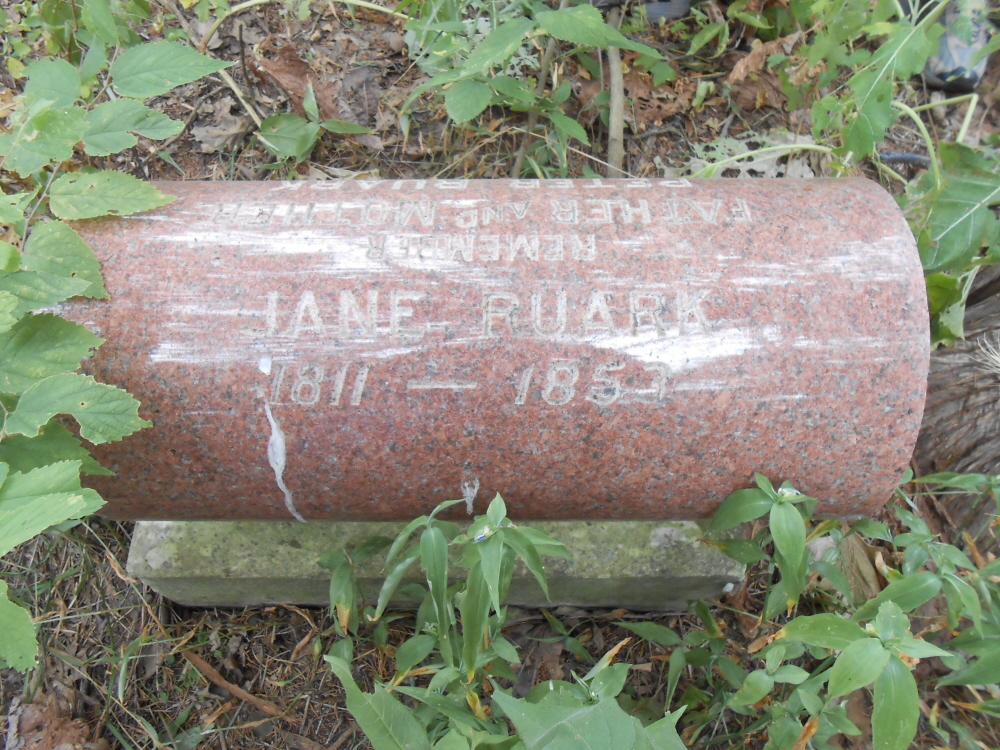
Cary DeVore uncovers the tombstone of Jane and Peter Ruark


All of the Ruark stones seem to have been installed long after the deaths of those whose graves they mark.

Jane died during 1853, according to her tombstone, as did a daughter, Patsy, age 7, and an infant named Mary.


Little Mary Ruark also died during 1853 as did a sister named Patsy.

Peter married as his second wife Frances M. (Smith) Morgan, a widow with two sons, during July of 1854 in Princeton, Missouri, and they were living in South Fork Township during 1860, then moved to the Confidence neighborhood of Wright Township.

Frances became the mother of 10 children by Peter, four of whom died --- and some at least were brought to the McDaniel Cemetery for burial. Ruark grandchildren also seem to be buried here. When Peter died at age 63 on April 14, 1874, his remains were brought to McDaniel for burial with Jane and his children by both marriages. Frances lived until 18 October 1911, but chose to be buried instead in the Confidence Cemetery.

Joseph Ruark, son of Peter and Jane, like the McDaniel boys, served during the Civil War. He enlisted in Co. I, 4th Iowa Volunteer Infantry, on 2 September 1861 and served until 28 June 1865, when he was mustered out at Louisville, Kentucky. He returned home, but died soon thereafter and was buried near his mother and siblings at McDaniel Cemetery.

+++

Find-a-Grave mistakenly locates the grave of Joseph A Johnson (1851-1931/2) at McDaniel because of an obituary reference that states he was buried in McDaniel's Cemetery --- although it specifies that the cemetery is located "two-and-one-half miles east of Confidence." Joseph actually is buried at Fairview Cemetery, also known as Main Station Cemetery and occasionally as McDaniel Cemetery --- north of the Rathbun dam. This is east of Confidence (Lake Rathbun intervened long after 1931/2), but quite a bit farther than two and a half miles.

Friday, August 23, 2013

From Jones to Jones with friends: Part 1


Getting together with old friends and visiting old cemeteries are two of my favorite things to do, so Thursday was a darned good day. And lunch at the Millerton Cafe was the bonus.

This was an expedition to five of Wayne County's pioneer cemeteries, plus a grave site, put together by Dianne (Vincent) Mitchell and her husband, Harold, and Dianne's brother, Jacob, and his wife, Marilyn.

Dianne, Jacob, Doris (Cottrell) Christensen and myself are alumni of Dry Flat country school. We were joined by Cary DeVore (plus his wife, Brenda, for lunch --- she manages the Wayne County Historical Society's Prairie Trails Museum in Corydon) and Confidence-area neighbors Kari and Paula Spinler.

Our itinerary started at 9 a.m. at the tiny Jones Cemetery and ended midafternoon at the big Jones Cemetery. In between we visited Brown Cemetery, Adcock Cemetery, Squire Wadlington's grave and McDaniel Cemetery. Brown and McDaniel cemeteries are so remote and challenging to reach that only the Vincents had visited them previously.

The photo at the top here shows the group (from left) gathered around the single standing tombstone at little Jones --- Kari, Jacob, Doris, Marilyn, Paula, Dianne, Harold and Cary. Both Harold and Jacob are Church of Christ preachers --- Harold at Sunnyslope in the old neighborhood; Jake, recently retired from a church in south Texas. We caught Harold standing behind a pulpit-shaped tombstone at Big Jones looking hopeful, but settled for a rousing verse of The Old Rugged Cross inside Jones Cemetery Chapel.

Little Jones is located in the northwest corner of Section 10, Wright Township --- in an open field some distance east of the former site of Rabbit Hill country school. The school stood in the oak grove visible beyond the vehicles parked along the road in the distance. Big bales of hay now are parked in the former school yard.


Little Jones was in the worst shape of any of the cemeteries we visited and looks especially tough here because herbicide had been applied to kill weeds that had grown up in the staked cemetery area. Wayne County has formed a Pioneer Cemetery Commission recently that has begun to deal with situations like this, but its road is going to be a long and hard one.

According to Wayne County Genealogical Society research, the first burial here was made prior to 1860 and it was first mentioned when it was exempted as a burial place in a deed executed by owner Nathan Jones during 1866.


Although there are a few field stone markers on the site, the only visible tombstone marks the grave of Sarah, Nathan Jones' wife, who died Dec. 29, 1861, age 55 years, 3 months and 9 days.


We spent quite a bit of time trying to read the "fine print" --- an inscription running across the bottom of the stone. The first part is 1st Corinthians 15:49: "And as we have borne the image of the earthy, we shall also bear the image of the heavenly." Deciphering the second line is a work in progress.

When I walked back to this cemetery with my parents many years ago, there was a tree or two here and the graves were covered by grass --- not bare earth. Hopefully order will be restored one of these days.

+++


Our next stop was the Brown family farm two miles south --- among the oldest farms in the county still owned by the same family. Benjamin Brown settled here during 1846, the first year Wayne County was open to Euro-American settlers.

Allison Brown (third from left) met us in front of the family home. Although the farm itself is owned by other family members, she purchased the 1911 house during 2010 and during the last three years has entirely renovated and restored it. Her ancestors would be proud.

The Browns settled first --- before there were roads --- a half mile west, where their small family cemetery remains. So Allison led us through three gates, across several fields and a farm pond dam and finally on a short hike down to a point of timber along the Walker branch of South Fork Creek where the cemetery is located. The first Brown home, a cabin dug into the hillside, was just to the northwest, Allison said.


There are six marked graves in the little cemetery, all in a single row on the downslope. The oldest of these graves is that of little Ralph, son of Benjamin and Carrie, who died Sept. 18, 1857, age 10 months and 3 days.


He was joined in the little cemetery by May, who died Sept. 30, 1864, age 4 years; Rosa, who died Aug. 30, 1866, age 7 years; father Benjamin, who died Sept. 25, 1872, age 75; and Frank, died Feb. 3, 1873, age 20. Mother Carolyn died June 2, 1905, and hers is the latest marked burial in the cemetery.


Her tombstone incorporated a small mystery --- a metal box wired to barbed wire wrapped around it. There was a note inside the box (yes, I'm nothing if not snoopy). Unfortunately, it had been written by a felt-tip pen and moisture had caused the ink to smear, making it indecipherable. Allison said she would work on figuring this out.


Doris is among the most prolific takers of photographs and creators of memorials for the Find-a-Grave Web site. So she was busy at Brown --- and all the other cemeteries we visited --- taking tombstone photographs and notes. Having conquered Lucas County's cemeteries, she's moving into Wayne.


Doris also introduced Marilyn to the fine art of grave-witching --- she got in a little practice both at Brown and the other cemeteries we visited.

After making our way back to the main road and thanking Allison for her hospitality, we were on our way to Adcock Cemetery, which has been hiding in plain sight east of Sunnyslope Church of Christ for many years until just recently when it was cleared of brush and refenced. More about that another time.