Saturday, November 15, 2014

Am I blue? Well ...


Epic soaps like Downton Abbey, churned out recently in Britain, don't interest me --- but there's nothing quite like a good British spy story (John le Carre, by the way, is now 83 and still writing). So I've been frittering evenings away this week watching the first two installments of the Worricker Trilogy, written and directed by David Hare and broadcast first on BBC Two. The final installment, Salting the Battlefield, airs Sunday on PBS.

Bill Nighy (above right) stars as Johnny Worricker, an aging MI5 operative who despite various trials, tribulations --- and romances --- manages to give the establishment fits. Great stuff. 

I've frittered a lot this week, which is why there's nothing especially productive here this morning.

+++

Part of the problem is, I am not a winter person --- unless the winter is happening in let's say Mississippi, where the seasons change but not quite so dramatically. 

So I've been frittering, too, by reviewing past and current posts on the Facebook site, "A Place Called Rodney,"  which I joined despite my Yankee-ness and the fact that the only family member who spent any time at all in that state, Uncle Jim Rhea, A Lucas Countyan of an earlier century, was killed during the Siege of Vicksburg and is still there, sort of.

Rodney is a ghost town in the Natchez District with a couple of wonderful old crumbling churches and the members of and contributors to the site incredibly and most interestingly productive. So it's a constant source of diversion for someone who obsesses about old buildings --- even though my interest in Civil War order of battle is underwhelming.

+++


Truth be told, I've been cowering inside too much since Tuesday, when the cold snap set in. I'm working on adjusting the old attitude, but it's going to take time.

One of the Facebook posts that diverted me this week came from a friend in one of Iowa's big cities who, while shopping his favorite Hy-Vee, ran into a guy with an automatic weapon strapped to his leg. Upon inquiring, the manager sent him a nice note saying the store does "not completely prohibit fire arms" and observing that, "This is an issue with no clear cut answer and much support on both sides."

Now I really don't care if people own guns, hunt, play with guns, any of that. But must say it's bad manners to carry a weapon into a retail establishment --- and probably dangerous, too. You never know when somebody's going to misunderstand your motivation and blow you away.

And I understand Hy-Vee's position, too. Ban guns and you end up with heavily armed folks in camouflage scaring the bejezus out of people in the parking lot.

I'm just grateful that the Chariton Hy-Vee management posts that little sign on the front door every summer reading, "Shoes and shirts required." Because only God knows how dangerous barefoot people are.

+++

Am I blue? Not necessarily, but the weather map is. Predicted high of 30 today --- and snow. Wonderful.

Friday, November 14, 2014

Sacred Heart's chandeliers, &tc.


I can be a little obsessive sometimes about figuring out where stuff came from, so was pleased yesterday when Gloria Lee loaned two big scrapbooks containing background information about the Sacred Heart (earlier, St. Mary's) parish to the historical society. We'll keep them a few days to copy items to add to our Sacred Heart file which, at the moment, has exactly one item in it (and I've been whining about that).

Among the items included are a few notes about the sources of various items in the church, including the altars, windows --- and the chandeliers. I speculated about sources recently when writing three Sacred Heart-related posts, which you can find here: Part 1, Part 2 and Part 3.

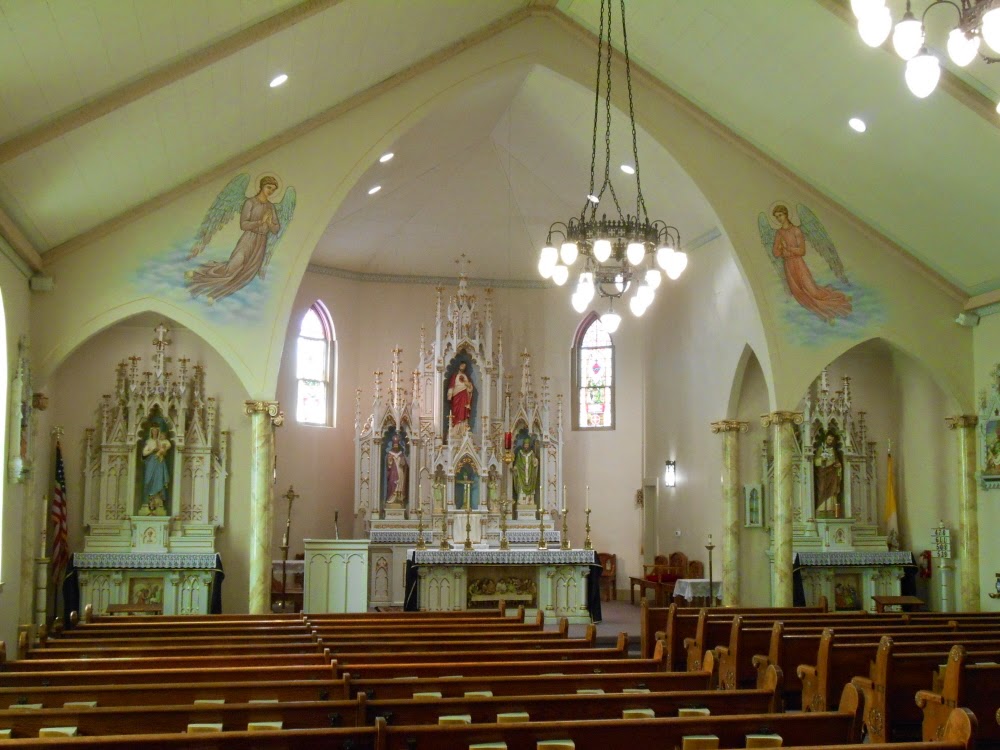
The scrapbooks also contained the image at the top here, shot from the balcony during midnight Mass on Christmas Eve, 1932. Here's how the chancel looks today, and one thing interesting to note is the addition between 1932 and now of the magnificent chandeliers that light the nave. According to a couple of notes in the scrapbooks, these chandeliers were brought to Sacred Heart from St. Patrick's Church at Georgetown, which in fact is the Chariton congregation's "mother" parish. No date for the move was noted, however.


I got to wondering about that, so pulled out my copy of a book about St. Patrick's of Georgetown published during 2007 by Michael W. Lemberger and Leigh Michaels. In it, I found a small and not especially clear photo of the interior of St. Patrick's, taken during 1908 --- and sure enough what appear to be the Sacred Heart chandeliers were suspended from what at that time was the soaring ceiling (since lowered) of that magnificent building. St. Patrick's is a larger building (it will seat 600) and there appear to have been more of these chandeliers than are in use now in Chariton.

St. Patrick's underwent a major remodeling in 1900 during which an elaborate tin ceiling was installed over the original plaster and I'm guessing the chandeliers date from that project. By 1951, when another interior photo of St. Patrick's was taken, the chandeliers had disappeared. You'll note in the 1932 photo here that much simpler ceiling fixtures were in use at Sacred Heart then. I couldn't find anything to tell me when the chandeliers were relocated, but was happy to know their source.

Unlike Sacred Heart, St. Patrick's interior was extensively altered during the late 1950s and 1960s. The ceiling was lowered and flattened and gorgeous altars "simplified." In addition, the north chancel wall was moved forward, blocking a beautiful rose window previously visible from the nave.

Other scrapbook notes state that the high altar at Sacred Heart was donated by Mr. and Mrs. Herman J.H. Steinbach; the side altars, by James and William Lyons and by J.C. Kinney and Laurence McCann. According to parish tradition, these altars were created in Italy.

Statues of St. Patrick and St. Boniface are located on the high altar and another note stated that Sacred Heart parishioners of Irish descent bought St. Patrick; parishioners of German descent, St. Boniface. The statue of St. Anthony of Padua at the rear of the church was brought to Sacred Heart from St. Mary's.

Other notes confirmed that several of the smaller windows in Sacred Heart --- including the three tower chamber windows --- also were brought from the old St. Mary's Church to the new Sacred Heart.

The high altar at Sacred Heart is flanked by windows devoted to the Sacred Heart of Jesus and the Immaculate Heart of the Blessed Virgin Mary and there is conflicting information in the scrapbooks about their source. In one place, it's stated that these windows, too, came from the old St. Mary's; in another, that they were brought from the "old" church at Georgetown.

I'm reasonably sure the latter just isn't true. These windows surely were brought from old St. Mary's to the new Sacred Heart.

One reason is the fact there are no openings in the venerable 1860s stone walls of St. Patrick's small enough to hold these windows. And the predecessor to the current St. Patrick's was essentially a log cabin.


Another reason is the dedication panel on the Immaculate Heart window, "Donated by Rev. Henry Maniett in memory of his Father & Mother." Henry was a son of the St. Mary's parish, arriving in Chariton with his parents, Joseph and Anna J. Katharine (Roder) Maniett, during 1869. The Manietts were among the founding members of St. Mary's parish. Joseph died during 1874 and Katharine, who later married James Gallagher, during 1901. 

Henry served as faculty member and administrator at St. Ambrose College in Davenport from roughly 1890 until 1901, when he was assigned as pastor to St. Mary's parish in Ottumwa and soon thereafter, to All Saints, Stuart. His whereabouts after that are obscure --- but his "absentee" estate was probated in Lucas County during 1917-1918.

The design of the Sacred Heart window, donated by Dr. M.F. Riordan in memory of his parents, is similar in many ways to that of the Immaculate Heart window  --- so there's no reason to think they've ever been separated. Exactly why Dr. Riordan would have donated a window to St. Mary's is a bit of a puzzler --- he was a Melrose physician who practiced extensively in Lucas County but seems never to have lived here. He and his wife eventually moved to upstate New York where both died and are buried.

Thursday, November 13, 2014

Black diamonds: Lucas County and coal (Part 1)


This photo from the Lucas County Historical Society collection reportedly was taken during 1880. It shows Lucas County's first great coal mine --- Whitebreast Fuel Co. No. 1, also known as Cleveland No. 1 --- about two miles east of Lucas. A total of 405 miners and 52 mules were employed at this mine during 1880. The mine generated its own electricity and lighted the mine with it --- the first in Iowa to do so.

I grew up hearing stories of the latter phase of Lucas County's coal mining industry because my mother grew up during the late teens and early 1920s on an English Township farm alongside a road that then, perhaps, was the busiest in the county. It connected the boom town of Williamson with the coal camps of Tipperary and Olmitz to the east and the Central Iowa Fuel Company No. 4 and Consolidated Indiana No. 3 mines, almost due north. Williamson miners employed at Central Iowa Fuel Co. Mine No. 5 walked right by Sunnyside School, east of Williamson, which my mother and her siblings attended.

By the time my mother graduated from Chariton High School during the early 1930s, mining still was going strong, but beginning of the end was in sight.

Now, coal mining in Iowa is extinct and rarely thought of --- except in Lucas, where the John L. Lewis Museum of Mining and Labor helps to keep that era alive.

So I thought it might be interesting to review that industry's history briefly off and on this fall and winter --- just so no one can say, "they didn't tell us about that." 

I'll bet you didn't know, for example, that one man --- William Haven --- can be identified as the father of Lucas County's coal mining industry. Or that there were two separate major coal mining phases in the county, one from the 1870s into the early 1890s principally near Lucas in the west central part of the county; the other, from 1900 until the industry foundered, principally in northeast Lucas County's English and Pleasant townships. And how many know what a "drift mine" is?

The most valuable deposits of Lucas County coal are very deep, accessed by shaft mines that descended between 200 and 300 feet to reach the coal beds. But drift mines --- small mines that tunnel horizontally into beds of coal that come very near the surface, sometimes as outcrops --- were earlier and more frequent.

What remains the most comprehensive short history of coal in Lucas County --- up to 1924 --- was written by geologist Alvin L. Lugn and published during 1926 on pages 101-238 of Iowa Geological Survey Annual Report, Vol. 32. It's earliest sections, however, are highly derivitive --- lifted errors and all from James H. Lees' 1908 History of Coal Mining in Iowa (Lees, James H., and Beyer, S. W., (1908) "History of Coal Mining In Iowa & Coal Statistics," Iowa Geological Survey Annual Report: Vol. 19: p. 521-597).

Here is Lugn's brief summary of the first phase of mining in Lucas County:

"The first discovery of coal in Lucas county is accredited to a ground hog burrowing in the banks of North Cedar creek in the vicinity of or east of the Briggs drift mine. To whom or the exact date when this fact became known the writer has been unable to learn, but was considerably prior to (Orestes H.) St. John's visit to the county in 1867 (St. John was a geologist and the first to formally analyze the lay of Lucas County's land). In 1860 the county produced 945 tons of coal. In the summer of 1867 when St. John made a survey of this area he recorded drift mining along North Cedar creek and its branches in the northeast part of Pleasant township, along English, Little White Breast and White Breast creeks. One of this type exposures ... was at Wheeler's mill (near Wheeler's bridge); an upper "Wheeler" coal and a lower "Panora" coal were being mind there at that time. All these mines were small and of very local importance. No attempt has been made to record the history of all of the drift mines of the county or to locate them .... The duration of any one of these has been so short and their production and aggregate importance have been so small that such a record would be of little value.

"In 1868 the production was 37,283 bushels or 1491 tons, but the beginning of coal mining history in Lucas county dates from 1874, when in June Mr. William Haven and others leased 540 acres of land on White Breast creek about two miles east of the town of Lucas. The leased lands belonged wholly or in part to Col. Byron O. Carr of Galesburg, Illinois. About a year later the White Breast Fuel Company was organized and Mr. Haven became associated with Wesley Jones, J.C. Osgood, Louis R. Fix of Burlington and J.T. Potter. Mr. Osgood was made president of the company.

"In the first prospecting of the White Breast field a number of holes were drilled. After many delays and much trouble, due mostly to financial difficulties, on January 16, 1878 (actually January 16, 1876), five feet, four inches of coal was reached. This marks the beginning of development in the White Breast field, one of the most productive in its day. James H. Lees, in his History of Coal Mining in Iowa, states "... a field from which a greater tonnage has been raised in shorter time than from any other field in the state." This interesting beginning is best told by a further quotation from Lees' paper: "The shaft was 250 feet deep and an eighty horse power engine was installed for hoisting the coal. Tail-rope haulage was installed in 1882. Electricity was used for lighting the mine, the first installation in the state. When the Mine Inspector made his first report in 1880, 405 men and 52 mules were employed and were raising 640 tons per day. The quality of the coal was considered superior to that of any other then produced in the state and the coal acquired a great reputation and an extensive market. White Breast No. 1 (also known as Cleveland No. 1) was the first mine to adopt the plan of shot firing once a day. This avoided the danger of explosions when the men were in the mine and also kept the air pure for the men and mules." The company operated several mines in this field and in 1880 the production was 126,490 tons, making the county an important Iowa producer.

"About 125 diamond drill holes were put down north and east of the White Breast Company mines in the years 1884 and 1885 but did not find any additional workable coal. Conditions in parts of the field being worked were so unfavorable that by 1891 the field was considered worked out and the large mines of the White Breast Company were abandoned. Production had risen to 594,450 tons in 1886; it dropped to 339,229 tons in 1890 and then in 1891 fell off to practically nothing. Lucas County did not again become a producer until Mr. Haven resumed operations in 1899.

"There were some other more or less abortive attempts to work the Lower coal but none was notably successful. In 1877 or 1878 Daniel Eikenberry of Chariton sank a shaft a mile and a half east of White Breast No. 1. This penetrated sixty or seventy feet deeper than the White Breast mine but did not find conditions favorable and hence was not develeped. In 1879 a cooperative company of miners and business men of Chariton was organized. The more prominent of these men were S.H. Mallory, D.Q. Storie and D.M. Thompson and the company was known as the Chariton Co-operative Coal Company. This company sank a shaft to a depth of 330 feet, the greatest depth of any mine in Iowa at that time. It was located about three-fourths mile north of the Eikenberry shaft. The cooperative scheme did not work well and soon a reorganation was effected, the business men taking over complete control. They, not being experts in mining, did not succeed, for as a consequence of unwise mining methods disastrous slumping and caving resulted and the venture had to be abandoned. They also had a good deal of trouble with water. The equipment was up to date and adequate.

"In 1877 the Union Coal and Mining Company of Ottumwa under the direction of its president, J.C. Peasley of Burlington, sought to enter the White Breast field. The company acquired the shallow Ladow shaft (in southwest Lucas, later known as the Big Hill Mine), which it deepened to the Lower coal, here five feet in thickness and at a depth of 300 feet. After considerable expenditure of money and the opening of several entries, the company abandoned the mine on account of the troublesome and excessive quantity of water, which it was inadequately equipped to handle. In 1899 this mine passed into the possession of Hon. H.L. Byers, associated with George Ramsey of Oskaloosa and Messrs. Shuler and Bates of Illinois. They reconditioned the old shaft and using it as an air shaft sank a new main shaft to the west of it. The water was pumped out and the mine operated for about a year when it passed into the hands of  S.W. White of What Cheer and of White City, and others. About a year later it was transferred to Mr. Reed of Illinois and he, with Mr. Byers, operated it for two months and then Mr. Moody of Kansas became part owner. Work was again discontinued late in 1907.

"About 1878 the Farmers Co-operative Coal Company was organized and opened a mine at Zero on the Chicago, Burlington and Quincy Railroad a mile and a half west of the Monroe county line. The shaft was 260 feet deep and reached the Lower coal, which is five feet thick at this place. This mine passed through several changes in ownership and was last operated under lease by the White Breast Fuel Company. After being worked more or less continuously for less than ten years it was finally abandoned owing to the large amount of poor coal and the "bowlders" in the coal and also on account of water entering through the sandstone roof. Where Lucas county mines, such as this and some in the White Breast field, had a sandstone roof, water has usually been one of the main causes of abandonment, but on the other hand a shale or "slate" roof usually means a dry mine.

"In 1890 the county's production was 339,229 tons; in 1891 it dropped to almost nothing. Between 1891 and 1899 Lucas county was almost a nonproducer, except for the local drift mines working upper thin veins.

"Mr. Haven, previously referred to, had sold his interests in the White Breast mines to Mr. Osgood in 1883 and also bound himself not to engage in mining along the Burlington line for ten years ...."

More of this another day ...
Wednesday, November 12, 2014

Demichelis Building blinks, then opens its eyes


The Demichelis Building, which blinked some months ago when upper-level openings were uncovered, now has opened its eyes --- all 21 of them --- fully. New custom-built windows are in place as the four new upstairs apartments in the building move closer to being ready for occupancy.

The four apartments under construction here are part of Chariton's 10-unit upper-level housing initiative that also includes two apartments in the Piper's Building and four apartments in the Iowa Realty Building. The project is funded by a state-administered grant of federal funds along with owner and city matches. Occupancy is scheduled for later this year or early in 2105.


Amanda and Jason Demichelis now own this great old building on the northwest corner of the square, constructed during 1906 by Jay J. Smyth as headquarters for his new Commericial Bank. An additional ground-floor storefront was rented out as were office and residential spaces upstairs. The identical double-front building to the east was built during the same year by Jay. J.'s brother, W.H. Smyth. A disastrous fire during December of 1905 had destroyed earlier Smyth buildings as well as three others on the north side.

The Demichelis Law Firm occupies this building's northerly annex, added some years later to house The Chariton Leader and other commercial ventures. The annex is not involved in the current project.

After Jay J. Smyth died in 1920, the building passed to his son, Porter Smyth, and then to his daughter, Marilyn (Smyth) Johnson. Marilyn can tell some great stories about the old building --- who would think, for example, that during the coldest weather someone had to sleep with the furnace in order to keep it operating?

Eventually, the market for upper-level offices and housing on the square dried up, rooms were closed off and, finally, a later owner blocked the windows and disconnected the building's second level from the grid.

The Demichelis have done a tremendous amount of work on the building, replacing its roof entirely, for example; and reworking the upper level of the annex.


Here's how the building looked before upper-level windows were reopened.


This post card view shows how the building looked not long after construction.


Tuesday, November 11, 2014

An American Anthem for Veterans Day


I spent a couple of hours rooting around in the museum garden yesterday afternoon, shirt-sleeve weather in early November, thinking now and then of the great Armistice Day blizzard of 1940. That storm had little impact in the south of Iowa, but proved devastating farther north when conditions on mid-continent prairies and plains abruptly turned savage.


I could have entitled this post "the last parsley of summer" --- lots of that hardy green stuff still flourished in borders otherwise brown and covered with oak leaves.


I was planting garlic --- too late by weeks for reasonable expectations, running on optimism alone. This year's crop (above) was a good one; the outlook for next year's, although well-mulched,  problematic. 

Driving home late, I spotted a young mom in a t-shirt, jacket tied around her waist, pushing the youngster up Columbus hill in a stroller. This morning, it's 26 degrees outside and we'll be lucky if the high creeps above 32 for a few days.

Life in general turns cold and savage, too, sometimes --- and seasons of war are among best example of that. The constant gardeners generally are young, fueled by optimism rather than logical expectation, who serve the causes of justice and freedom, often fight and sometimes die. And today's a day to remember all who have served.

I like this Gene Scheer song, "American Anthem," performed by Norah Jones. Written in 1998, it was featured in Ken Burns' 2007 documentary, "The War." It's words characterize as well as any I've heard those who serve:

"Let them say of me, I was one who believed,
in sharing the blessings I received."

And then,

"Let them know in my heart,
when my days are through,
America, America, I gave my best to you."

Monday, November 10, 2014

The press is about ready to roll ...


Several of us put in a good deal of time over the weekend reading the final proof of this --- a book entitled "The Charitone: Reviving the Cornerstone of Chariton's Square" that will be published later this month by the Lucas County Preservation Alliance, just in time for Christmas.

I've been buried up to my nose in this project for weeks during the late summer and fall --- and it's easy to lose your perspective from that vantage point. So I was pleased to to discover just how well it reads and how interesting the completed narrative is.

A majority of the text, about 75 pages, traces the history not only of the now-renewed hotel and the people  associated it, but also of the corner lot on which it stands and its predecessors there. One of Chariton's earliest post offices operated out of a log cabin on the site during the 1850s; the Opposition House hotel was built there in 1867; for a brief time at the turn of the 20th Century it was the site of Chariton's first "big-box" department store; and finally --- just before the hotel was built --- the biggest and longest series of revival meetings ever in the south of Iowa were held in a temporary "tabernacle" on the site.

I've written the historical text and narrative following the renewal process from gutted shell to official opening of the Charitone Market Grille earlier this year. Ray Meyer has added a detailed introduction that answers any questions anyone may have about the process and actually reads like a preservation-related adventure story --- from near-despair to triumph. Many of the photographs are mine, too --- but the hugely talented Jerri Reeve and her camera helped out considerably here, too --- especially with cover images and design.

Extensive appendices follow the narrative and here you'll find a complete accounting of financial contributions to the project. The sheer determination of several people to save the old hotel started this project, but it would not have been possible without extraordinarily generous financial support from Hy-Vee ($1.6 million), the Vredenburg Foundation ($500,000) and many others.

You'll also find here all of the "Cornerstone" newsletters prepared and published by Ray as the project proceeded.

No, we don't know quite yet how much the book will sell for --- but will let you know soon. All proceeds from the book, once printing costs have been covered, will go to the Lucas County Preservation Alliance. Since this has been a labor of love for everyone involved, none of the rest of us will see a dime of the proceeds. Stay tuned for more information.

+++

Tomorrow is Veterans Day, so be sure to stop at Midwest Heritage Bank later today and Tuesday to see the special display there featuring military-related artifacts from the Lucas County Historical Society collection.

Mike Armstrong and I are meeting at the museum early today to gather and transport elements of the display. I told him last week to remind me, just in case I forgot --- but I've remembered. But now I've got to start moving.

+++

It looks like we'll dodge the worst of the "polar vortex" moving into the upper Midwest this morning, but this is going to be the last day for a while when we see highs in the 60s. Low 30s will be more like it. So there's lots to do on that end of things, too.

Sunday, November 09, 2014

Sunday morning breakfast links ...


For a skeptic, I spend a lot of time reading and thinking about religion --- perhaps because the Christian church, and Christians in general, have been the enemy for so much of my life. And it's always a good idea to keep an eye on those out to do a guy harm. 

Occasionally, however, friendly faces appear --- and Rachel Held Evans (above) certainly is one of those. I was moved this week by a brief video Evans made in conjunction with The Work of the People entitled "Broken and Beloved." Because of formatting issues, it wouldn't embed here --- so if interested you'll have to follow this link. The illustration is just a screen capture. Nothing will be accomplished by clicking on it.

Evans refers, during the clip, to a lovely translation by Eugene Peterson in "The Message" of vs. 28-30 of the 11th chapter of the Gospel according to Matthew: “Are you tired? Worn out? Burned out on religion? Come to me. Get away with me and you’ll recover your life. I’ll show you how to take a real rest. Walk with me and work with me — watch how I do it. Learn the unforced rhythms of grace. I won’t lay anything heavy or ill-fitting on you. Keep company with me and you’ll learn to live freely and lightly.”

That poetic combination of words, "Learn the unforced rhythms of grace," is my favorite line this week from the realm of holyspeak.

+++

Also interesting was this Time piece headlined, "Southern Baptists Strike a Different Tone than Catholics in Conference," contrasting the tones of two recent gatherings, the Extraordinary Synod of the Bishops called in Rome by Pope Francis and the Southern Baptists' three-day "The Gospel, Homosexuality and the Future of Marriage" get-together in Nashville.

Both were called to consider matters related to family and marriage, but the Rome conference was designed to address a variety of issues; the Baptist conference --- only the hazards presented by those wicked gay people. Although women, not unexpectedly, were marginalized at both gatherings, Catholic bishops were invited to speak their minds; Baptists, to toe the official line. In the end, America's bad-boy bishops and others skewed the final report from Rome away from graciousness, but still ....

Although I certainly don't want to encourage Catholics opposed to marriage equality, I've always had a bit more respect for the dilemma in that faith tradition. Most protestants have a rather low view of marriage, but in the Catholic realm, marriage is sacramental. The same can be said for Mormons, who add the concept of unions sealed not only for time but also for eternity. It's kind of fun to envision the elderly gentlemen at the head of the LDS church banging their heads against walls in Salt Lake City while trying to figure out how to fit same-sex spouses into that scheme of things.

+++

Speaking of sacraments, here's Richard Beck's take on baptism as it relates to the fundamentalist/evangelical protestant concept of "born again," a somewhat puzzling process in which one "accepts" Jesus. As Beck points out, the only response to the Gospel prescribed in the Bible is baptism, which of course was the response adopted by the early church, carried forward by its Roman Catholic and Orthodox successors as a sacrament and followed, too, in much of what's today is called "mainline" protestantism but with a broader range of opinion regarding significance and consequence.

+++

This also was the week during which noted Baptist theologian David P. Gushee officially "changed his mind" and came out as a supporter of the LGBT community and its quest for marriage equality and equal rights. You'll find a Washington Post piece by Gushee explaining his change of heart here.

This is significant because the most noted proponents of LBGT equality operating within evangelical protestant circles to date have been young men and women like Matthew Vines (Reformation Project), Jason Lee (Gay Christian Network), Rachel Held Evans and others. None of these good folks are trained formally as theologians, therefore considered dismissible by some, but Gushee is and therefore harder to dismiss.

It's always interesting to discover that outlooks quite often change after a family member comes out. In this instance, it was Gushee's younger sister.

+++

Finally, here's a link to a piece by Fr. James Martin, a Jesuit, entitled "10 Things I Wish Everyone Knew about Jesus." Lots of food for thought here, too --- although "miracles" are not my thing.

Saturday, November 08, 2014

Farewell to old Olmitz


Although I made it out to Olmitz Hill this fall, didn't take the turn and drive on through the old Olmitz coal camp site to this marker commemorating a fascinating chapter in Lucas County history. So the photograph here is recycled from an earlier post.

What I did do the other day was find an article in The Chariton Leader of July 26, 1932, commemorating the end of the small village, written just after the last remaining public building at Olmitz had been sold for removal. The story, headlined "School House Sale Writes Finis For Olmitz Mine Camp," would have been written by Henry Gittinger, Leader editor and an interesting guy, although remarkably unconcerned some days about accuracy. So I've rewritten his second paragraph, my edits indicated by italics:

+++

"With the sale of the school house for two-hundred dollars at auction last Saturday passed almost the last vestige of what once was the thriving village of Olmitz. H.A. Turbot, of Russell, purchased the building.

"Olmitz was born in 1915, a year after the sinking of a coal mine by the Central Iowa Fuel Company, Central Iowa Fuel Co. No. 2, known as Tipperary. Central Iowa Fuel Co. No. 3, known as the Olmitz mine, opened in 1916. The decline began in 1926 with the closing of the Olmitz mine; Tipperary closed a year later. The fall of this little coal empire is now complete, and the obituary can be written. The last remaining family, that of Charles Oswalt, has moved elsewhere. The school building, in which two grades of high school subjects were taught, will soon be dismantled.

"Olmitz at one time was home to almost five hundred people. The mine(s) employed 450 men. The fuel company alone built over one hundred homes for the workers. For eight years the payroll averaged $50,000 each month.

"Today, less than forty windowless, weather-beaten houses remain. It is a graveyard of memories.

"Olmitz has gone the way of many Iowa towns that existed by coal alone. The last black diamond had engraved upon it, for everyone and everything concerned in the town's existence, the word 'finis.' "

+++

Then I happened upon this advertisement in a December, 1913, edition of The Chariton Herald-Patriot that reflects the optimism that opening of these two coal mines inspired. I could find nothing to tell me how the auction went and obviously, projections made by the town site company's owners, were overly optimistic.


Exploitation of vast coal reserves under northeast Lucas County did not commence until 1901, when the Inland Coal Co. sank the shaft northeast of Chariton known after 1913 when it was developed fully as Central Iowa Fuel Co. No. 1.  Arrival of the Rock Island Railroad line during 1913 allowed mine development and work on a spur to the projected site of the Tipperary mine (Central Iowa Fuel Co. No. 2) and the projected village of Olmitz commenced in 1914, when during March work sinking the Tipperary shaft began.

The Tipperary mine (also site of a coal camp) was just north of Olmitz and, during 1916, the Olmitz mine (Central Iowa Fuel Co. No. 3), just west of the village, opened. The Olmitz mine's coal reserves lasted only 10 years, however, and it closed in 1926, mined out. The Tipperary shaft, badly damaged by an explosion, closed a year later.

By that time, the town of Williamson had flowered as the heart of Lucas County's mining industry with the opening of Central Iowa Fuel Co. No. 4, Central Iowa Fuel Co. No. 5 and Consolidated Indiana No. 3. 

The coal camps of Olmitz and Tipperary then just faded away, allowing Gittinger to write --- during 1932 --- an obituary.

Friday, November 07, 2014

A York Avenue saga


The bravest souls during any election campaign --- without regard to party affiliation --- are those who go door to door. I didn't do that (a) because my job was data entry and (b) because I'm a big chicken. Or more accurately, I didn't knock doors because (a) I'm a big chicken who (b) justified cowardice with the claim I was busy.

But I did go along sometimes as chauffeur, guide and occasional petter of dogs that might or might not have been hostile.

Doing that gives a guy new appreciation for people who display their house numbers prominently and a lingering suspicion that some houses do not exist (or rise from beneath the surface Brigadoon-like only during quadrennial elections).

You also quickly learn that the layouts of our towns do not always make sense --- even though they may once have.

In Russell one Saturday afternoon we were looking for a house I was kind of familiar with because I went to school in that district many years ago. In the intervening years, the railroad crossing that once allowed the street it was on to jump the tracks had been closed. So we set out into sparsely populated northwest Russell to find another approach, then discovered that the weeds were taller than the street signs. I was necessary to stop the car, get out, part the weeds and look up in order to figure out where to turn. In this case, a machete would have been useful campaign equipment.

In Chariton, after careful consideration, I've declared York Avenue a contender for Most Confusing Street.

York has been York since the 17th of February 1896 when, for some reason, city elders decided to rename all the streets in town. And so by an ordinance of that date it was declared, "The fourth street south of Court Avenue shall be known as York Avenue."

York starts in an area of southeast Chariton known to some of us still as White City. You'll find four blocks of York Avenue there between South 1st Street and South 5th Street. Logically, that might be all there is. But you have to remember that during 1913 what now are the Union Pacific railroad tracks were cut through east Chariton, kind of cutting White City off.

So after a detour down to Business 34 and west through the underpass, you discover another block of York between South 6th and South 7th. Then it seems to end.

But we had two addresses on York Avenue that were too high to be in the east part of town, so had to keep looking.

Finally, we found the last stretch of York Avenue --- a block of gravel that skitters along a pretty hillside --- the equivalent of six blocks to the west, not far southwest of where I live. As it turned out, we found one family at home there and the other, not. And I'd previously had no idea York Avenue was down there, barely out of sight.

My only advice, if you make a friend who lives on York Avenue in Chariton and are invited to visit --- print out the Google map before you set out.


Thursday, November 06, 2014

Now where have I put my Hillary button?


I met RMax Goodwin in the rain yesterday evening to turn over boxes containing equipment and material used during the Democrats' go-vote-please campaign that began in Lucas and Wayne counties Friday and continued through Tuesday. We had scuffled briefly at the close of business Tuesday about who would take custody of this stuff until RMax could collect it; I conceded.

He heads home to Los Angeles, most likely on Saturday, and I wish we could keep him --- but he's probably not the kind of guy to relish bucolia on a long-term basis.  Headquartered in Creston --- Union County was the bridge between two-county and four-county chunks of his field organizing territory --- RMax was in constant motion for about three months, dashing from one end to the other organizing, delivering, cajoling, convincing and, in between, making thousands of phone calls and knocking doors himself. What a guy. We'll miss him.

I enjoyed the campaign, which really was the first I'd ever been actively involved in since university. That's one of the penalties of a career in which activism is actively discouraged in the interests of alleged objectivity. So it was fun and rewarding to work with party activists new and older.

+++

A young guy named Ben, age 23, was the rock star among campaigners in Lucas County, knocking doors endlessly to gather data, encourage people to vote absentee or otherwise and purge lists of useless people (Republicans).

So Kylie asked him over the weekend about his impressions as the end of his labors neared for this term. Ben said he'd begun enthusiastic about politics and people; ended a little less enthusiastic about politics and considerably less enthusiastic about people.

That loss of enthusiasm about people had nothing to do with partisanship, but with people who announced that they just didn't plan to vote --- for anyone.

My friend Patrick, while on a Facebook rant Wednesday, had a few choice words about "fools" who vote straight party tickets. I'm one of those and will claim the title gladly in order to keep doing so. But the profound idiots, we'd both probably agree, are those who don't vote at all.

+++

The only person during the entire campaign who really pissed me off was the chair of the state Democratic party. Actually, he managed to piss off many of the party faithful in the two counties I'm most familiar with during single short Sunday afternoon visits a couple of weeks ago. That's quite an accomplishment, but not a story intended for the general public.

+++

I was happy that Dave Loebsack held onto his seat in our 2nd U.S. Congressional District. That means we'll see more of both Loebsack and his district representative, Monroe County's Dien Judge, during the next two years. 

And content with state legislative outcomes --- Democrats continue to hold a narrow lead in the Senate. That near-even split in the state Legislature has proved to be productive, so maybe Iowa will be able to move forward a little while Republicans in D.C. pursue their only agenda --- making the Obama administration look bad.

It was good, too, to see hometown boy Chaz Allen, now of Newton, hold the Iowa Senate seat in District 15 for Democrats.

+++

And now you'll have to excuse me while I go do some more searching. Somehow I've managed to misplace my Hillary button.

Wednesday, November 05, 2014

All Saints' weekend at Sacred Heart (Part 3)


I'd intended to write more Monday about the fascinating glass that fills the windows of Sacred Heart Church, then was sidetracked by electioneering. So this is the piece that should have appeared then.

It's important to remember that Sacred Heart's imagery, although beautiful, was not intended principally to be decorative. Each item, and each window, tells a story --- preaches a short homily if you like. The observer, however, sometimes has to be attentive to discern it.

The window at the top, in the west wall of the Sacristy, is another of my favorites. It is a mate to the west-wall window in the south ante-room, but the striking circular blue panel here contains an image of the Sacred Heart while the south window's blue panel contains lilies. The background colors are more successful here, too, than the combination used to the south.


The north Sacristy window, with Lamb of God imagery, contains a dedicatory panel, "Donated by Mrs. Lizzie Lyons in memory of her uncle Michael Smith."

That panel and other clues here and elsewhere suggest that the Sacred Heart windows date from two periods. All of the windows visible in the nave and chancel are similar in design --- unique central images are surrounded by  glass frames in the form of stylized candlesticks and candles. These windows probably were commissioned for the new 1915 church building.

Most if not all of the smaller windows in the chancel anterooms and church tower probably were removed from the original St. Mary's Church after it had been deconsecrated and sold to Samuel Neptune and brought here.

Michael Smith, for example, died in Chariton at age 68 on Nov. 29, 1897. A native of Ireland, he had moved to Chariton some 15 years earlier from Melrose. His niece, Elizabeth Smith, joined him in Chariton, where she met James Lyons. They were married in Melrose during 1896 and lived west of Chariton until his death in 1943. When Michael died, Elizabeth (Smith) Lyons was a principal heir and it seems likely she commissioned this window for St. Mary's not long his death in gratitude for his life. Although Michael was a faithful member of St. Mary's, his remains were taken to Melrose for a funeral Mass and burial in Mount Calvary Cemetery.

There are five large windows along the south side of the Sacred Heart building. The most westerly, St. Cecelia, is located in the south chancel anteroom; the other four open into the nave.


The window nearest the side altar dedicated to the Blessed Virgin Mary is a depiction of her in stained glass.


the remaining three window all depict scenes from the life of Christ (my favorite is the St. John the Baptist window).


The most easterly window is partially blocked by the balcony at the rear of the nave.

It is possible that there originally were four large windows along the north wall of the nave, too, and that nearly all of the most westerly was removed and the opening blocked so that a door could be cut to provide access to a newer north entrance to the church and the elevator. Only a portion of the top arch of that "ghost" window remains --- if it were ever there at all.


The remaining three windows also are depictions of Christ and, as on the south side of the nave, the balcony partially blocks the east-end window.


The Confessional screen at the rear of Sacred Heart is among the building's most interesting features although it no longer functions as originally intended. The screen has been modified to serve as the west wall of a small but comfortable confessional room accessed by the middle, grilled door. Originally, the priest would have been seated in a small area behind the grilled door and penitents would have knelt in small spaces behind the solid doors to the left and right. Those flanking doors now are sealed.


The Confessional in its original form was a gift to Sacred Heart by Edward Freel in memory of his parents, Dennis (who died in 1903) and Elizabeth (who died in 1913), both natives of Ireland. Dennis was a bridge-builder and railroad man, working as a conductor of the C.B.&Q. line until his death. The family arrived in Chariton during 1879 and was a mainstay of St. Mary's Church.

Edward followed his father's footsteps into railroading and was an engineer on the Illinois Central Railroad at the time of his gift to Sacred Heart.

There's a close tie between the Confessional and one of three Sacred Heart windows that I'm willing to wager most who attend Mass at Sacred Heart never have seen. These are located on the second level of the building's towering steeple and most likely came, too, from the old St. Mary's Church to the new Sacred Heart.


The north tower window with beautifully detailed cross and crown imagery was a gift (to St. Mary's I'm fairly certain) by the Freel family in memory of their son and brother, James. James, or Jimmy, was the bad boy of a highly respectable family and he came to a very, very bad end during 1898. You can read more about Jimmy and other members of this very interesting family, long vanished from Chariton, here in a post from 2012 entitled "Saints & Sinners among the Freels."


Another tower window contains a depiction of St. Patrick with the blank dedicatory panel suggesting that it was purchased by the St. Mary's parish rather than an individual donor.


The third tower window was donated by Ellen Foley in memory of her parents, but I ran out of time before tracking down more about Ellen and her family.

Well, this is the end of the Sacred Heart visit --- for this time at least. Hopefully I'll get back during late December when the chancel is decorated for Christmas.

Tuesday, November 04, 2014

Vote Democrat, vote often ...


I'd intended to take photos of the front-yard political signs yesterday --- just so there would be no misunderstandings about my affiliation --- but neglected to do that yesterday morning and didn't get home until after dark last night. I'll probably add one later.

It's traditional on Election Day morning to express the hope that everyone, without regard to party affiliation, votes. What I actually mean, if I inadvertently say that, is I hope that every Democrat and left-leaning Independent goes to the polls (or already has voted) and that Republicans stay at home in droves.

It's also traditional on Election Day to sigh in relief and say something to the effect, "thank goodness it's over; can't remember a more negative campaign." That's not true, of course --- American politics always have been nasty, deceitful, dirty and loud. You're living in a dream world if you think otherwise.

I'll be glad to have a little more time now to do other things, but the facts I don't watch television, listen mostly to public radio and toss all political advertising that arrives by mail into the trash immediately generally keeps me on the sunny side.

Nor do I pay much attention to polls and projections. It's not wise to be either over-confident or pessimistic before Election Day. There's plenty of time for celebration or depression after.

I've enjoyed being involved in a modest way in this year's campaign and working with others both relatively new to politics and veteran campaigners. The younger ones --- wow! Ben, Karoline, Kylie and RMax, too. You're amazing.

Most likely I'll do what I usually do after finishing up on Election Day --- go to bed early, then digest the election results tomorrow. Wednesday's blog post most likely, finally, will be about Sacred Heart's stained glass windows.

One of the more interesting day-after entertainments of the 2012 election involved Facebook tantrums among my friends distraught after Romney lost. I actually was "unfriended" by two, despite the fact I always try to be offensive in the nicest possible way. So I'll probably not comment about the election there on Wednesday.

Two interesting thoughts about election results. First, candidates who win elections, regardless of party, eventually will get exactly what they deserve. Second, he or she who crows too loudly about an election result is quite likely to end up eating crow in two years.

If you're a Democrat who hasn't voted, get out there and do it as soon as possible today. If you're a Republican --- relax, have an extra doughnut, don't worry about getting to the polls. There are plenty of Republicans out there voting. It'll be fine if you decide just to stay at home.

Monday, November 03, 2014

A little bit about absentee ballots

I ran into two friends --- one a Democrat and the other a Republican --- over the weekend who had not yet turned in absentee ballots. Easy enough to happen --- and while I've never been in that position it's a result more of dumb luck than careful planning since I always vote early (and only for Democrats), either at the courthouse or more often by absentee.

The difficulty is, there's a lot of misinformation out there about what happens in Iowa to late-blooming absentee ballots, and about what to do with them.

If your ballot just turned up under a pile of paper, your best bet is to hand-deliver the completed ballot sealed as directed today or on Election Day to the county auditor's office. You cannot, repeat cannot, turn in your voted absentee ballot at a polling place on Tuesday. Only at the auditor's office.

Contrary to various legends, absentee ballots received in the auditor's office before polls close on Tuesday are counted and results included in the totals announced at end of business on Election Day. There is no truth to the rumor that absentee ballots ever are counted only in case of close elections.

Technically, you can still drop a completed absentee ballot in the mail today --- but it won't be counted until after Election Day and in order to be counted at all it must bear today's postmark. That's an issue because post offices no longer postmark local mail routinely. So don't drop a ballot off at say the Chariton post office this morning for delivery to the Lucas County Courthouse. Without that local postmark, it won't be counted. 

If you've lost your absentee ballot, you need to take care of that today at the auditor's office, too. You can go to your polling place on Tuesday, but will be required to sign an oath. Even then, your ballot will be provisional and your vote won't be added to official tallies until after the provisional board has made sure your absentee ballot wasn't submitted, too.

And keep in mind that on Tuesday you can vote only at official polling places and not at the auditor's office --- unless you're trailing in with a completed absentee ballot.

And now I'm going to have another cup of coffee and feel smug about having gotten my ballot in the mail in a timely manner.

Sunday, November 02, 2014

All Saints' weekend at Sacred Heart (Part 2)


The first installment of a weekend visit to Sacred Heart Church ended near St. Anthony of Padua, but I wanted to return to the chancel and point out a couple of things about the altars, including the statues on the lower level of the high altar reredos. That's St. Patrick, patron of Ireland, on the right and St. Boniface, patron of Germany, on the left.


Their presence makes the altar unique to Sacred Heart, reflecting the blend of principal national backgrounds that formed the parish when the church was built, German and Irish. Very soon after, the arrival in Lucas County of coal mining families from Italy, France and Eastern Europe broadened the base substantially, but the Irish and the Germans were first.


We were talking Friday morning about the fact the statues and the bas-relief works in the bases of the altars had been repainted, but so skillfully that the new work was not evident. Suzi Crane James noted in a comment to that post's link on Facebook that it was her mother, Margaret Crane, who carried out this task in the family basement. Mrs. Crane also fashioned the shamrock that St. Patrick is holding.


The imagery in the south side altar is especially lovely, the Blessed Virgin Mary holding the infant Jesus who, in turn, is holding the globe. The bas-relief in the altar's base depicts the Annunciation.


The side altar to the north of the chancel is dedicated to St. Joseph, stepfather of Jesus. The imagery here is interesting because it includes two traditional symbols of Joseph --- a carpenter's square and a flowering staff. The white flowers springing from the staff often stand independently as symbols of Joseph, too.


Another of the friends showing me around Friday identified "Heart" windows that flank the high altar as her favorites in the building. These two windows appear from a distance to be identical, but when approached (and that's a challenge because they're set high in the chancel) the differing imagery in the window devoted to the Immaculate Heart of Mary (to the left) and the Sacred Heart of Jesus (right) is evident. The leading in these two windows is among the most intricate in the building.


Finally for this morning (I'll finish up with more windows on Monday), more painted imagery. The Stations of the Cross high on the north and south walls of the nave are wonderful --- the quality of the bas-relief molding and the subtle painted color schemes extraordinary.


The charming statue of the infant Jesus at the rear of the church, like the altars and Stations of the Cross, is loaded with symbolism. The crown, robes and globe topped by a cross symbolize kingship. Two raised fingers banded together in gold symbolize hypostatic union --- Jesus as both God and human. And the fact three fingers in all are raised symbolizes the Trinity.


Third and final installment tomorrow.


Saturday, November 01, 2014

All Saints' Day at Sacred Heart


It's All Saints' Day, a good morning to begin a two-day visit to what overall is Chariton's most beautiful --- in my opinion, of course --- church, Sacred Heart. Although First Methodist's elegant stonework has the edge so far as exterior is concerned and I love the jewel-box interior and crowning stained glass dome of First Presbyterian, Sacred Heart is just drop-dead beautiful.

Two days because there's a lot of stained glass to cover and, besides, I'll be spending the next four days working for my beloved Democrats --- so a single topic spread over multiple days is about all I can manage.

That Sacred Heart steeple topped by a cross --- the city's tallest then and now --- has towered over Chariton since 1915, and I'm wondering if some sort of centennial celebration for the building is under consideration.

The parish itself, however, dates from 1869 when it was formed as a mission of St. Patrick's of Georgetown, mother church of several southern Iowa parishes, by the Rev. Bernard McMinemy. And it was first called St. Mary's. The first church building, a simple frame structure, was built on Brookdale Avenue --- that street that angles northwest from the C.B.&Q. Freight House --- during the 1870s.

In 1878, The Rev. Edmund Hayes became St. Mary's first resident pastor and in 1881, he purchased lots on Orchard Avenue near its intersection with North 7th Street (now Highway 14, too), and a rectory was built there. The church building was moved on skids from the old location to the new one and continued to serve the parish through 1914.

In that year, Herman Steinbach donated lots at the intersection of Auburn Avenue and North Main Street to the parish and plans were made for a considerably larger church to serve the needs of a growing parish, now a mix primarily of people of Irish and German ancestry. The corner lots were set aside for the church; a lot just to the north was the site of a two-story frame house occupied by the J.H. Carroll family --- and that became the new rectory.

Ground for the new church was broken during May of 1915 and the cornerstone was placed on Sept 9, 1915, with the Rt. Rev. Austin Dowling, first bishop of the Diocese of Des Moines, as officiant. It was during this year, too, that St. Mary's became Sacred Heart.

During October, the old church and rectory were sold to Samuel Neptune and he moved his family immediately into the rectory. Both the rectory and the old church still stand, although the church is no longer recognizable as such because of its conversion into a dwelling.


The photos at the top and just above here show the Sacred Heart chancel, which has changed little in form since the church was built although the altar rail no longer is in place and the high altar has been modified so that its base is now free-standing and the "wedding cake" reredos is detached.

If I'm remembering correctly, the chancel at one point took a major hit from faux wood paneling, but that has now been swept away and good order restored. I'm told that these wonderful altars and their statues were under siege some years ago when the diocese was going through a simplicity phase, but Sacred Heart stood firm and they survived.

Both nave and chancel are considerably lighter now than when the church was built due to a thoughtful redecorating scheme some years ago. The columns in the chancel as well as those that support the balcony in the rear of the nave are wood, originally dark. The current hand-grained surface is intended to simulate marble, and does a very good job of it. In all, it is a light, bright and uplifting space.

Beyond the altars, glass is a principal glory of Sacred Heart, filling every window opening --- including a few in obscure areas rarely visited by parishioners.


This wonderful image of St. Cecelia, patroness of musicians, is located in a small anti-room in the southwest corner of the building behind the side altar dedicated to the Blessed Virgin Mary. It's the favorite of a friend who was showing me around Friday. Since this room is used as a staging area when flowers and other decorative items for the chancel are being prepared, Cecelia is partly blocked by a storage unit but absolutely glows in sunlight.


Although far simpler, this is one of my favorite windows --- also located in the small anti-room. The lilies, of course, are a symbol of resurrection --- and that shade of blue is wonderful.


I'll end this morning with another image of a saint --- Anthony of Padua --- located under the balcony in the northeast corner of the church. Anthony is the patron of those of us who lose things. I'm currently looking for the magic marker I need to do my job today. Now if I can just find my St. Anthony prayer card ....


More about Sacred Heart another day.