Tuesday, January 31, 2017

Walter W. Bulman's "Huskers at Night"


A friend wanted to read the balance of Chariton attorney Walter W. Bulman's poem, "Huskers at Night," so here it is. The poem was published in The Herald-Patriot of Oct. 23, 1914, and was one of several he had read during a noon Rotary meeting the previous Friday.

Poetry was Bulman's sideline and apparently his poems were published in several of the journals open to aspiring wordsmiths of the time, but this is the only example of his work I've found.

I'd hoped to find a corn-husking photo to go along with it among family snapshots, but the best I could do was the snapshot above of my dad with three of the horses he farmed with. He is flanked by Nellie (left) and Bess. Pet, who really was my dad's pet, is in the background. Pet had a partner named Pete who apparently was elsewhere when the photo was taken.

I only have vague memories of my dad's horses, but he had many more --- until around 1951 or so when the market for work horses dried up and he went out of that line of business while switching full-time to a Case tractor for farm work. I do recall that while he plowed, planted and cultivated with a tractor he preferred to pick corn with horses. They would move along the rows at command while he worked so it was not necessary to climb aboard, start an engine and move a vehicle himself.

The gulp and ring of scoop from crib is borne;
the noisy huskers, bloused, are homeward bound;
The moon dim lights across the ripened corn;
And wagons rattle on the frozen ground.

He, musing, hears again where fancies husk
In oaken kitchen's warming mellow glow;
The men unhitching in the faded dusk;
And jingling lugs trace where the horses go.

The lanterns light the darkened basement stalls;
The mangers filled; the scent of lofted hay;
The harness hangs around the timbered walls
Where horses eat and toss their feed in play.

There perched the fowl along the dingy sill
Inquiring who so rudely with a light
Molelsts again, when everyone was still,
To throw the litter on the floor at night.

And memory has the supper table set;
The joking men recount their hurried toil,
The gentle pour of tea he visions yet,
The Sire, stern as his 'round of rustle moil.

A sister gets the readers down for school;
In denims romp again the urchin pair,
Restrained to glances by parental rule;
The evening spent, they creak the boarded stair.

And so tonight, in going fondly back
To shocks of corn in fields his boyhood knew
To see the rift of snow or hear the quack
of winging lines aloft that southward flew;

To live again a few of olden hours
In husking time in candle-lighted 'stead,
A form that always comes amid these bowers
Lends erring feet and tucks a blanket bed.

On rugged walls let shadowed play abide;
The sounding throw-boards break the lonely hush; 
Let laughter close the husker's eventide;
His clumsy teams afield disturb the thrush.

Monday, January 30, 2017

Walter Bulman & murder most foul, Part 1


This distinctive looking gentleman is Walter Washington Bulman, who practiced law in Chariton for more than 50 years and came to his final rest here, in the Chariton Cemetery, at the age of 98 during 1971.

Later in the week, I'm going to write about a murder trial that transfixed Iowa briefly during 1915. Although it was held elsewhere and the defendants were not Lucas Countyans, Bulman's investigation led to the charges and he was chief prosecutor in the case. So I thought I'd introduce this major player in a fascinating story this morning.

The portrait came to the Lucas County Historical Society from the Meyer Law Firm a couple of years ago. In his later years, the semi-retired Bulman worked primarily as an associate of other Chariton attorneys, assisting them in the preparation of briefs and other lawyerly tasks. 

Among those firms, from 1945 until 1957, was Hoegh & Meyer --- Leo Hoegh, elected Iowa governor during that year, and Virgil Meyer, who continued to practice independently, then with his sons, for many years thereafter. In addition to being colleagues, Bulman and the Meyer family were close friends.

Walter was born March 16, 1873, to Thomas and Phoebe (Stocks) Bulman near the tiny village of Dorchester, north of Waukon in northeast Iowa's Allamakee County. He began his working life as a printer, but ultimately decided the law was his future and graduated from the University of Iowa College of Law during 1898.

Upon graduation, Bulman returned to Waukon to open his first practice and during 1902 married Ceceilia Maud Mitchell, daughter of a prominent Allamakee County banker.

Casting about for greener pastures, Walter decided upon Chariton and during March of 1907 purchased the law library and office furniture of W.B. Barger and established himself here. Later in the year, Cecelia joined him. Some years later, during 1919, Cecelia's parents, William J. and Elizabeth Mitchell, moved to Chariton, too, and a joint household was established in the then-fashionable Spring Lake Subdivision along South 8th Street.

The Bulmans became active in their new hometown. When Company H, Chariton's first National Guard unit, was formed Walter was named captain. He was a 50-year-plus member of Chariton Lodge No. 63 A.F.&A.M. and the couple were communicants of St. Andrew's Episcopal Church.

Walter never quite retired, but after the Cecelia's death during 1953 he did cut back a little. The couple had no children so when old age finally caught up with him, he moved into Des Moines to make his home with the William Hewitt family, where he died at age 98 on May 28, 1971. Funeral services were held the following Tuesday at Beardsley-Fielding Funeral Home and burial followed beside his wife and father- and mother-in-law in the Chariton Cemetery.

+++

On the side, Walter was a poet. Not a great poet, but certainly an enthusiastic one whose works, mostly with historical themes, were published in various anthologies.

According to The Herald-Patriot of Oct. 23, 1941, "Mr. Bulman's poems have received much favorable comment, one of them having been read over 11 radio stations, and the other having been published in magazines. One publisher asked him to submit several poems for consideration. He sent in five, but instead of making a choice the publisher used all of them."

Had you attended the noon Rotary meeting on Friday, Oct. 17, 1941, at the Charitone, you'd have been able to hear Walter --- the program that day --- recite several of his poems, including "Huskers at Night." Here's just a taste, the first three of nine stanzas:

The gulp and ring of scoop from crib is borne;
the noisy huskers, bloused, are homeward bound;
The moon dim lights across the ripened corn;
And wagons rattle on the frozen ground.

He, musing, hears again where fancies husk
In oaken kitchen's warming mellow glow;
The men unhitching in the faded dusk;
And jingling lugs trace where the horses go.

The lanterns light the darkened basement stalls;
The mangers filled; the scent of lofted hay;
The harness hangs around the timbered walls
Where horses eat and toss their feed in play.


Sunday, January 29, 2017

The (lunar) new year benevolence resolution ...

Dusted off the credit card yesterday and made a modest donation to the American Civil Liberties Union of Iowa in gratitude for the prompt and decisive action taken by ALCU lawyers in response to the madness of President Trump's anti-immigrant, anti-refugee and anti-Muslim executive orders.

This is part of a new year's resolution --- made on the lunar rather than solar new year: To give a modest (like millions of others, I live on a fixed income) amount weekly to organizations that will need progressives' support in the chaotic days that surely will follow.

Planned Parenthood of the Heartland is next. It's almost inevitable that the Iowa Legislature, now in Republican control, will halt the flow of state funds to that worthy organization this year, endangering programs that offer health care services to poor women, and others, who would not otherwise be able to afford them. Neither state nor federal funding supports abortion services.

In return for defunding, Republican lawmakers are pledging to add the affected services to those currently available through other state-funded programs. I think we all know that will not happen. Therefore, Planned Parenthood needs progressives' support.

Conservatives uncomfortable with Planned Parenthood can help, without donating, by keeping the feet of politicians to the fire and insisting that they carry through on their health-care promises.

And then OneIowa, our state's principal advocacy organization for LGBTQ rights. It's inevitable that Republicans will attempt to chip away at or sweep away hard-fought progress in this area. OneIowa needs our support, too.

I expect to donate, too, to the Southern Poverty Law Center and expect that other giving opportunities will occur as the weeks pass.

Join me?

Saturday, January 28, 2017

Chuc Mung Nam Moi!

Or, Happy New Year! The lovely thing about the lunar new year, called "Tet" in Vietnam, is the second chance it offers to those of us who celebrated the solar new year on Jan. 1 and have been less than pleased with occurrences during the month that followed.

'Tis the Year of the Rooster --- Chinese zodiac signs revolve during 12-year cycles through the lunar new year process. I'm excessively fond of chickens; it's a propitious sign.

The card, manufactured in China no doubt, came from a shop in Las Vegas and, with its companions, was darned expensive. So I only distributed three --- and kept this one for myself and to share.

If I thought about it long enough, I could come up with the year that George and I marked the first day of Tet by sharing a celebratory supper with the Nguyen family in their apartment above the family beauty shop somewhere in or near the Cholon district of what then was Saigon.

The most rewarding part of that long-ago year was interacting with the Vietnamese civilian and military types we worked with in a "combined" center where Americans were outnumbered six to one, or something like that.

Returning to the United States, quite a number of those I'd worked with there arrived as refugees here after Saigon, and Vietnam, fell. None ended up in Iowa, so far as I know, but under the prophetic leadership of Republican Gov. Robert D. Ray, thousands of refugees did. The Tai Dam in 1975; others, commencing in 1979.

During the early 1980s, it was an incredible honor to serve as co-sponsor --- with several others --- of the Luangnikone family, forced to flee their native Laos. So long as I live I'll never forget meeting these wonderful people, fresh from a Thai refugee camp and newly equipped with cold weather gear, at the airport in Minneapolis on a freezing winter day.

There were those who objected, of course --- "they'll take our jobs," "they're 'foreign'," "they're not Christian." But until quite recently Iowans continued to open their arms to refugees --- Sudanese, Burmese and more. And they have enriched us, as have all the immigrant groups who have found a home here since the 1830s.

That's no longer the case and controlled by fear, facilitating hate, we've become preoccupied with turning away desperate refugees from Syria and elsewhere, building walls between ourselves and our neighbors to the south.

Yesterday was Holocaust Remembrance Day and among the items I looked at was a video clip of a good-old-boy Texas politician, speaking during the 1930s as the "America first" crowd was growing in size and strength, denouncing proposals to ease immigration restrictions on Jews fleeing the Nazi regime. His counterproposal was to deport immigrants then living in the United States who were "taking our jobs" and, in his view, had caused the Great Depression.

It's often said that those who forget history are doomed to repeat it. Others add, those who remember history are doomed to watch the repetition.

Friday, January 27, 2017

Holocaust Remembrance Day & Scattergood


Today is International Holocaust Remembrance Day, established by United Nations resolution during 2005 and observed worldwide to commemorate the six million Jews and lesser numbers of other minority groups systematically slaughtered by the Nazi regime during World War II.

The commemoration is held on Jan. 27 because on that date during 1945, Soviet troops liberated Auschwitz-Birkenau, the largest of the Nazi concentration-death camps, where an estimated 1.1 million people were exterminated.

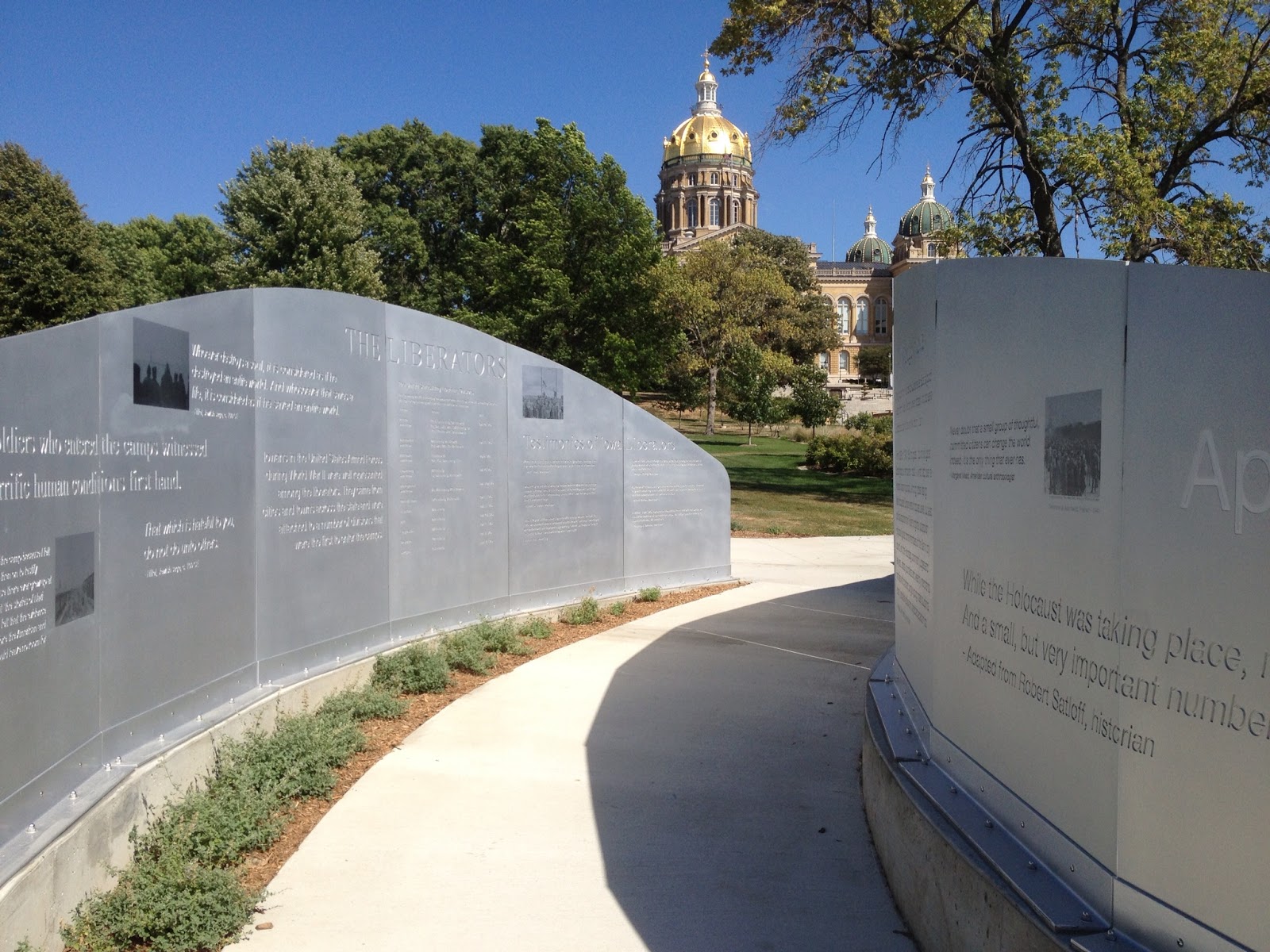
Iowa's Holocaust Memorial (top), constructed during 2013 with financial support from the Jacqueline and Myron Blank Fund, is located on the west terrace of the state Capitol grounds in Des Moines, near the intersection of East 7th Street and Grand Avenue and is well worth visiting today, or any other day. The photo here is taken from the Memorial's web site; the Memorial's Facebook page is located here.

But I wanted to write something this morning about a little-known program in Iowa that still shines like a very small, but very bright, candle in the darkness of U.S. immigration and other policies during that era --- including overt stonewalling by the U.S. State Department --- that prevented thousands of Jews seeking refuge in America from reaching safety on its shores.

Iowa native Michael Luick-Thrams wrote the book on the Iowa project, "Out of Hitler's Reach: The Scattergood Hostel for European Refugees, 1939-1943," back in the 1990s and it remains available via Amazon and other sources. I met Michael shortly after the book was published --- and bought a copy --- when he visited our Unitarian Universalist fellowship in Mason City. Then last year, I was pleased to hear from him again.

The Scattergood project grew out of a 1938 gathering of young Iowa Quakers at what then was the Iowa Methodist Camp on Clear Lake's south shore. They were aware of the increasing persecution, in Germany, of both Jews and vocal opponents to the Nazi regime. They also were aware that Scattergood Friends School, near West Branch, had been forced to close during the Great Depression and was standing vacant.

The young Friends developed the idea of using the Scattergood campus and farm as a hostel for German refugees fleeing Hitler who had been able to reach the United States. There, they would be assisted as they prepared to build new lives in America.

The hostel plan was carried out with assistance from the American Friends Service Committee and during the four years it operated provided hope and sustenance to 185 refugees who remained there for an average of several months each. The Quakers did not note the religious affiliation of those who found refuge with them, but Michael estimates that about 85 percent were Jewish.

The hostel, supported by nearby Quakers and the community in general, flourished until 1943, when war blocked the arrival of additional refugees.

The Friends then proposed that the hostel be opened to Japanese-Americans who had been rounded up and were being held in concentration camps of another sort in various places across the United States. But the communities that had welcomed the German refugees to Iowa said a firm "no" and the Scattergood experiment ended on a less than harmonious note.

The video here, a segment from the old "Living in Iowa" program, will tell you more about the Scattergood hostel. There's much more to be found, too, at Michael's Web site, "Traces." Scattergood Friends School continues to flourish. Its web site is located here.

Thursday, January 26, 2017

John Ricker and his "she-devil wife," Sidanah


Considerably more than a century has passed since children in the Old Greenville neighborhood  --- down southeast of Russell --- have been sent off to bed on cold winter nights with tales fresh in their heads of old John Ricker and his "she-devil wife," Sidanah, shared by lamplight around the stove.

To hear Henry Gittinger tell it, youngsters "dreaded to go to sleep for fear that John and Sidney (sic) might steal out from under the trundle bed and cut off their heads. Often did the writer feel of his head to see if he was intact the next morning after one of those recitals."

Henry recounted this bit of lore in The Chariton Leader of April 27, 1905 --- one of a number of references he made over the years to the nefarious couple.  It was Henry who branded the unfortunate Sidanah a "she-devil," based on the assumption that she was complicit in her husband's evil deeds.

Had he not thusly ensured their immortality it is likely that this episode of Lucas County history would have faded entirely collective memory.

But make no mistake about it, the Rickers were real people who lived in Washington Township for roughly 10 years, from 1853 until 1863, then vanished, by some accounts overnight. Legend has it that they left behind the remains of a victim, partially dissolved in quicklime, under their pioneer cabin and were never heard from again.

+++

John Ricker made a cameo appearance here on Monday in a post entitled "Charley Noble: From Lincoln to Roosevelt."  In reporting on a political debate near Greenville during the fall of 1860, when Lincoln and Douglas were vying for the presidency, Henry reported that Charley, "On nearing the 'Corners' ... ran into a group of men quarreling as to which was the smarter man.... The question was discussed vehemently on both sides and a free-for-all fight ensued. Finally there was a thunder of imprecations and curses heard above the din of battle and the notorious John Ricker, the terror of Honey Creek, appeared on the scene and branded each and all Douglas men rebels and liars, crackling his fists together and frothing at the mouth."

Some seven years earlier, during 1853, the Rickers had made a lasting impression on their pioneer neighbors upon arrival in Washington Township, according to Leander O. "Tip" McKinley. McKinley, son of Samuel and Mary, was 10 years old at the time and had arrived with his parents from Indiana during 1848.

Here's how Leander told the story 46 years later, in a letter dated Aug. 12, 1899, written at his home in Miller, South Dakota, and mailed to Henry, who was editor of a long-vanished Russell newspaper at the time.

"A peculiar writ of ejectment was served on Wyley Knight by John Ricker in 1853. Jonathan Rowlans entered 160 acres of land on Honey Creek (afterwards known as the Fisher farm) in 1851. He sold the place to John Ricker early in 1853; was to give Ricker possession in the fall. Rowlans rented the place to Knight until his time was out and Ricker should have possession.

"Ricker came on a few days before Knight's time was out and demanded possession, which Knight refused to give. Ricker then swore if he didn't get out he would burn him out, and went to the barn, set the hay on fire, which consumed the barn and all of Knight's feed he had prepared for winter. Ricker then threatened to set the house on fire, but Knight got out and Ricker was arrested."

"This," McKinley wrote, "was the introduction the people had of Ricker."

Nathan Kendall, another Washington Township pioneer whose home was on a high hill overlooking the farm where the Rickers settled to the north, added a few details in a letter published in The Leader of October 3, 1907. Sadly, this paper is torn at a crucial point and the paragraph I'm quoting from is not entirely legible:

"In the year of 1853, there came a man from Indiana, settled and built a habitation just at the north edge of the little bottom on Honey Creek, north of where the bridge on the 'Mormon trace' road is now, and his name was John Ricker. In the course of about a year there came four of his brothers from the Hoosier state --- named George, Mike, Pete and Al --- and they all settled on the foothills of Honey Creek, in the brush lands, close together (on a branch of Honey Creek; at the) time this was called Ricker's Branch. There came with the Rickers (torn) Jasper Niday, and a man (torn) of Rawlins. They also (settled on the) so-called Ricker's Branch."

Nathan characterized the new arrivals this way: "To say that they were a tough lot would be putting it mildly. At that time the writer of this article was in his teens, but well does he remember the depredations that were being carried on by this band of border ruffians, and especially by the original one, John Ricker himself. He kept whisky and tobacco for sale."


+++

Quite a few of the Rickers make an appearance in the 1856 state census of Washington Township, along with Leander McKinley, Nathan Kendall, their families and neighbors. The John Ricker household consisted of himself, a Tennessee native, age 40; Sidanah, age 34, born in Indiana; John W. Divine, age 14, born in Ohio, whose role in this story will become evident later; Joseph M. Whitsett, 24, Rodah M. Whitsett, 21, and John H. Whitsett, age 2. I'm speculating that Joseph Whitsett was Sidanah's brother and Rodah and John, his wife and son.

Living nearby were George W. and Sarah Ricker, ages 52 and 49 respectively, with five younger people ranging in age from 21 down to 2; Peter and Nancy Ricker, ages 31 and 26 with two very young children; and a household consisting of Gidings Ricker, 24, Sarah Ricker, 38, Martin S. Ricker, 19, Sarah Ricker, 10, and John W. Ricker, perhaps 5.

But by 1860 all of the Rickers save John, enumerated as 45, and Sidanah, age 33, had moved along, some it would appear to Kansas, others perhaps back to Indiana. The third person in John's and Sidanah's home during 1860 was Elizabeth Whitsett, age 64 and perhaps Sidanah's mother. Adjoining the Ricker home were three "unoccupied" cabins --- possibly until quite recently the homes of other members of the extended Ricker family.

The neighborhood where the Rickers lived is familiar to me, but I'm not sure I can explain it --- too many of the old farms are gone and their occupants dead. A bridge still crosses Honey Creek on the old Mormon Trace road about two and a half miles southeast of Center Church. When I was a kid, Kendall descendants still lived in a small house on the old home place high upon a hill southeast of the bridge. What had been the Ricker place was immediately across the road to the north, 120 acres stretching along it in three 40s. The Lester Palmers lived there when I was small; later, the Horners --- in a big white house set back on a rise a ways from the road. The Ricker "roost," however --- home base for all that lawlessness --- was up the creek north a ways and back along a branch to the west, in the woods of the far west 40.

Recalling the site of boyhood adventures in The Leader of Jan. 2, 1913, Henry described it this way: "Up the green valley once upon a time, there had flourished a 'robber's roost.' until it was finally routed by the brave settlers and the outlaws escaped. It had been a rendezvous for rough, unprincipled men and much stolen goods had here been concealed. Even murder itself had been committed there. The ruins of the primitive castle might yet be observed. It was shunned by even the stout hearted by day and the ghosts stalked the place by night --- so it was said."


+++

Everyone who wrote about John Ricker and his gang had roughly the same sort of story to tell.

Henry wrote of the Rickers this way in The Leader of Jan. 15, 1920: "At that time, in a little secluded gulch not more than a half mile away (from the home of his grandfather, Xury West) John Ricker, the outlaw, had his rendezvous. And I guess if the history if it was written it would form as thrilling narrative as any pirate tale upon the Spanish main. Hard characters came and went and the gulch had a reputation. Ricker's liquor flowed freely, and the mysteries of the rendezvous kept the settlers terrorized. It was generally understood to be the headquarters of a horse thief band, until murder itself, through the way-laying of travelers, became the common report."

Leander McKinley remembered John Ricker this way: "He kept the neighborhood in a constant reign of outlawry until finally he was compelled to leave the country. He was a bold, bad man.... Ricker was accused of all the crimes (almost) known to the criminal statute."

Here's Henry again, in The Leader of July 15, 1915: "In the early days, within less than a mile of where the writer was born in Washington township, was a 'robbers' roost' maintained by an outlaw by the name of John Ricker. Desperate characters often congregated there and it was the exchange rendezvous for stolen horses. Travelers sometimes stopped there and one night a belated pilgrim was seen to ride up to the Ricker haunt --- and he never rode away."

+++

It seems to have taken a shooting incident at the cabin of Xury West, Henry Gittinger's grandfather and Washington Township's first and perhaps most highly respected pioneer, to set the neighborhood firmly and decisively against John Ricker, however. Until that time, his truculence had been tolerated and Sidanah was included in social gatherings of neighborhood women, reportedly suggesting on one occasion that her husband would not sell whisky unless there was a market for it among their husbands.

Although the year is not given, there's general agreement that West had most likely denounced Ricker publicly not long before the shooting occurred.

Here's how Nathan Kendall recalled the shooting and its aftermath: "It was in the night time. I would say about 9 o'clock. Some miscreant willfully shot through the window of Xury West's house, no doubt with full intent to kill him. I happened to be there that evening and heard the shot and saw the glass fall from the window, and then the man disappear on horseback in the gloaming to the west, so I know of what I say.

"The alarm was given, and the nearer neighbors who responded to the call to arms were Samuel McKinley and his boys, Abbott Kendall, Abner McKinley and a few others. After gathering at the West home there was held a council of war and to say that the excitement ran high would be a mild way of expressing it.

"By this time it was growing late, perhaps near midnight, and all present seemed to think it was John Ricker, the desperado, who had done the shooting. So it was put to a vote and carried unanimously to march down to his stronghold and call him up and have a hearing. 

"At that early day it was all open prairie and the road at that time trailed down and across the foothills, passing near where Mrs. Margaret Aldrich's farm house now stands. There was a ford on Honey Creek just east of the Ricker castle, and when we got to this ford there was another council of war held and it was decided that Leander (Tip) McKinley and the writer would be sent to the house and call Ricker up, under the pretense of buying some tobacco.

"To say it took some nerve for two young fellows to carry out the detail hardly conveys the point --- but we went forth with fear and trembling just the same. The agreement was than when we called him out and the 'reserve' saw the light, they were to rush in, which they did in good order.

"But to describe the actions of Ricker and the language used by those infuriated men would be impossible at this late day. I well remember that Isaac West came near braining Ricker with a chair. I think he was the worst feared desperado I ever saw. After we had kept him company about an hour, to his great discomfort, and giving him his orders for his future conduct, we all went home, but we did not sing a song."

+++

There is no specific account of the incident that finally, according to neighborhood lore, put the Rickers to flight --- and details vary. Several allege that a traveler disappeared, the neighborhood rose up, John and Sidanah fled in the night and the remains of a victim were found in the cellar of their cabin.

Here is Henry's account from Jan. 15, 1920: "The settlers rose up and John and Sidney (sic) Ricker fled --- and have not been seen or heard of since. Search was made and quick lime in the cellar, with human bones, told the story."

Here's an earlier version from Henry, published in The Leader on April 27, 1905: "No formidable steps were taken against him until a murder was reported at the robber's roost, and then only when he and his she-devil wife had fled. the search of the premises revealed dead men's bones in the cellar. they had 'taken a stranger in.' "

Leander McKinley added another twist in his 1899 letter: "He kept the neighborhood in a constant reign of outlawry until finally he was compelled to leave the country. It was supposed he murdered a boy he had living with him (John Divine), as he disappeared and was never heard of since."

Those who have been paying attention may recall that a 14-year-old lad named John Divine was indeed living with John and Sidanah Ricker when the 1856 census was taken.

+++

There's no way now to figure out exactly what happened so long ago in the Old Greenville neighborhood. There's little doubt that old John Ricker was a holy terror, but a murderer? And was his wife unfairly implicated in her husband's evil deeds? Who knows? This is Lucas County's oldest cold case.

No one lives in,  even especially near, the vale of Honey Creek these days --- but many pass through it bound for elsewhere. If that's you late some night and whilst crossing the bridge you look upstream and see a light in the woods along Ricker Branch --- watch out!

Wednesday, January 25, 2017

Our true happiness ...

Mornings (the noon hour and occasional early evenings, too) play out like this sometimes --- while writing, reading, thinking deep thoughts (or taking a nap), the telephone rings. "Uh, did you forget ....?"

My ability to forget meetings is near-legendary.

To launch 2017, returning to a practice of the olden days, I ordered up a daily engagement calendar. This used to be an annual rite, generally futile, because if you have an engagement calendar it's necessary to write stuff in it, then remember to look at it.

I've resolved to do better. Just wrote in a 9 a.m. meeting for Tuesday, January 31st. That morning is officially full now.

Considering the likely chaos of 2017, it seemed like a good idea to acquire a little inspiration along with the calendar pages. Thus, the annual Thich Nhat Hanh daybook issued by the Unified Buddhist Church, Inc., which represents Thay and his Sangha in the United States.

Thay himself, exiled from his native Vietnam for peace-making efforts during the late war and colleague of such luminaries as Dr. Martin Luther King Jr. and Thomas Merton, turns 90 this year and is handicapped by a 2014 stroke. Although well enough to travel during December from Plum Village in France to a satellite center in Thailand, his writing has ceased.

But his words remain, including these --- the thought for January accompanied by Nicholas Kirsten-Honshin's artwork:

"Our true happiness comes
from being fully conscious
in the present moment,
aware of our connection
to everything in the universe."

Tuesday, January 24, 2017

A sad, but unverifiable, winter's tale


This is one of those stories embedded in Lucas County lore that can't be verified, although there's no reason to believe that it --- or some version of it --- did not occur. But it had passed as oral tradition from person to person many times before Clarkson C. "Clark" Burr (1861-1939) finally wrote it down at the turn of the 20th century. 

He shared it twice in writing, first as just a paragraph in a memoir of early life in Warren Township prepared for an Old Settlers Association meeting just after the turn of the 20th century; then again, for publication as follows, in The Chariton Leader of March 26, 1929.

Clark heard the story from his father, Milton J. Burr (1821-1893), who with wife, Alcinda, and older children were among several Quaker families --- including my own Dent-Chynoweths --- who arrived in Lucas County from Belmont County, Ohio, not long before the Civil War. Milton Burr would have heard the story from earlier settlers.

The "bands of roving Indians" cited were parties of friendly --- and curious --- Potawatomi who ranged across the county in hunting parties sometimes while headquartered in far southwest Iowa. The cabin in the snow is located on the Lucas County Historical Society museum campus and this photo was taken a few years ago. Our ground is bare --- at the moment. Here's the story as Clark Burr wrote it:

In last week's Leader, reference was made to the venerable Charles Noble, and the wonderful changes that have occurred in this country in the span of one human life. And I will now relate an incident of frontier life that has never been published, and as told by my father, over half century ago, was always listened to with great interest, and illustrates the manner of living of the early settlers, and the sufferings and privations they endured.

Near the year 1850, a family of newcomers arrived from Indiana and built a cabin near the timber, by the Chariton River; this family consisting of a man, his wife and a boy. In the early days, almost everyone lived near the creeks and timber, thus having the three necessities of frontier life close at hand --- water, fuel and protection from the storms of winter.

For several years this family lived and prospered, until the father sickened and died, leaving the mother and son alone. In their struggle for a living, the son became very much discouraged and begged his mother to return to their former Indiana home; he also talked to the neighbors in the same manner, and it was generally known that he was greatly dissatisfied.

So events passed, until one November day, the son said he was going hunting, and taking his rifle disappeared in the timber, and never returned.

Upon appeal from the mother, the neighbors searched for the missing boy, but from the start it was generally supposed he had returned to the Indiana home; however, the mother gave this idea no consideration, and her belief was attributed to mother love, and then followed a winter of sorrow and loneliness, as she lived in the cabin, menaced in the daytime by bands of roving Indians, and the nights made hideous by the howling of the wolves.

Finally the winter ended and one day in March, she made her daily visit to the spring, for a bucket of water for her household use, when she saw, beyond her reach in the water, some object, and upon the arrival of some neighbors, they were horrified to find it was the body of her lost son, and upon searching upon a steep bluff, above the spring, evidence was still plain, by the broken brush, showing where the son had evidently stumbled, and fallen to the overhanging bluff above the spring, where he had fallen to his death in the water below. Later his rifle was found in the bottom of the spring.

I am unable to give the name of the family, or the part of the county in which this tragedy occurred, and will add this was one of several incidents of pioneer life furnished by my father to the late T.M. Stuart, who it is understood gave much of his time, in the last years of his life, to the collection of these events with the intention of having the same published in book form, and it is a loss to posterity, to know Mr. Stuart passed on, and the book was never published.

Monday, January 23, 2017

Charley Noble: From Lincoln to Roosevelt


Charley Noble, who passed to his final reward in Chariton at the untimely age of 97 during 1933, was quite the story-teller. And as a resident of Lucas County for more than 75 years, he had lots of stories to tell. Franklin D. Roosevelt was in the opening months of his first term as president when Charley died; the race between Republican Abraham Lincoln and Democrat Stephen A Douglas during 1860, the first presidential campaign he observed.

During 1907, Charley paired up with Henry Gittinger, then editor and publisher of The Chariton Leader, to tell a tale from the divisive campaign that preceded Lincoln's election.

Charley couldn't vote that time --- he still was a citizen of his native Canada who declined to pledge allegiance to the United States of America so long as slavery was allowed within its borders. But he was interested in politics and during the fall of 1860 set out to attend a political debate down at Union Corners --- as far southeast as you can get in Lucas County, near where the corners of Lucas, Wayne, Appanoose and Monroe counties converge.

Noble, then a young blacksmith, was a resident of Lagrange --- tending to the hooves of Western Stage Co. teams when they stopped at that now-vanished village. Glance to the north as you cross the Lucas-Monroe county line on U.S. 34 today and you'll see the Lagrange Cemetery back in the field and a couple of houses that remain on the old town site.

+++

Here's the story of that debate, as published in The Leader of Feb 7, 1907, under the headline "In the Olden Days: The Way Political Meetings were Conducted Here Before the War."

C.F. Noble, of this city, fell into a reminiscent mood, Monday, and related some of his personal experiences soon after coming to Iowa from his native Canada. He resided at LaGrange.

In the fall of 1860 political discussion was at a high ebb. This was the campaign in which Lincoln and Douglas were pitted against each other for the presidency.


On a certain night a great Republican rally had been advertised in Woodruff's barn, at Union Corners, down in Washington Township, this neighborhood then being one of the most populous places in the county.

It was but a little before sundown that he saddled his mule and started to hear the discussion. On nearing Old Greenville he met the Chariton marching club, in full eclat, with band and banner, passing up the old trace road to torture a virulent Democrat with a "Patriotic serenade."

This, of course, raised the castle and brought the desired result, which terminated short of a pitched battle. Yells and echoes were held from every quarter ---- charges and counter-charges.

At that time, the Hon. Robert Coles and Dr. Lind were rival orators and had been billed to hold a joint debate at LaGrange a week later.

On nearing the "Corners" he ran into a group of men quarreling as to which was the smarter man, Coles or Lind. The question was discussed vehemently on both sides and a free-for-all fight ensued. Finally there was a thunder of imprecations and curses heard above the din of battle and the notorious John Ricker, the terror of Honey Creek, appeared on the scene and branded each and all Douglas men rebels and liars, crackling his fists together and frothing at the mouth.

Finally a truce was had and the discussion proceeded at the barn. But even the women had seemed to enjoy the excitement and had often grown desperate in their cause, loving their heroes with true partisan devotion whether of the drubbed or drubbing.

+++

Some 24 years after Charley's account of political tension down in Washington Township was published, the old gentleman celebrated his 95th birthday. That resulted in a long story in The Herald-Patriot headlined "Countless Friends Say 'Many Happy Returns' to Charley Noble on his 95th birthday." He was still a story-teller and many of them were woven into the text:

 Charles F. Noble, of Chariton, one of the finest and most beloved pioneers of Lucas county, today is enjoying his ninety-fifth birthday, feted and congratulated by hosts of friends both in this and other communities of Iowa. For seventy-four of those years have been spent in Lucas County, long years that have grayed the hair of Charles Noble but have failed to quench his indomitable spirit or dim the recollection of honorable years gone by.

When he was called upon by a representative of the Herald-Patriot Wednesday afternoon for a short interview concerning the many years that he has spent in this community, Charles Noble welcomed his guests with simple dignity and gave an hour of his busy day to the recounting of his life both in this state and in the country of his birth, Canada. Chuckling delightedly at many of the incidents that recalled themselves to his mind as he went back in memory over those years, Mr. Noble regaled his listeners with as interesting a story as has been heard in years.

Charles Noble has lived a simple life, an honest life and a straight forward life. But his life has been so irrevocably bound with the early history of the Hawkeye state that it takes on transcendent interest as the years fall away and we live once again with the stage coach, the log cabin and the war of the Rebellion.

Charles F. Noble was a member of a large Scots family and was born on a farm seventy five miles north of Montreal, Canada. The elder Mr. Noble was from the Scotch Highlands and had made the crossing of the Atlantic in search of the land offered in those times of colonial growth. The farm on which Charles was born was purchased for $1 an acre and was covered with virgin forest.

Charles spent eighteen years of life on this rock-bound, forest farm before the urge to travel, which later became a dominant factor in his life, manifested itself. As he confessed Wednesday afternoon, the appearance  of two local boys who had spent the winter in the United States, with fine clothes and reports of easy money to be had for common labor, led the Scots lad to think of trying his fortune in the new territory.

His first trip to the States was to Washington county, New York, where he entered the employ of a blacksmith. the stipulation was to be $30 for the first year, $40 for the second and $50 for the third year. However, a saloon operated in connection with the blacksmith shop took too much time of his employer and the shop was closed (before the contract had been fulfilled).

Mr. Noble had his first and last experiences with coffee and tobacco during this period of his life and chuckled with glee as he recalled how sick he was following his first chew of tobacco. Informed by his brothers that tobacco was sweet, young Noble bit off a generous mouthful and then described with many a burst of laughter, "how the fireplace rose in front of him and the room turned around and round." While in Montreal on his way to New York, coffee, a new liquid to the Scots emigrant, was tasted but a similar reaction followed and the drink was crossed off his list. Mr. Noble has not tasted coffee or tobacco since that time.

Following his two years spent in New York, Noble returned to Canada where he worked at various jobs for five months. The blacksmithing trade that he learned in New York was to stand Noble in good stead when he entered the fertile fields of Iowa.

Inflamed with the reports of fortunes to be made in the newly admitted state of Iowa, young Noble became imbued with a desire to go to the new state. His sister and brother attempted to prevent his journey with the arguments that Iowa was settled only with rascals, criminals and Indians and that only death and misfortune awaited those in the new state.

His sister, refusing to permit him to make the trip alone, he brought her with him and in the spring of 1857 they entered the city of Chicago, then the center of the west. Merchants in Chicago warned young Noble and his sister from going on to Dubuque, Iowa, claiming that temperatures of forty degrees below zero were maintained there the year around and that blizzards were of such strength to tear wagon spokes from their sockets. Blizzards were reputed to be of such velocity that the room of a log cabin would be covered with a foot of snow that entered solely through the key hole of the door.

Even Davenport was said to be of frigid climate and the Canadian party was advised to go further south. Undaunted by those reports and with a steadfast refusal to enter a state that permitted slavery within its borders, young Noble and his sister finally entrained for Davenport, Iowa, where he spent several days in search of work. From Davenport the party went to Iowa City, then to Montezuma, Iowa, in slow journeys, always the search for steady employment being uppermost in the minds of the immigrants.

At Montezuma, where Charles was to spend the next four or five years of his life, employment was wide and varied. Dake and Dryden, contractors, probably one of the first contracting organizations in the state of Iowa, were the first to secure Noble's help and the court house and the Methodist church at Montezuma were built during this period. Mr. Noble was paid a top wage of about $18 a month during this time but this figure of course included board, room and washing.

While working at Monezuma, Charles was frequently asked why he did not take out naturalization papers that would make him a citizen of the United States. The young pioneer steadfastly refused and declared that he would declare allegiance to no country that permitted the abominable practice of human slavery.

"If I am asked to aid a starving, freezing Negro, I will do so, by the grace of God, and I will permit no government to prevent me," he said in reference to the Fugitive Slave Act, then a much disputed law of the country.

Although Mr. Noble was so prominent in the early history of Montezuma, he has not been back to the scene of early manhood laboring days for seventy four years.

Mr. Paisley, then engaged in the manufacturing of prairie plows for the breaking of the virgin sod, engaged the labor of Noble next for the sum of $20 a month and post making, cradling wheat and digging foundations for buildings all secured the attention of the young immigrant during these days.

A group of young men of the community at that time made up a party that heard the command of Horace Greeley "to go west." Journeying in a wagon owned by the party, the trip was made slowly across the plains of Iowa through Des Moines, Pacific Junction via Glenwood to Council Bluffs.

Pacific Junction was then reputed to be in the future the great capital of the middle west with trunk lines of all western railroad lines slated to make their headquarters in that city. The project was purely visionary and the group of young men found only an occasional log cabin when they went there on the return trip.

An Ottumwan who was returning to his home city was engaged in to bring Noble and a companion back to Montezuma. A few miles west of Glenwood at a French settlement a trader attempted to get the two men to establish a blacksmithing shop in their settlement. He offered to set the two young adventurers up in business, give them the land necessary to build the shop and aid them in every way.

"I asked if his winsome daughter might be included in the bargain and he agreed," smiled Mr. Noble Wednesday, but the lure of the open road proved too great and the two men journeyed on toward the east and home.

Continuing toward the east, the party stopped over night at a trading camp twelve miles east of Chariton at LaGrange. At that time Chariton had no court house but used a small log cabin for the transaction of county business. At this time no railroad had been built in the county and it was not until 1867 did a railroad appear in Lucas county.

Noble Olmstead maintained a stage shed at LaGrange at this time and cared for the horses and travelers that were making the long trip across Iowa.

Olmstead offered him a start at LaGrange in the blacksmithing business and after a short time spent at the old town at Montezuma, young Noble returned to LaGrange to make his residence. R. Lynn, of LaGrange, owned a blacksmithing shop in the town that had been foreclosed previously and with this equipment the new shop was originated.

Charles was somewhat impoverished at this time because of his many excursions and as a result Olmstead went on his bond for the purchasing of the blacksmithy equipment.

In 1861 Charles was married to Katherine Long, a girl whose parents had died previously and who was all alone in the world. Miss Long was employed in a private home located on the site of the present library in Chariton where she was employed for $3 a week and room and board.

The Nobles set up housekeeping in LaGrange and remained there for a period of ten years, where he shoed the horses of the stage company and took care of the blacksmithing work of the county. Numerous humorous anecdotes amused the old pioneer considerably and on one occasion he rocked with laughter as he recalled an attempt to charge $2 worth of dishes. Dr. Lynn, the owner of the smithy equipment, this time failed to provide credit and Noble was required to break a $5 gold piece for the dishes. Nobel evened matters up with the doctor later by refusing to give him credit on some black smithy work and admitted that "he was uneasy for a spell after that because the doctor was the only medical expert and preacher for miles around he he was some worried for fear he would be denied medical aid if sick and absolution if he died." However, the doctor saw the humorous side of the case and later became warm friends with the young blacksmith.

The new railroad was completed about this time and the road was built several miles from LaGrange. The settlement was doomed and Charles was the first to sense this and moved to a farm in Washington township to spend the next fifteen years of his life.

During this period spent on a farm the Noble farm grew from a matter of 160 acres to 720 acres and in 1888 the wealthy land owner moved to Chariton, retired and devoted his time to the administering of his estate.

Chariton was in its construction program and Mr. Noble had the following to say of an old anecdote he recollected. Joe Brown had just finished the construction of a modern home on the corner of the present square and the home was the admiration of all Chariton residents. One of the feminine residents, overcome with curiosity, complimented Mr. Brown on the completion of his home and inquired if it was modern. "No, it isn't modern," Brown replied. "In the sense that no mortgage hangs over its gables."

Three children were born to the Nobles, Ira C. of Chariton, Sevy, who died in 1892 in a power house accident in Des Moines, and Melissa Marshall, now of Berryville, Arkansas.

Mrs. Charles Noble passed away on March 12, 1920.

The simple Noble residence is cared for by Mr. and Mrs. John O'Hara, whose father was a lifelong friend of Charles at the farm near LaGrange. The house is thronged daily with friends who come to chat and dream of the golden days of their young in the quiet, rugged simplicity of the Noble home.

On the eve of his ninety fifth birthday, Mr. Noble was visibly moved by the remembrances of his friends in Lucas county and expressed boundless satisfaction with his lot in life. 

+++

Charley died at his home in Chariton two years later, on June 8, 1933, at the age of 97. He had failed during his final year and for the most part had been unable to leave the house, but maintained a complete range of mental faculties until the end.


Sunday, January 22, 2017

In grateful appreciation to those who marched ...

In Des Moines

I was so proud yesterday of friends, Facebook and otherwise, who participated in Women's Marches --- the mother march in Washington, D.C., sister marches across the nation (and the world).

At first, it seemed like it might be possible to keep track of all of these folks as social media reports started coming in from Des Moines.  Then there were dispatches from the West Coast, south and east through Texas and Oxford, Mississippi to Florida, up the East Coast to D.C., even skipping across the Atlantic to Paris --- and the impracticality of that became evident. 

In Des Moines.

The photos here are a few I snagged along the way, most Iowans, some with Iowa and/or Lucas County roots.

An estimated 26,000 turned out in Des Moines --- a huge deal in Iowa where march organizers thought originally the crowd would be small enough to fit into the Capitol. Crowd estimates are notoriously difficult to sort out. But there's general agreement that this was the biggest one-day demonstration of solidarity in the history of America as the number of marchers climbed into the millions.

In Des Moines

All in all, it was a welcome antidote to the poison of that dark, foreboding and by comparison sparsely attended inauguration ceremony on Friday.  

There are perilous days ahead and it's important to remember that President Trump is only the front man --- emotionally immature, morally empty and easily manipulated by malignant interests motivated by white nationalism, racism, xenophobia and Christianist-right extremism.

In Los Angeles

It's useful to remember, too, that many in that minority of Americans who voted this regime into power had no clear idea of what the consequences of their votes would be.

It wouldn't surprise me if women took the lead in seeing us safely through this, so thanks again to everyone I know who organized and marched.

Saturday, January 21, 2017

America, America ...


President Trump's distorted and dark inaugural vision of America, past and present, seemed to leave little hope Friday. A significant opportunity missed to unite and move us forward together.

So I looked elsewhere for a more accurate vision of where we've been and who we have the potential to be --- and found it in a song, usually reserved these days for Veterans Day, performed so memorably by Norah Jones in Ken Burns' 2007 documentary series, "The War."

"American Anthem," composed by Gene Scheer, premiered during 1999 at a Smithsonian Institution ceremony marking restoration of the "Star Spangled Banner" and subsequently was featured during the 2005 inauguration of George W. Bush.

Here it is, performed by mezzo-soprano Denyce Graves, who premiered it. And read the lyrics, too.

All we've been given by those who came before
The dream of a nation where freedom would endure
The work and prayers of centuries have brought us to this day
What shall be our legacy? What will our children say?

Let them say of me I was one who believed
In sharing the blessings I received.
Let me know in my heart when my days are through
America, America, I gave my best to you.

Each generation from the plains to distant shore
With the gifts they were given were determined to leave more.
Battles fought together, acts of conscience fought alone:
These are the seeds from which America has grown.

Let them say of me I was one who believed
In sharing the blessings that I received.
Let me know in my heart when my days are through
America, America, I gave my best to you.

For those who think they have nothing to share,
Who fear in their hearts there is no hero there.
Know each quiet act of dignity is that which fortifies
The soul of a nation that will never die.

Let them say of me I was one who believed
In sharing the blessings I received.
Let me know in my heart when my days are through
America, America, I gave my best to you.

Now get out there, damn it, and give your best. To those participating in Women's Marches today --- you go out there in Los Angeles, Roberta --- thank you!

Friday, January 20, 2017

Let there be (new) light


Jeff Bailey (above) and Tyler Wignall (below), both of Des Moines-based Tesdell Electric, have been at the museum this week installing new LED lighting in the Vredenburg Gallery and Library of the Lewis Building. 


Looks like the job will be finished today --- bringing almost to a close a year-long project to update these two rooms, which fill the top floor of the 1975-76 wing --- the first new building constructed on the museum campus after development began during 1966.

The last phase will involve --- finally --- getting everything back into place and restoring order before we open for a new season on May 1. (These rooms were open during the 2016 season, but order had not been fully restored.)

We began early last year by evacuating the two rooms, repainting the walls, then tearing up and replacing what seemed like acres of the original 1975-76 carpet --- durable stuff that none-the-less had served its purpose. Four new cases to house items from the military collection also were installed at that time. All of this project was funded by a generous grant from the Vredenburg Foundation.

New lighting wasn't part of the original plan, although the need for it became increasingly evident. The old lighting system, rows of 1970s-era fluorescents, was too dim and did not extend into two gallery alcloves. Enough funds still were available from the Vredenburg grant to fund about half a lighting project --- so we went ahead.

The result is going to be very bright indeed, but can be adjusted with dimmer switches until the proper level is reached, should that be necessary. It should be possible now to see clearly everything on display in these two areas.

It's going to be great to have this project finished and move on to others. Projects during 2016 also included repairing and residing the north wall of the Lewis Building and paving (thanks to a gift from the Coons Foundation) a parking area just east of it.

Come spring, we'll be replacing sidewalks leading to and from Otterbein Church and improving handicap accessibility to buildings in that part of the campus, also with Coons Foundation funds. And we're getting estimates on rewiring the Stephens House, the 1911 dwelling that is the original building on our campus. So if it isn't one thing, it's another ....


Thursday, January 19, 2017

Mississippi, the Civil War & Chariton's John Aughey


I stumbled upon an interesting 2014 documentary the other day from Mississippi Public Broadcasting that provided fresh insights, to me at least, about the Civil War, its causes and effects. It's entitled "Mississippi's War: Slavery and Secession" and runs about an hour, a considerable commitment of time in this day and age, but worthwhile.

Although the documentary deals specifically with the war, its causes and long-term effects in just one  state, the Mississippi experience and the Iowa experience certainly were linked in various ways. Among them, Iowans benefited from the booming "king cotton" slave-based economy of the South during the years leading up to war; then during the war, hundreds of young Iowans died there --- including two uncles of mine, Jim Rhea and Gene Dunlap, one in combat at Vicksburg, the other of disease at Jackson.

+++

The Civil War, its causes and post-war consequences are relevant in the divided United States as we're experiencing it now, some would argue, in large part because as a nation we've never dealt with racial issues that arise from the fact a slave-based economy underpinned it during formative years. Just as we've never dealt with racial, cultural, religious and other issues that arise from destruction of our native people during those same formative years and beyond.

In any case, the documentary deals concisely with a number of historical "sacred cows" that have developed during the post-war experience. Among them, especially in the South, is the idea that the war resulted from something other than a desire to preserve the institution of slavery --- state rights often are cited.

And then there's President Lincoln's burnished reputation as the "great emancipator." Which he was, of course, but he also was a pragmatic man of his time and a politician and while not in favor of slavery probably would have allowed it to stand where it existed before war erupted had it been possible to find compromise at crucial times.

Then there's the idea that the economic elite of the south favored war. In Mississippi, at least, hotheads favored war. The planters --- the millionaires of their time --- in a good many cases were opposed to secession because they knew war would disrupt if not destroy their businesses and doubted the ability of the South to prevail. Many were prepared to take their chances with Lincoln.

And finally, that our Iowa Union ancestors fought and died to end slavery. In the long run they did, but most thought at the time that they were fighting (and dying) to preserve the Union; slavery was a secondary issue. Although there were active and vocal abolitionists in Iowa at the time, the great majority of our Iowa ancestors were not among them.

+++

I was also pleased to find in the Mississippi documentary a cameo appearance by the handsome mug of and a few words from the Rev. John Hill Aughey, later of Chariton, who was living and working in Mississippi when war broke out. 

A Unionist firebrand, his 1863’s “The Iron Furnace: or, Slavery and Secession,” became widely influential in the North. His next book, “Tupelo,” completed during the 1880s when Aughey was preaching in Chariton, was a revised and expanded version of “The Iron Furnace,” and it, too, was a best-seller. You can read more about Aughey and his two terms as pastor of Chariton's First Presbyterian Church here.

Wednesday, January 18, 2017

Iowa's deadliest blizzard kills 20: Jan. 7-8, 1886


I wrote yesterday about the "Schoolhouse Blizzard" of 1888 on the northern Plains, getting the cart a little ahead of the horse by failing to mention that Iowa's deadliest storm --- reports usually state that 20 died as a result of it --- had occurred two years earlier, on Jan. 7 and 8, 1886. 

The 1888 blizzard struck Iowa in the night, when most were at home, and so there were few reports of deadly consequences in the state. The 1886 storm  moved in earlier in the day and it had been five years since the last storm of such magnitude had struck the state --- on March 2-4 1881. The 1886 blizzard caught many Iowans unprepared and the deaths that resulted were scattered from southern Iowa to the far north. The photograph here, found online, reportedly was taken in Cherokee after the 1886 winds had stopped blowing.

The editor of Chariton's Democrat, setting type as the wind continued to blow on Friday, Jan. 8, reported the storm's development in Lucas County as follows:

"For the past two or three weeks the weather in this part of Iowa has been remarkable for mildness. there was a general break up of the short season of severe weather we had in the early part of December, and indications pointed to a general open winter. No ice, was the fear of the ice men. Then followed a week of rainy weather, growing colder Saturday; and Sunday last, the rain froze as it fell, covering the earth with ice and literally breaking down the trees with the accumulated load. Yesterday (Thursday), a blizzard from the west hurled drifting snow about promiscuously, the mercury rapidly sinking. Last night the thermometer indicted 15 degrees below zero at 8 o'clock and 25 degrees this morning. We shall probably have winter enough."

Lucas Countyans were lucky, however, and rode out the storm with no serious consequences. Passengers on a north-bound train that left the C.B.&Q. depot at 5 p.m. Friday were, however, inconvenienced. They were headed for Des Moines via Indianola when the engine got stuck in snow drifts just south of Ackworth and they were forced to spend the night there aboard their passenger cars. A crew from Chariton reached the stranded train on Saturday morning, shoveled it out and those aboard finally reached their destination at 4:30 p.m. Saturday.

Reports of more serious consequences began to appear in The Iowa State Register, published in Des Moines, on Sunday, Jan. 10:

"GRIMES, Jan. 9 --- Early this morning Ben Zickafoose, living two miles south of Grimes, came in and reported that a man had been frozen to death about 40 rods south of his place. A party was at once made up, and on reaching the place the man was found to be Mr. Wm. Cook, an English farmer, about 55 years of age, and living about two miles from Grimes. He had gone to Des Moines Thursday, where he was caught in the storm, and when two miles from home had wandered from the road, and in the blinding storm had driven onto a pond, the ice broke, he made an effort to free the team, but was unsuccessful. Both horses were found dead with one tug fast to the sleigh. The bewildered man then started on foot across the prairie, and had got about twenty rods from the sled, when, overcome by cold, wet and fatigue, he fell on his face and was found frozen stiff. He was forty rods from a house and ten rods from a hay stack, but in the blinding snow it was impossible to see anything. The body was taken care of and the family notified. The family are in needy circumstances, but people here in town sent out coal and provisions enough to meet all immediate needs."

CRESTON, Jan. 9 --- Henry Teri, an aged citizen, was engaged yesterday in drivinig a coal team for E. Q. Soulman, and on his way home in the evening he was overcome with the cold and was found in the street in a semi-conscious state, by some citizens and cared for. He died at 12:15 this morning. He leaves a wife and little daughter in destitute circumstances.

It's difficult to judge the accuracy of the claim that 20 died as a result of the 1886 storm. There was no central reporting agency, no statewide news services and reports of fatalities began to spread in most cases only after they were reported in local weekly newspapers.

And in some instances, death reports turned out to be inaccurate. The Register, for example, killed off John Shipley, of Bedford, in its Jan. 10th edition, then was forced to resurrect him in the form of a correction in later editions.

Reports of the death of a young school teacher in northwest Hancock County did not begin to circulate until early in the week following the storm when the following report was carried in several newspapers:

"BRITT --- Miss Bertha Nelson, a young lady teaching school seven miles northwest of town, was frozen to death during the last storm. Thursday morning she started to school with several children, and the storm being so fierce they remained in the school house all night. A man living near there took provisions to them Friday morning and told them not to leave the building as he would take them home with his team as soon as the storm abated. Friday afternoon, the teacher and children started for home, the nearest home being a quarter of a mile distant. They had gone but a short distance when she went back to the school house for something she had left, and told them she would overtake them. On reaching the house, the father of one of the children saw them, and took the six year old boy into the house and inquired for their teacher. Being told she was coming, he started toward the school house and called her name all the way. Not finding her, and the school house being locked, he went home and supposed she had reached her boarding place. Saturday he called there, and was astonished to learn that she had not been seen since Thursday. Search was made for her on Sunday and Monday, and word sent to Britt for help. Tuesday morning about forty men went, and her body was found on the prairie about a mile and half from the school house, and half a mile from her boarding place. She was frozen stiff. Her brother was telegraphed for and arrived Wednesday night. He starts tonight for Keokuk, with her remains. His name is Aven Nelson and he is principal of the High School at Ferguson, Mo."

(Bertha, age 29, was a daughter of Christen and Anna Nelson, natives of Norway, and is buried in the Scandinavian Cemetery, Lee County.)

That same report also contained the news that "A young man named Carl Berner, living in the southern part of (Hancock) county, started for Corwith at 4 a.m. Thursday for a doctor. The storm commenced and increased so fast that he was benumbed with cold. Coming up to a house, he inquired the way, supposing he was lost. He was found to be on the right road, but was urged to remain until the storm ceased. He went on and was lost. He found a haystack and unhitched his team and tried to burrow into the stack. The team went home alone, and on following the tracks his neighbors found him on one side of the stack, frozen to death."

This report also stated that "one man at Forest City, another at Belmond and a women and two children at Algona were also frozen to death," but I was unable to find other reports that confirmed those deaths. The Algona report seems to have been false; January reports in the newspapers of that city mention no such occurrance.

On Jan. 13, the following death was reported in Humboldt newspapers: "A man named Peterson, living three miles from Goldfield, was frozen to death last Friday afternoon while on his way to bring his nine-year-old boy from school. He was not discovered until Monday night."

The Burlington Hawk Eye reported on Jan. 13 three deaths in Union County that I could not confirm through other reports: "Word comes to us from Creston that a man, wife and child were frozen to death near the north line of Union county. They were riding in a sleigh and were overtaken by the blizzard. One of the horses was also frozen to death."

And the Carroll Sentinel of Jan. 15 carried the following report, attributing it to the Denison Bulletin: "Mr. Frank Wingrove, of Washington township, was frozen to death within half a mile of his home last Wednesday night. He left Dow City afoot for home, three miles distant, about 10 o'clock at night, and as appearances indicate did not leave the road until he was within a mile from home, when he took a short cut across to lessen th distance. In the intense darkness that preceded the coming storm it is supposed he became bewildered after leaving the road, and soon succumbed to the bitter cold of that dismal midnight. His body was found by searching parties late in the afternoon Saturday, and that night the sad intelligence was conveyed to his father, who was snow-bound in Denison. The deceased was a popular farmer who was well respected and stood high in  his neighborhood. He was about 30 years of age, and leaves a wife and two children to mourn the loss of husband and father."

Although the storm was over by Saturday, its aftermath could prove deadly, as this report from The Iowa State Register of Wednesday, Jan. 13, datelined Council Bluffs, Jan. 12, proves:

"Thomas Delisle is a farmer residing ten miles south of the city (Council Bluffs). Saturday his son, Louis, came to town to do trading. In the evening he started for home, and when some distance from here the team took fright and ran away, throwing Delisle out. He got up and gave chase and caught the team in a snow drift three miles from the city. He extricated them, and while hitching up they started again, throwing him down. One wheel passed over his breast. he again gave chase, but he soon fell exhausted from his injuries. The mule team finally reached home. Mr. Delisle and a party hastened in search of his son. The search was continued all night Saturday, and Louis was discovered near Willow Slough bridge with both hands holding to a barb wire fence and his arms frozen stiff. He was in a kneeling position, both legs frozen and could not move. The thermometer was 25 degrees below zero. He had dragged himself for a mile. He was carried home and died that night."