A little silence perhaps this morning to remember Frank Buckles (above and left), a Missouri and Oklahoma boy who died at 110 on Sunday near Charles Town, West Virginia, the last man standing among U.S. veterans of World War I. More than 4.7 million U.S. troops served during our relatively brief but decisive 1917-1918 involvement in that war, including my great-uncle Jerry Miller, who died on Feb. 2, 1986, approaching his 94th birthday. Of this number, nearly 117,000 died.
Although our losses seem stunning now, an estimated 1.4 million French troops died and nearly 900,000 British.
Buckles was born on a farm near Bethany, Missouri, just down the road southwest of here, and easily could have been our neighbor had he not moved to Oklahoma as a teen-ager with his family. He lied about his age to enlist at 16 and perhaps because of extreme youth never was assigned to combat although he did see action as an ambulance driver in France.
Something of an adventurer as a young man, he happened to be in the Phillipines as a civilian when the Japanese invaded in 1941 and spent three and a half years in prison camps there before returning to the United States, marrying and settling down on a West Virginia farm.
An Australian man and a British woman are now believed to be the last surviving veterans among those who served on both sides of the Great War.
One curious thing about our World War I dead is the fact we have so few memorials to them, although there is no shortage of memorials to those who died in our other wars. There’s nothing in Washington, D.C., and if you walk around the Iowa Capitol grounds in Des Moines, you’ll find substantial memorials to the dead of the Revolutionary and Civil wars, World War II, Korea and Vietnam, but nothing related to World War I.
+++
It would be interesting to know what veterans of these earlier wars would make of our current cultural wars, which continue on various fronts.
In Wisconsin, Gov. Scott Walker continues his crusade against Unions --- those wicked, wicked teachers and other overpaid public employees --- something that seems increasingly to look more like a personal issue rather than a substantive one.
The surprising thing to me at least is how many have forgotten that much of what those of us who work or have worked for others owe to unions --- decent wages, child labor laws, overtime, health insurance, occasional pension plans, 40-hour work weeks (more or less) and the like. And that unbridled capitalism, not strong labor, landed us in our current fix.
Even those like me who worked for a corporation renowned for union-busting benefitted from the fact even it had to behave in a civil manner much of the time to its employees in order to keep unions at bay. That of course changed when ill-advised investments sent the company into a downward spiral, leaving its workers entirely unprotected. Interesting, that.
+++
On the marriage front, The Des Moines Register’s latest Iowa Poll suggests, not surprisingly, that Iowans split into approximate thirds on the question of same-sex marriage --- a third enthusiastically against it, a third enthusiastically for it and a third in the middle --- but trending from indifference toward acceptance.
A major factor in all of this probably is increased familiarity with LGBT people and the increasingly evident truth that the loudest anti-gay Christian combatants in recent skirmishes are hypocrites or liars or both.
The noise from the extreme right tends to obscure that fact that many Christians who are neither hypocrites or liars do oppose same-sex marriage but have no particular interest in demonizing LGBT people. Their voices, however, tend to be lost amid the shrieking.
In the end I wonder if the church won’t be the big loser in all of this. At a time when indifference to the institutional church seems to be growing, it’s probably hard to appreciate its worth when the loudest voices emanating from it create the impression that all those churchy folks do on Sunday mornings is listen to sermons on the evils of homosexuality and eye each other’s crotches speculatively.
... of prayer --- For the Human Family, taken from, as you might expect, the Book of Common Prayer:
"O God, you made us in your own image and redeemed us through Jesus your Son: Look with compassion on the whole human family; take away the arrogance and hatred which infect our hearts; break down the walls that separate us; unite us in bonds of love; and work through our struggle and confusion to accomplish your purposes on earth; that, in your good time, all nations and races may serve you in harmony around your heavenly throne; through Jesus Christ our Lord. Amen."
Caveat regarding prayer: Not necessarily a wish list of items you'd like Daddy-in-the-Sky to include with those keys to a new car; more often than not returned to sender with instructions to proceed. Just where do you think the Spirit within is going to get hands, feet and a voice if not from you after all?
The Iowan at the top of the news heap this morning does not so far as can be determined have a political agenda. So forget same-sex marriage and union-busting Wisconsin governors. This is important.
Aussie, a black Australorp hen who lives with her owner, Nathan Batten, at Bonaparte has laid a 4.1-ounce egg that is three and a half inches long and six and a half inches in circumference. Nathan plans to contact Guinness World Records and I'm convinced, at least for this morning, that God still is in her heaven and all is right with the world.
You already know about my partiality for Van Buren County --- this is just more frosting on the cake. Australia is a special place, too. That's where Aussie's biological family is headquartered. By following this link, you can read all about Aussie and see a photo of Nathan and the egg. Sadly, there isn't a photo of the hen in question. That's too bad. Think of how painful this production must have been. The owner and the egg are getting all the glory.
Be warned that this link to the Des Moines Register story will not work for long since newspapers like The Register move archived stories around a lot, finally into a hole where one is required to pay to read. But this is big enough news that I suspect for years to come you'll be able to google "Nathan Batten," "Aussie" and "egg" and read all about it elsewhere.
This is another of the Chariton Cemetery tombstones that I admire, located just south of the main entrance drive perhaps a block in. I don't know anything at all about the four members of the White family whose graves it marks --- just that I like thier tombstone.
It is of a transitional type, marking the shift from marble to granite as the preferred material of tombstone makers. The base and the urn adop are of marble, but the shaft is highly polished pink granite. I know of at least one other smaller version of the type --- marking the grave of David Arnold at Salem Cemetery. The stone probably was erected soon after David White died during 1882. His wife, Amanda, lived 30 more years --- until 1912.
George White, son of David and Amanda, and George's wife, also an Amanda, are memorialized on another panel of the tombstone's base.
Granite had the edge so far as durability is concerned, but took much of the artistry out of tombstone art as it replaced marble, turning potential poetry into craft. I happened last week onto a pamphlet published about 1900 by the Stantons, who owned the Chariton Cemetery then, actively encouraging patrons to buy granite tombstones --- not marble --- citing the durability factor. Not long thereafter, marble was practically a thing of the past in cemeteries.
The wonderful symbols carved into marble on the transition panels between base and shaft on the White tombstone are among the things that make it so interesting. The cross and crown expresses faith.
This probably is a fraternal symbol, but if it is Masonic it isn't the one I'm accustomed to seeing carved into stone.
And finally, an especially beautiful depiction of a sheaf of wheat, the symbol of harvest, more appropriate for the women here --- who lived much longer lives than the men.
The urn atop the tombstone appears to be flaming, although I'd need a ladder to be sure of that and it seems unlikely I'm going to go quite that far. Whatever the case, the whole confection is a good reminder that if you pay attention to detail while wandering around a cemetery you won't be disappointed.
+++
We've had two consectuve overnight snowfalls here --- nothing dramatic; four or five inches Thursday night, another one or two last night. A pretty good reminder that winter's not quite done with us yet, however.
+++
In addition to the ongong culture wars, I've been watching this week from beginning to end the episodes of "Foyle's War," a British detective series set during World War II that followed another favorite series, "Inspector Morse." Great stuff.
+++
And finally, I rose before dawn to bake bread this morning --- then realized soon after pouring four cups of boiling water over two cups of old-fashioned oatmeal that I didn't have the molasses needed as part of the next step --- to be added before the hot oatmeal mixture was entirely cool. That meant a quick trip to Hy-Vee (and packing down the snow on the driveway I'd planned to shovel before backing over it). Then the phone rang. But I got to the grocery store, got the molasses, baked the bread --- and all was well.
This is the Iowa Building at the World's Columbian Exposition of 1893 in Chicago.
I went out into the country after lunch yesterday to visit a piece of property a friend acquired recently --- house, barn, contents, several acres --- lock, stock and barrel. He’ll clean it up, restore what is restorable and redevelop it --- but right now it’s in a sad state.
Because of all sorts of unfortunate circumstances, the contents of the place --- in some cases stacked to the ceiling --- were left to rot for several years. The roof failed, much of what was inside got wet and is damaged and very little of it --- the accumulation of generations --- has any meaning because no one is left alive to explain it.
There are all sorts of lessons to learn at that place, including the hazards of family fights and unbridled acquisitiveness, but the importance of context is one of the most important.
This is the Chariton Public Library fireplace in which andirons from the Iowa Building were installed during 1904.
Sorting through photos later, I got to thinking about the context of an old pair of over-sized andirons in the fireplace at the Chariton Public Library, wondering how many people had every actually looked at them or wondered if they had a story to tell. They’re obviously a little large for the library fireplace and the installation of a fairly recent fire screen means that they’re practically invisible much of the time.
The andirons are hidden much of the time now behind a newer fire screen.
But those old pieces of wrought iron do have a story to tell, linking Chariton to the one of the great public events of the late 19th century --- the World’s Columbian Exposition, or Chicago World's Fair, of 1893. The event, American triumphalism at its highest, celebrated the 400th anniversary of Christopher Columbus’s arrival in the new world in 1492.
An estimated 27 million people visited the great Beaux Arts White City along Lake Michigan, never intended to be permanent, constructed for the event’s six-month run.
During 1892, Chariton’s own Smith H. Mallory (left) was appointed to the Iowa Commission for the World’s Columbian Exposition by then-Gov. Horace Boies and elected chairman of its Executive Committee. Because of that, he devoted substantial time and energy to organizing construction of the Iowa Building, even moving his family into a rented house in Chicago to ensure that everything would be in order for the fair’s May-October, 1893, run. He also was on hand during the fair to superintend the building’s operation.
The Iowa Building was unique among fair structures because it was not entirely new, but an adaption of an existing structure, a massive lakeshore pavilion built in 1888 to house dancing and musical performances. The Iowans adapted the pavilion into an exhibition hall and built a vast addition (torn down as soon as the fair ended) to house a reception hall and other amenities.
The andirons now at the Chariton Public Library were designed for and installed in the grand fireplace in the Iowa Building’s reception hall.
When that wing of the Iowa Building was torn down, Mallory brought the andirons home to his Chariton mansion, the Ilion. (Mallory’s other world’s fair souvenir, more widely known, is the clock in the Lucas County Courthouse tower).
Here's Charitons 1904 public library (the sympathetic wing that doubled its size is not visible here).
Smith Mallory died in 1903, the same year construction of Chariton’s new Carnegie public library commenced. His widow and daughter, Annie Mallory and Jessie (Mallory) Thayer, donated the andirons for the new library’s fireplace --- and there they’ve been ever since.
So there you have it --- the context of those old chunks of iron in the library fireplace.
I've been amusing myself this week by looking at results of a new study by the Thomas Fordham Institute entitled "The State of State U.S. History Standards 2011." Like any good schoolmarm, the Institute assigned grades to all 50 states. A majority received "D" or "F." Both Iowa and Texas failed --- miserably.
In the interests of fair disclosure, I just picked Texas out of a hat in order to have another state to compare Iowa to --- and picked another loser. But the field of winners is narrow. Only one state, South Carolina, received a straight A; six other jurisdictions, Alabama, California, Indiana, Massachusetts, New York and the District of Columbia, received A-minuses. Twenty-eight states were awarded "D" or "F" grades.
I'm interested in this for various reasons --- the predominant nature of this blog the most obvious. But here's the deal: History is the foundation of everything, literally, and nothing occurring today is without historic parallels that offer useful lessons. George Santayana stated it most succinctly: "Progress, far from consisting in change, depends on retentiveness.... Those who cannot remember the past are condemned to repeat it."
In a time of intense polarization, it seems, the regressive right wing is busy rewriting history in its own image while the progressive left wing is busy marginalizing history --- behaving too often as if it isn't important, that only the future counts. It's hard to say which approach carries the most hazards --- perhaps the latter.
The Thomas Fordham Institute, by the way, considers itself right of center in outlook although it draws big bucks from all directions because of its perceived integrity. Based in Washington, D.C., and Dayton, Ohio, the extreme right dismisses it as left wing and elitist; the extreme left, as a crusader for evisceration of public education because of its interest in charter schools and voucher programs.
Here are a couple of things the Fordham survey report had to say about Iowa's history standards. Keep in mind that Iowans of all but the most extreme extremes like to think of this as an educationally progressive state:
“The history component of social studies,” Iowa’s core curriculum document declares, aims to “build upon a foundation of historical knowledge,” in order to “describe the relationship between historical facts, concepts, and generalizations. History draws upon cause and effect relationships within multiple social narratives to help explain complex human interactions. Understanding the past provides context for the present and implications for the future.
If, however, Diogenes searched with his lamp through the Iowa standards for an honest attempt to create this substantive "foundation" he would discover a startling fact: There is no history whatsoever in the Iowa “core curriculum.
Instead, the state offers little more than a series of vapid social studies concepts and skills. Students are expected to understand these concepts without having to bother with historical information.
And finally, this:
The so-called “core curriculum” contains neither core nor curriculum. No subject matter is clearly assigned to any grade, resulting in no measurable grade-specific levels of substance and/or rigor. The standards do not even make a meaningful distinction among American, world, and other histories. As a result, there is no Iowa U.S. history curriculum to assess — or indeed any historical curriculum at all ...."
If apparent indifference to history is the problem in Iowa, too much interest in manipulating history to further an agenda seems to be the problem in Texas. Here are a couple of things the Fordham report had to say about conditions in that state, where the curriculum has been rewritten recently by a State Board of Education dominated by the Christian right:
"Complex historical issues are obscured with blatant politicizing throughout the document. Biblical influences on America’s founding are exaggerated, if not invented. The complicated but undeniable history of separation between church and state is flatly dismissed. From the earliest grades, students are pressed to uncritically celebrate the “free enterprise system and its benefits.” “Minimal government intrusion” is hailed as key to the early nineteenth-century commercial boom—ignoring the critical role of the state and federal governments in internal improvements and economic expansion. Native peoples are missing until brief references to nineteenth-century events. Slavery, too, is largely missing. Sectionalism and states’ rights are listed before slavery as causes of the Civil War, while the issue of slavery in the territories—the actual trigger for the sectional crisis—is never mentioned at all. During and after Reconstruction, there is no mention of the Black Codes, the Ku Klux Klan, or sharecropping; the term “Jim Crow” never appears. Incredibly, racial segregation is only mentioned in a passing reference to the 1948 integration of the armed forces."
And this:
The conservative majority on the Texas State Board of Education (SBOE) has openly sought to use the state curriculum to promote its political priorities, molding the telling of the past to justify its current views and aims. Indeed, the SBOE majority displayed overt hostility and contempt for historians and scholars, whom they derided as insidious activists for a liberal academic establishment.
Hanging out with the artistic types Monday morning, we got to talking about our worry tapes --- those loops of anticipated woes stored in our heads with controls set on autostart. Mine launches at about 4 a.m. some days and serves as an alarm clock since the only way to stop it is a cup of coffee --- or two.
Natural disasters usually aren't included on my tape, but the earthquake at Christchurch (where the death toll is creeping toward and may exceed 100) did send me scurrying to the Iowa Department of Natural Resources' "Iowa Perspective on Midwestern Earthquakes," which I generally find reassuring --- up to a point.
Those of us who live out here in the middle tend to look toward the West Coast, where a broad slash of seismic red stretches from border to border, and wonder in a self-congratulatory kind of way why in the world anyone would want to live in a region where a slight underground shift could dump a guy and several hundred thousand others into the Pacific with less than adequate notice.
We tend to overlook the New Madrid Fault, centered in the Mississippi River Valley quite a ways south of us and named for a little Missouri town down in the bootheel, just because it hasn't fired in a big way recently --- not since 1811-1812 actually. When it did go off, seismologists estimate it generated the largest North American earthquakes in recorded history. There weren't many people around at that time, so the human toll was minimal --- but its effects reportedly were felt from the Rockies to the Atlantic coast. And the Mississippi reportedly ran backwards for a while.
The destructive potential is greater along New Madrad than along the coastal faults, the experts say, because the earth's crust here is older, thicker, cooler and more brittle. Several major population centers are in extreme danger zones from New Madrid --- St. Louis, Memphis, Nashville, Little Rock, Birmingham, Louisville.
The good news for Iowans, if there is good news in a scenario like this, is that most likely only our four southeasterly-most counties would be affected and even then damage probably would be minimal. Predicting earthquakes is an inexact science of course, but some of the experts say that the chance of a major quake along New Madrid will increase to 90 percent by 2040.
But then there's other disconcerting news from Christchurch --- the existence of the fault that caused this week's damage wasn't even known until a few months ago when a less severe quake hit the city.
So that brings up the question --- is there, deep under Chariton, an undetected fault --- just waiting? Yikes! I'm still trying to decide whether or not to worry about this.
+++
I've been hanging out at the museum a lot this week, continuing the great Stephens House sort. This involves dividing the contents of a previously out-of-control storage closet under the back stairs into two sections: Hundreds of documents related to Lucas County's rural schools before consolidation into one collection (these documents will stay where they're at for the time being) and everything else, into another. "Everything Else" is moving gradually to another building and into more organized storage --- or display. In many cases, "everything else" involves books, documents and the like that reached us in very poor condition, should never be handled on a regular basis because of their fragility and must be securely wrapped and placed in accessible storage in case someone does want to take a look at them at some point.
I did emerge something of a hero yesterday because I managed to accidentally find the curator's "New Testament," which she had absent-mindedly misplaced several weeks ago. You need to know the terminology here to know what's going on. Our "Bible" is the big black ledger into which all accessions since the beginning have been painstakingly entered according to a consecutive numbering system. All of that's on computer now, too, but the "Bible" still is the most convenient tool to use when we need to track down the provenance of something. The "New Testament" is the notebook in which the curator makes preliminary notes regarding accessions before they're entered first into the ledger, then the computer.
So I found the "New Testament" stuffed among church-related documents on a staging shelf in the library yesterday --- and now there's great rejoicing in museumland.
Although it had not been used for many years, Mount Zion Primitive Baptist Church stood in Mount Zion Cemetery until 1979, when it was torn down.
That’s a slight paraphrase of the old Isaac Watts/Robert Lowry hymn that is one of the great marching songs of the church, but it always seems especially appropriate when approaching either of Lucas County’s Zion cemeteries --- one in Pleasant Township and the other in Liberty. Both are in lovely hilltop settings --- Zion in Pleasant with a spectacular view of the Cedar Creek valley and Mount Zion in Liberty, with a slightly more modest view down the Whitebreast Creek valley.
I’ve been thinking more lately, however, about Mount Zion while updating earlier posts to this blog, the latest about Sheriff William B. Ramsey, shot to death in the line of duty near Freedom early Friday morning, June 28, 1889, and taken for burial from Chariton to Mount Zion by special train the following Sunday. You may read the updated post about Ramsey’s death and burial here. Mount Zion also is the burial place of Henry McKinnis and his three sons, killed on April 1, 1893.
But Mount Zion also was until 1979, when it was torn down, the site of Mount Zion Primitive Baptist Church --- and Primitive Baptist churches are a rare commodity in Iowa. Although Primitive Baptist preachers were among the first Baptists to look upon Iowa as a mission field, their take on faithful practice did not catch on in the Midwest and most of that denomination now are found in the southeastern United States.
All that remains of Mount Zion Church today is this marker at the base of a flagpole.
We don’t know too much about Mount Zion, organized in a Liberty Township schoolhouse in 1867, in part because it had become inactive by the 1940s --- so few remain to tell its story. It seems to have had the distinctive marks of the Primitive Baptist outlook --- Self-educated (theologically, not in general) leaders who were called elders rather than pastors, absence of musical instruments in church, foot-washing as an element of communion, the use of wine (as opposed to grape juice) and unleavened bread as communion elements, and so on. The Mount Zion congregation seems also to have gathered for worship on the old Sabbath, Saturday, rather than the new --- more the mark of a Seventh Day Baptist than a Primitive Baptist Church.
Here's the view down toward the Whitebreast Creek valley from Mount Zion.
Here’s information on Mount Zion prepared by the late Elizabeth Tuttle, whose accounts of Lucas County history once were published regularly in the Chariton newspapers. I’ve removed a few paragraphs that had nothing to do with the church (Elizabeth was a delight and a good local historian, but occasionally lost her footing and was swept away for several paragraphs on waves of hyperbole).
“Mount Zion cemetery is on the hill, sentineled by a great spruce tree. There, too, stands the church. We are indebted to John Stierwalt for the use of a remarkable set of records from which we have drawn for this bit of its history. In March, just one hundred years ago (during 1867), four devout persons assembled to organize the "Primitive Baptist Church.” They were the Rev. W. S. Hughes (grandfather of the late Farrie Hughes), Mr. and Mrs. Richard Welch and Thomas C. Stone. The congregation grew and prospered and met in various places -- school houses, the homes of members and for several months in the station at Lucas until 1880 when they built the church at a cost of about $550.
"The Rev. W.S. Hughes was a preacher of great ability and was famed far and wide for that day. He was a prosperous farmer and he drove a carriage with fringe on top drawn by a pair of sleek, jet-black horses. Primitive Baptist preachers received no salaries in that day but went about as near as possible in the manner and spirit of the early Apostles 'on their own.'
"Saturday was their Sabbath as late as about 1940. Their roster of membership has such names as Mr. and Mrs. Millard Musselman, grandparents of Lois Frank of Frank's Tea Room; William and Martha Cottingham, parents of Mrs. Lewis Beem and Mrs. Roscoe Redigo; the Rev. Andrew Goforth; Mr. and Mrs. William James, grandparents of Ray and the late Delbert James; Mr. and Mrs. Aaron Burgett, grandparents of Glenn Burgett (Mr. Burgett walked from Brown County Indiana to Lucas County to make his home); William and America Skidmore from whom the four acre tract of land was bought for $1. They were the grandparents of Mrs. W.C. Evans of Lucas. James F. Baugh and wife, Margaret Byrd Baugh (a descendant in the line of the Admiral Byrd family of Virginia) were the grandparents of Burdette Conrad of Lucas.
"Today in our age of skepticism, cynicism and unbelief, it is refreshing and reassuring to read the pages (and between the lines) of ordinances and ritual of these devout people. They practiced the ritual of the washing of the feet. In the dawn of Christianity, the followers of Christ used the Jordan River as their baptismal font. In like manner, these Primitive Baptists used Whitebreast flowing nearby. There is an entry in their record of June 1943 stating that a baptismal ceremony was so performed by Elder J.W. Vincent.
"On the first Saturday and Sunday in June of each year, there was a conference of several churches of this denomination as far away as Grinnell, Iowa, and other distant places. They came in buggies, spring wagons and carriages for a week-long convention. These were honored guests. Hospitality during these happy times was graciously extended in all homes round about regardless of church affiliation. There would be twelve to fifteen or more in each home and since no house was large enough to accommodate so many, the men would take blankets and comforts to the hay mow, sometimes to the corn crib, to sleep while the women and children were billeted in the house. This was enjoyed by all because guests brought news from outside in a day when communication was scarce."
Here’s more about Mount Zion (no source indicated) that may be found on the Web Site of the “The Primitive Baptist Library of Carthage, Ill," where all sorts of other information about Primitive Baptists is available.
"Mt. Zion Church was organized in 1867 at the school house in section fifteen, Liberty township, Lucas County, Iowa. The original members included Elder W. S. Hughes, Richard Welsh, Elizabeth Welsh, Isaac Renfro, Thomas Stone, Melvina Davis, Elizabeth Davis and Elizabeth Callon.
"In 1880, they built a place of worship at a cost of about $550. D. E. Musselman, William James and William Skidmore were leaders in the construction. The meeting house stood about one and a half miles north of Oakley, in Liberty township, on a hill, surrounded by the Mount Zion Cemetery.
"Elder Hughes was a minister of great ability, and was known far and wide. He drove a carriage with fringe on the top, drawn by a pair of sleek, jet black horses.
"Names of some of the members down through the years that appear on the records of the church include William and America Skidmore, who sold the four acre tract of land for the church and cemetery for $1. Also Mr. and Mrs. Millard Musselman, William and Martha Cottingham, Elder Andrew Goforth, Mr. and Mrs. William James, Mr. and Mrs. Aaron Burgett, James F. Baugh and wife, and Margaret Byrd Baugh, a descendant of Admiral Byrd of Virginia.
"Elder Hughes was followed as pastor by Elder Andrew J. Goforth.
"The church practiced feetwashing, and baptisms were performed in Whitebreast, a stream flowing nearby. The record indicates a baptism was performed by Elder J. W. Vincent as late as June 1943.
SURNAMES OF MEMBERS:
"Baugh, Boylan, Burgett, Callon, Chappel, Conrad, Corwin, Cottingham, Davis, Dodd, Exley, Fread, Goforth, Hughes, Humphreys, James, Jordan, Keeney, Leach, Lester, McCollum, McFane, Moss, Musselman, Newell, Renfro, Roberts, Rodgers, Rogers, Runyon, Shelton, Skidmore, Stamburg, Steirwalt, Stewart, Stone, Threlkeld, Vincent, Welsh, Young (incomplete list due to loss of records)."
The only story I've heard personally about Mount Zion may or may not be true, so take it with a grain of salt. But I was told that some years after regular services ceased at Mount Zion, an older resident of the neighborhood decided to build his own coffin of native lumber.
His wife discouraged him from storing it at home, so he asked surviving Mount Zion members if he might store it in the unused church until it was needed --- since Mount Zion was where he planned to be buried --- and was given permission to do so.
Some time later, a cemetery visitor decided to peer through the windows of the closed church and spotted the coffin and decided he'd better call the sheriff. Which he did, and every one involved was relieved to discover during the investigation that followed that the coffin was unoccupied.
Mount Zion, because it is in such a pretty spot and has plenty of available real estate, still is a popular Lucas County burying place. Zion Cemetery in Pleasant Township, however, is plumb full --- so if you're looking for eternal rest with a view there you'd best already have acquired a lot.
The east front of the Henderson Lewelling house in Salem.
To say that Henderson Lewelling led an interesting life is to understate the case. And the jumping off point for his remarkable adventures is the Quaker village of Salem, just southwest of Mount Pleasant in Henry County, where his 1840 home is preserved as a landmark of both the Underground Railroad and early Quaker history in Iowa.
The Lewelling Quaker Museum it is open to the public during the summer and early fall --- but wasn’t on the autumn day we visited several years ago, just passing through on the road to somewhere else.
Salem was Iowa’s first Quaker settlement, commencing in 1838 --- and Lewelling, affiliated like his neighbors with the Indiana Yearly Meeting, was among the earliest to settle here and a charter member of the Salem Meeting. The little town became southeast Iowa’s chief station on the Underground Railroad and Lewelling, one of its chief conductors.
The Lewelling house from the southwest.
Although Henderson and many of his Quaker friends were active abolitionists --- others of his neighbors were not. Most Quakers were opposed on general principles to slavery, but the Indiana Yearly Meeting frowned on breaking the law to actually assist fleeing slaves.
That caused a split, resulting in the formation during 1843 of the Indiana Yearly Meeting of Anti-Slavery Friends and a similar split in the Salem Meeting. The Lewellings affiliated with the new Anti-Slavery Meeting and Henderson reportedly became a leader of it. His family, and others, were disfellowshiped as a result by the mainline meeting.
When building his fine stone house in 1840, Henderson reportedly planned the crawl space under three of its rooms, accessible through a concealable trap door, as a hiding place for runaways. There’s simply no way of telling how many former slaves the family assisted.
+++
The Lewellings left Salem behind in the spring of 1847 and headed west, but during the next year, because of its association with what became known as the Daggs slave case, the house gained a prominence not enjoyed by others of the several Underground Railroad sites in Salem.
Nelson Gibbs (1823-1903), a youthful justice of the peace, had located his office in the rented two front rooms of the home vacated by the Lewellings by the time the Daggs case began to develop during June of 1848.
The incident began on the first of June, 1848, when nine slaves fled the farm of their owner, Ruel Daggs, in Clark County, Missouri. They were ferried by a friend across the Des Moines River and then brought to Salem by wagon. They were found at Salem by slave-hunters Samuel Slaughter and James McClure, but the Salem Quakers prevented their return to Missouri and demanded a hearing before Gibbs which began at the Lewelling house but was moved shortly thereafter to the Anti-Slavery Friends Meeting House.
Because Slaughter and McClure could not prove ownership, Gibbs released the slaves, who scattered. Five escaped; four were captured and returned to Daggs.
Some time later, Ruel Daggs brought action in federal court against the Salem Friends under provisions of the Fugitive Salve Act and was awarded a judgment of $2,900 against several of those who had aided the slaves although it does not appear that he ever managed to collect.
Salem remained a hotbed of abolitionist activity until the issue of slavery was resolved by the Civil War.
+++
Henderson Lewelling, safe in Oregon by the time the Daggs case developed, was by trade an orchardist, cultivating and selling during his years in Henry County not only fruit but also plant stock. During the mid-1840s he realized the potential of Oregon and in the spring of 1847 set out along the Oregon Trail with friends --- and an especially designed and cumbersome wagon containing the rootstock of more than 700 fruit trees and shrubs, rootstock that had to be tended and watered on a daily basis.
Seven months later after a near-miraculous journey, the Lewelling party and the plants arrived in Oregon’s Willamette valley where the rootstock was planted and thrived. Lewelling generally is recognized, as a result, as the godfather of the Pacific orchard industry. Even the Bing cherry, reportedly developed by Manchurian Chinese orchardist Ah Bing in the 1870s with grafts onto rootstock brought from Iowa years earlier, sometimes is traced back to Salem, Iowa.
Henderson Lewelling was not content to remain in Oregon, however, and in 1854 transferred operations and rootstock to California, where his brother, John, had settled earlier. Henderson developed an extensive operation called Fruit Vale, east of Oakland.
During these years, Henderson’s religious convictions had developed in interesting ways. In Oregon, he apparently became affiliated with the Spiritualist movement, considered logical progression by some radical Quakers. That led to the dream of establishing a utopian community based upon Quaker/Spiritualist principles in central America.
In 1859, Henderson sold out in California, using the proceeds to finance an expedition to Honduras of a group identified in newspapers of the day as the “Harmonial Brotherhood.” Newspapers also identified the group as “free lovers,” although it’s not exactly clear what that meant. Lewelling left behind, when this expedition began, his fourth wife and their young son. She subsequently divorced him.
In any case, the Honduran experiment was a disaster --- the first Henderson had experienced; and he limped back to Calfornia impoverished. The remaining years of his life were spent in obscurity. He died at San Jose on Dec. 28, 1878, of a heart attack sustained while clearing brush and was buried in Mountain View Cemetery at Oakland where the surname is spelled “Luelling” on his tombstone, which further identifies him as the “father (of) Pacific horticulture.”
Henderson’s first wife, Elizabeth --- who had accompanied him west from Iowa --- died at age 35 on March 7, 1851, in Oregon, and is buried in the Milwaukie Pioneer Cemetery there. The surname on her tombstone is spelled "Luelling," too.
\
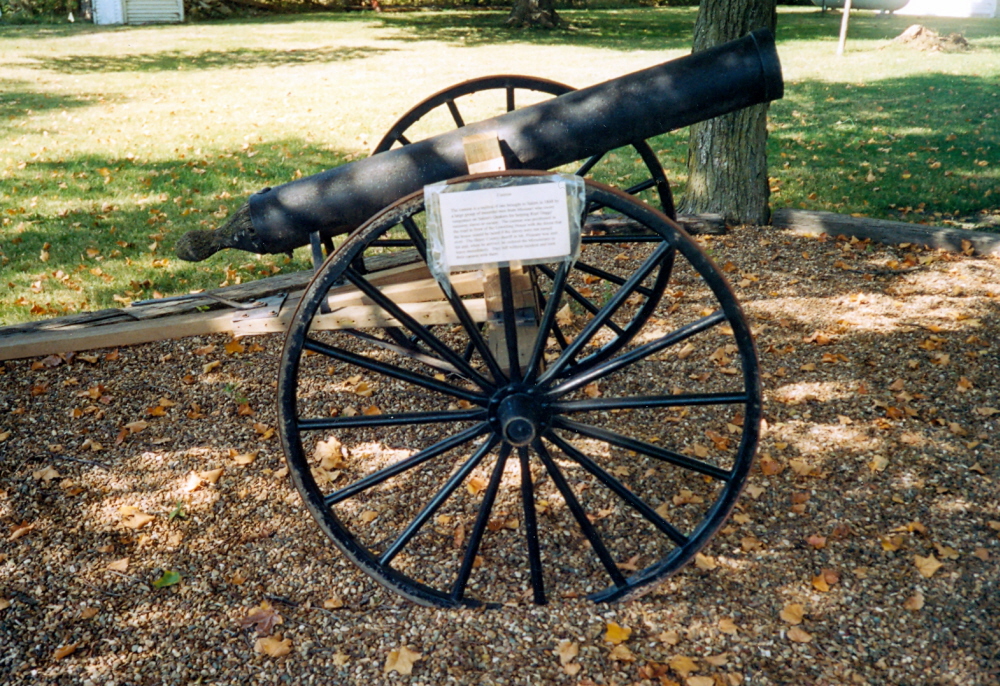
The sign on this replica Civil War canon explains why it is located in a picnic area south of the Lewelling house, but I failed to note what it said.
Note: Jean Leeper’s wonderful Web site entitled “Lewelling Quaker Museum” was the source used for some of the information here and was used to fact check other information. If you’re at all interested in Salem’s history, early Iowa Quaker history or the Underground Railroad in southeast Iowa, don’t miss it. This Web site also provided the photo of Henderson Lewelling.
An explosion that rocked the Whitebreast Creek valley and killed four south of Newbern on April 1, 1893, reportedly was heard for miles --- and we still talk of it sometimes, especially when visiting Mount Zion Cemetery, a lovely place on a bluff above the Whitebreast where the victims are buried beneath a unique tombstone.
The victims were Henry McKinnis, 51, and his three eldest children: John, 19; Henry Jr., 12; and Billie Ted, age 10. The source of the explosion was the stationary steam engine used to power a portable sawmill that provided the family livelihood. And Henry was probably to blame --- although all who were there at the time of the blast were killed. Impatient and apparently careless in maintaining and operating the boiler, it is believed he instructed son Henry Jr.to climb up and pour a bucket of cold water into a hot, dry boiler --- resulting in a blast that blew the boy to bits and killed the three others.
Mount Zion also contains the remains of another Lucas County sheriff shot and killed in the line of duty. My next goal is to update that post.
+++
I've been watching the mass (peaceful) demonstrations this weekend in Madison, Wisconsin, resulting from Republican Gov. Scott Walker's plan to eviscerate the collective bargaining rights of public employees. The Saturday crowd reportedly reached 70,000. And Democratic senators have fled the state to prevent quorum and stall legislative action. Another example of that tactic I can call to mind happened some years ago in Texas. Texas-style politics have come to the Midwest, apparently.
Do you suppose Lucas County's native son, John L. Lewis (born Feb. 12, 1880 in the mining ghost town of Cleveland) is rotating in his grave over there in Springfield, Ill., where the family moved after leaving Lucas County and where his body was brought for burial? Lewis, you may recall, is a founding father of the American labor movement. If you didn't remember that, shame on you.
The idea that public employees (and everyone else for that matter) should be denied collective bargaining rights has long been an element of the GOP agenda and several other states now ruled by Republicans apparently are eyeing Wisconsin to see what happens.
I'm sure Iowa's public employees are targets, too. Gov. Terry Branstad's spokesman Tim Albrecht, for example, pulled out of his hat recently the false allegation that Iowa state employees make 47 percent more than comparable workers in the private sector --- a lie. They actually, as a rule, make less.
Albrecht pulled that figure out of hat during a somewhat tortured explanation of why his boss fell justified in continuing to double-dip --- collecting a $50,000 annual pension for past state service in addition to his current $130,000 salary --- while asking others for sacrifice. Interesting.
Chariton's D.Q. Storie house was built during the same year construction of the Mallory family's Ilion began. Unlike the Ilion, the Storie house has survived.
I'm still trying to spend a little time every day in the basement of this blog with broom, scoop-shovel and scrub brush --- restoring order (when possible). And bringing old posts that some may find of interest to light.
Because of changes during the last seven years to Blogger, which powers this beast, the clean-up involves opening each post, doing some modest reformatting, reprocessing photos, integrating the photos into the posts they were intended to accompany, then killing off the separate posts each once occupied. If a post is of general enough interest, I'm then indexing it in the sidebar to the right of the main page here to make it accessible.
I'm also finding it necessary to update posts occasionally, add notes to reflect more recent occurrences and in some cases to correct misinformation.
Two others deal with fine old Chariton homes on the market when the posts were written but now in the hands of new owners, the Gibbon-Copeland house and the D.Q. Storie house.
You'll find a post about Brownlee Cemetery here. Brownlee is the oldest of English Township's three cemeteries. Among my family members buried there (in an unmarked grave) is a cousin, 7-year-old Alonzo Miller (son of Sylvanus and Adelia), who died in August of 1869 after being bitten by a rattlesnake.
There's also a post regarding Benjamin Franklin Bates, proprietor of Chariton's legendary Bates House hotel; a little bit about the Civil War monument up on the square that we're so used to we hardly see any more; and a little history of Mount Carmel Church, built on the Myers family farm in Benton Township.
Although it's been indexed for some time, this part of the blog also contains one its most interesting yarns --- an account of the July 1870 murder of Sheriff Gaylord Lyman and the subsequent dispatching of his killer --- thrown out of a courthouse window with a rope around his neck causing predictable results.
All of these posts and others have been indexed in the sidebar and I'm going to keep plugging away at this. Only six hundred and some posts to go!
+++
The weather map for north Iowa is a crazy patch quilt of green (flood warning), pink (winter storm warning) and blue (winter storm watch) this morning. The big danger up thataway is ice --- and while Iowans are up to just about anything in the weather department, ice is probably the most dreaded in winter.
Down here, the map's a reassuring brown --- with patches of green scattered around. That means we're in for a wet weekend and possibly snow on Monday. But ice is not predicted --- yet. Iowa is not an especially big state, as states goes, but there can be a good deal of contrast between conditions down here and up there. Sunday's predicted high in Chariton, for example, is 64; up at my old home in Thompson, the predicted Sunday high is 32.
After a day of highs in the low 70s nearly all the snow is gone and it felt for the first time like spring yesterday --- and it felt slightly wrong; as if the apocalypse were near. Not that it wasn't appreciated. But it's only mid-February after all.
Ice has receded from the shoreline at the marsh and is softening farther out; elsewhere, it's breaking up on the bigger rivers, causing jams and occasional flooding (George Flagg Parkway in Des Moines was closed for a time yesterday in fear a jam on the Raccoon would send the water up and over rapidly).
But it's good to be out again, even with wet feet and mud. Cooped up inside, I start taking myself and a whole bunch of other stuff way too seriously. A long walk is a good reminder that I'm not a centerpiece of the universe, nor among its crowning achievement --- just an element, significant for the most part because of the potential us pesky humans have to damage creation and our fellow critters.
+++
I like the rhythm of the seasons, or wouldn't live here. And the rhythm of the liturgical year, too. Easter is extremely late this year, on April 24 --- one day short of the latest date upon which it can occur.
That's probably a good thing from a practical point of view. We'll be serving a Shrove Tuesday (March 8) pancake supper as a benefit for the local food bank and that takes a certain amount of doing.
Providentially, Hy-Vee had a two-day special last weekend on link sausage --- $1 a crack for boxes of 12 (limit 10 boxes). So we all went to the grocery store (in truth, some went twice) and now the freezers are full. If there's a blizzard on the 8th --- we'll be eating sausage for a good long time.
+++
And then there was the game night in the parish hall last evening --- something we do occasionally. Pick an evening when some other group isn't using hall, then get together with popcorn and hot chocolate to play table games.
Isn't it amazing that we can still amuse ourselves without television, the Internet and other technological advances? The only part of this that seems unfair to me is that Marian, at 90 our oldest parishioner, always wins. Marian is a saint --- really, a genuine saint; you should meet her --- but if she'd taken up poker rather than other callings, she'd be a millionaire by now.
+++
The lectionary readings recently have brought us face to face again on Sunday mornings and at other times with those most inconvenient words from the Gospel according to St. Matthew --- a little something call the Sermon on the Mount.
Consider the total wrong-headed impracticality of this for example: "You have heard that it was said, `You shall love your neighbor and hate your enemy.' But I say to you, Love your enemies and pray for those who persecute you, so that you may be children of your Father in heaven; for he makes his sun rise on the evil and on the good, and sends rain on the righteous and on the unrighteous. For if you love those who love you, what reward do you have? Do not even the tax collectors do the same? And if you greet only your brothers and sisters, what more are you doing than others? Do not even the Gentiles do the same? Be perfect, therefore, as your heavenly Father is perfect."
Jesus Christ! Who does he think He is?
+++
I've spent two days in what I call the "hell hole," a storage closet under the back stairs of the LCHS Stephens House, and have the dust-fueled sneezes and sniffles to prove it. Decades of troublesome documents, books and ephemera that are impractical to display or too delicate to be handled on a regular bases have been stored here.
I'm trying to sort out everything other that the thousands and thousands of documents related to our rural schools before consolidation and move this stuff into the main museum building where it can be made more accessible.
Fascinating things turn up --- the blueprints for Russell's Woodman house, Woodman store and First Baptist Church, for example (extremely delicate, worn and torn by up to a century of use) in one instance; justice of the peace records from Liberty Township commencing in the mid-1850s and continuing into the 1880 --- similarly fragile --- for another.
"Turn up" is a little misleading. All of these items have been accessioned and catalogued --- just inaccessible under the back staircase.
And I've got to get back to the museum this morning and back to work. I purposely waited to tackle it until the curator went away for a week --- not wanting to cause her undue distress. But she will be distressed and the cleaning lady will have my head unless I deal with those piles now scattered all over the back parlor and dining room floors before Monday.
Zach Wahls, the young man from Iowa City whose defense of same-sex marriage went viral after his recent appearance before the Iowa House of Representatives, has now appeared on the Ellen De Generes Show. What an impressive guy (his moms and sister, too). Here's the YouTube version:
I'm interested in the fact that Zach and his family are members of the Unitarian Universalist Society of Iowa City --- makes a guy proud to be an honorary UU. That's a church I remember from college days when a (gay) friend taught Sunday school there.
I really enjoyed my time, later, as a UU --- now if they'd just consider the Book of Common Prayer, I'd consider ... Oh never mind.
Jackson Pollock's "Mural" on the walls of the Figge Art Museum in Davenport with Sean O'Harrow, now director of the University of Iowa Museum of Art, and Pamela White, former interim director, in the foreground (Lee Rosenbaum/Culture Girl).
Let’s face it: Most Iowans are members of the hell-Maude-I-could-do-that-with-spray-paint school of art appreciation when it comes to anything other than Norman Rockwell. Still, it seems a little extreme to force the Board of Regents to sell Jackson Pollock’s 1943 “Mural.”
That proposal gained momentum in the always-entertaining GOP-controlled Iowa House this week after approval 2-1 by a subcommittee that will move it to the full House and likely approval there . You just never know what these guys will get themselves up to when they take a week off from gay bashing.
“Mural,” considered by some to be the finest modern painting, period, was a 1951 gift of the late Peggy Guggenheim to the University of Iowa Museum of Art, intended as a learning tool for Iowa art students. Its current value is estimated at $140-150 million, making it perhaps the finest and most highly valued work of art in the state. It is entirely possible, should we decide to sell it, that the Guggenheim Foundation would mount a court effort to get it back.
Republicans have hatched the sale idea allegedly as a way to fund art scholarships but most likely as a way to take a slap at the University, Iowa’s finest (fair disclosure --- I’m a double-dip alum). Republicans tend to favor Iowa State, in Ames, where students still must dodge cow pies as they polka around the campus. And where Norman Rockwell is king.
Sale of the Pollock came up in 2008, too, proposed then by quixotic Regent Michael Gartner after Iowa River flooding devastated the U of I arts campus (the Museum of Art still is years away from reopening; the Pollock and other works, on display at the Figge Art Museum in Davenport).
Governor Branstad has taken the sort of insightful and well-informed stand on the issue that we’ve come to expect from him: “I really haven’t researched that,” he reportedly said. “I’ve heard there are different view points on that and I really haven’t taken a position on that.”
Democrats are likely to derail the proposal in the Senate as the few Republican lawmakers who are secretly appalled by the excesses of their dim-witted fellow partisans run for cover, hoping not to be noticed.
+++
For diversion on Monday, another Iowa House subcommittee cleared the way for consideration of a bill that would grant full personhood rights to fertilized eggs (human, not the sunnyside-up variety). The target here is Iowa’s middle-of-the-road laws regulating abortion. Again, Senate Democrats are likely to derail it.
Over in South Dakota, a proposal cleared last week by the House Judiciary Committee there that would have made homicide in defense of a fertilized egg justifiable has been put on hold, probably a good thing when you consider the potential for mass slaughter outside the womb.
Now I’m fine with abortion debates, so long as they’re open only to women. And whatever they decide is fine by me. But I’ve never understood why anyone would even listen to what a person with a penis has to say on the issue. Oh --- I forgot --- sexual assault both actual and virtual is a man thing.
+++
My favorite exchange came in the Senate during discussion of Iowa’s preschool program, which Ottumwa Republican Mark Chelgren compared to Nazi, Soviet and Chinese Communist indoctrination. As it turns out, he really didn’t mean exactly what he said --- or so he says --- and actually has enrolled all four of his own children in preschool programs.
+++
Although Iowa lawmakers have taken a break from attempts to make adultery a purely heterosexual pastime, there has been activity elsewhere.
Civil union legislation cleared the Hawaii senate Wednesday and now goes to the governor for expected signature. The California Supreme Court prolonged the Proposition 8 wrangle there when it agreed to decide if proponents of it may defend it in federal court, something the state has declined to do; and the chances appear to be improving in Maryland for legislation allowing same-sex marriage.
Over in Indiana, the Legislature gave first-round approval to a constitutional amendment to ban same-sex unions --- and so it goes.
In Britain, it is likely now that the government will allow (but not require) civil unions --- including same-sex unions --- to be performed in houses of worship (keep in mind, the government controls the church there, if it chooses to do so); and is giving strong consideration to removing the legal distinctions between civil unions and same-sex marriage for LGBT people.
Some years ago, I followed the threads of the underground railroad in Iowa to Lewis, located almost due east of Council Bluffs in southwest Iowa's Cass County, and wish I'd followed up on the interest I had then so that I knew more now. Especially since Lucas County's underground railroad role, if any, has never been adequately explored. That's the great challenge of life --- so many things to you'd like to know more about; so little time to do the research and reading.
But southern Iowa, because of its proximity to the border of Missouri, a slave state, was in those years prior to and during the Civil War a hotbed of underground railroad activity as slaves managed to escape their masters down there and slip across our border. Because of activist Iowa judges, all men and women were by default free once they set foot on Iowa soil.
Also because of our proximity to Missouri, however, those now-free men and women were not safe from raiders and slave hunters until they had been spirited farther north. Those who aided them also were subject to federally-imposed penalties under the fugitive slave act of 1850 and that combined with a good number of southern Iowans who were southern sympathizers made secrecy necessary.
The Rev. George B. Hitchcock, whose home is carefully maintained now at Lewis, was one of the state's leading abolitionists and his fine stone house, a station along the underground railroad.
Hitchcock was born in Massachusetts during 1812 and moved west through Illinois to Iowa, arriving in Scott County along the Mississippi in 1841. He felt the call to the Congregational ministry, was tutored in that calling at Fairfield (where his parents had settled and his father, David, is buried) and was ordained during 1844 in the Congregational Church at Bentonport --- a fine old building that now is gone.
Congregationalists and Quakers were at the forefront of Iowa's abolitionist and underground railroad movements
Now affiliated with the Congregational American Home Mission Society, he served callings in Oskaloosa (1844-48) and Eddyville (1847-53) before moving west to Lewis, He was a jack of all clerical trades --- missionary, evangelist, organizer of congregations and pastor serving broad areas centered on the town where he established his family's home. Ministers at that time also were expected in many cases to farm in order to help support their families, and so he did that, too; and also picked up skills as a stonemason.
The Hitchcock family moved to a cabin on this hill west of the East Nishnabotna River in Cass County overlooking the river and the emerging town of Lewis, in 1853. Soon thereafter, he conceived the idea of building this unusual stone house, completed in 1856. He reportedly helped quarry the standstone east of the Nishnabotna, raft it across the river and haul it up the slope to the building site.
The basement of this house is generally thought to have been the place were former slaves were concealed, and the entrance to one of its two rooms reportedly could be concealed if danger threatened. A fireplace in the other basement room may have provided warmth.
The Hitchcocks remained in this home until 1865, when George felt called to minister to newly-freed slaves in Missouri and moved to Kingston. Still following that call, he moved in 1869 to the neighborhood of Baxter Springs in extreme southeast Kansas, but died there on Aug. 4, I872.
The Hitchcock home at Lewis served as continuously occupied farm home until 1966. During the next 20 years, when it stood empty, structural problems developed and the building was heavily vandalized, but Lewis-area residents and others pulled it back from the edge of collapse.
Today, the site is owned by the state but managed by Cass County Conservation and operated by volunteers affiliated with several organizations. The Hitchcock House has a simple Web site that can be accessed here.
This elaborate wrought iron frame in the side yard of the Hitchcock House may (or may not) mark the gravesites of a Hitchcock son who died at age 19 in a shooting accident and a young girl who died along the Mormon Trail. The location is traditional, but unconfirmed.