
Wednesday, May 31, 2017

Sanborn maps and the Hickman Block


I was really happy the other day to learn that the Library of Congress had started digitalizing and placing online its collection of Sanborn Fire Insurance Maps, including the three earliest series from Chariton --- 1883, 1893 and 1899.

These large-scale maps of the business districts, industrial zones and some residential areas of thousands of U.S. cities large and small were produced between 1867 and the mid-20th century for the benefit of fire insurance companies and underwriters.

Since Mary Stierwalt has been sharing via Facebook history of the shoe stores, including her own Family Shoe, that have occupied the south half of the Hickman Block (above) since it was built on the east side of the Chariton square during 1894, I thought it might be fun to use Sanborn maps to show how the east side of the square developed between 1883 and 1893.

Attorney Stephen D. Hickman built the Hickman Block during 1894 after a fire had damaged earlier frame buildings on the site. When this photo from the Lucas County Historical Society collection was taken shortly after the building had been completed, the Hickman law offices occupied the north suite of offices upstairs and W.B.E. Lusk, a tailor, rooms to the south. Weiford Shoe Store --- now Family Shoe --- occupied the south side of the first floor; Alexander & Co., Grocers, the north half.


Here's how the east side of the square looked in 1883. Pink, on these maps, indicates that a building was constructed of brick; yellow, of frame. I've labeled the two frame buildings that sat then on the site of the Hickman Block. Note that both were grocery stores. The only brick buildings on the east side of the square at the time were in the north half of the block --- the Gibbon Drug Store at the far north end, the Mallory & Law Block immediately to the south and what now is the pet shop (the oldest building still standing on the square), just north of the alley. "Mill'y & Notions" on these maps is an abbreviation for Millinery and Notions.
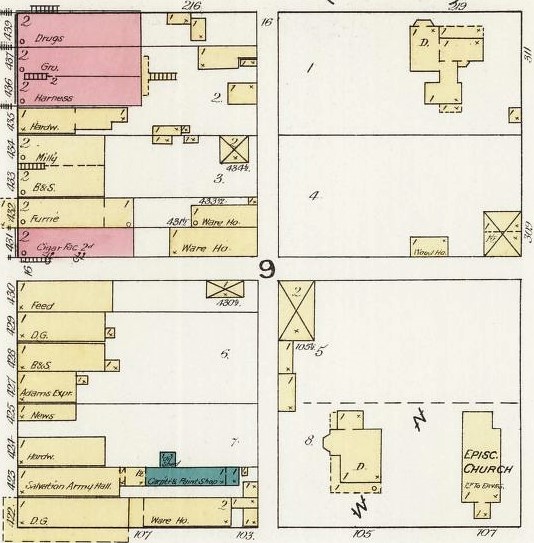

Ten years later, the east side of the square hadn't changed that much. The surprise (to me at least) here was that a one-story frame building on the north half of the current Eikenberry-Crozier Block site was at the time a Salvation Army Hall.


There was a major building boom on the east side during 1894, evident in this map from 1899. With one exception, the north half of the east side now was entirely brick and the Eikenberry-Crozier Block now formed the south end of the block

The "B&S" label on the south half of the new Hickman Block means "boots & shoes." A plumbing and bicycle shop occupied the north half of the building. Note the "Public Library" label on the Gibbon Drug building --- by now the Chariton Free Public Library had found its first home upstairs.

If you're interested in taking a look at the three series of Sanborn maps for Chariton (or maps from any other city for that matter, although the Library of Congress so far has moved only a small fraction of its collection online), follow this link to the Sanborn Maps Collection page, click on "Collection Items," navigate down the left side of the page to "Location" and select "Iowa," then scroll until you get to Chariton.

The State Historical Society of Iowa also has available online a larger selection of Sanborn Maps, including 1907, 1913 and 1927. In order to access that collection, however, you have to apply for and receive an Iowa Library Serivces Card and sign into the web site with a 14-digit identification number. 

The Sanborn maps are not protected by copyright and may be downloaded in various formats from the Library of Congress site --- but not from the Iowa site.

Here's how an entire map sheet --- one of two --- from the 1883 Chariton collection looks. For more detail, right click and open in a new window. Remember that Chariton streets had different names in 1883, so don't be confused by that.


Tuesday, May 30, 2017

Dedicating Lucas County's Veterans Memorial Park


 Memorial Day turned out to be just perfect in Chariton for dedicating a park --- the new Veterans Memorial Park on the former county jail site just northwest of the post home of Carl L. Caviness American Legion Post No. 102.

This I suppose is my favorite photo, taken as a Burlington Northern & Santa Fe coal train played its part --- punctuating the ceremonies as an active duty Marine and a Marine veteran waited to unveil one of five benches commemorating the five branches of service.

Trains have been rolling past this site in precisely the same location since 1867 carrying among other things service personnel to and from their duty stations and supplies for the nation's war efforts so its appearance was entirely appropriate.


A terrific crowd was on hand early for the event.


U.S. Sen Joni Ernst (R-Iowa) and U.S. Rep. Dave Loebsack (D-Iowa) were seated in the shade.


Active duty personnel from the U.S. Army, U.S. Navy, U.S. Marines and U.S. Air Force were on hand to do their part.


And a Chariton High School brass quintet, led by band director Daniel Scheetz (center; yes I know he has his eyes closed) were there to provide appropriate music.


The indefatigable Earl  Comstock (right), who has spearheaded the park effort for Legionnaires and others, was present to narrate the program and Tony Irving, to sing the National Anthem.

Pastor Brenda Crossfield, of First Lutheran Church --- headed off now to a new assignment at Decorah Lutheran Church --- performed her last official acts in Chariton while delivering the invocation and benediction.


And Boy Scouts led the Pledge of Allegiance before the principal speakers were introduced.


Loebsack was first.


Then Ernst, the keynote speaker.


As the brass quintet played music appropriate to the branch of service, the five benches were unveiled. Army and Air Force were on the opposite side of the park.


But I was able to trample enough people to take a few shots as active duty representatives and veterans unveiled the Navy bench.


And the Marine bench.


Active duty Coast Guard personnel couldn't be present, so the Navy stepped in. Coast Guard veterans are a rare thing in Lucas County, but the late Dwight Vredenburg was one and so his son, John, represented him as the bench representing this branch of service was unveiled.


Finally, Daniel ended the service with "Taps."

A lot of work on the park --- and fund-raising --- remains to be done. When complete, for example, a heavy-duty decorative fence will separate the park from the railroad right-of-way. But Sunday's dedication capped a tremendous effort to date --- and was a lovely way to spend Memorial Day afternoon.

Monday, May 29, 2017

With Oshea Strain at St. Mihiel American Cemetery

St. Mihiel American Cemetery, Thiaucourt

As noted yesterday when writing about Pvt. Fred A. Culbertson, two young men of the 26 native to Lucas County who gave up their lives during World War I remain buried in France. The other is Pvt. Oshea J. Strain, born in Otter Creek Township, who rests with 4,153 of his comrades at St. Mihiel American Cemetery, Thiaucourt, some 180 miles east of Paris.

Oshea, when he filled out a draft registration form during June of 1917, gave his date and place of birth as Dec. 5, 1893, in Lucas County. But the death of his mother, Lizzie Jane (Terril) Strain, when he was 14, caused the family to scatter --- and so we don't know that much for sure about the young man.

He was living with his parents and siblings on a farm in Otter Creek Township when the 1900 federal census was taken. The family, headed by George R. Strain and Lizzie Jane, included three children --- Ira M., born during August of 1887, Oshea, and Amy Louise, born during December of 1898. George, 47, was a son of Levi and Louisa Strain, who brought their family from Illinois to the Lacona area during the early 1870s; Lizzie Jane, a daughter, of John Marlin and Martha E. (Ashton) Terril, of Marion County.

One entry on that census record confuses the issue of parentage. Census-takers asked during 1900 how many years couples had been married. George and Lizzie replied, six. Mothers also were asked how many children they had given birth to and how many of those were living. Lizzie replied, four children, three of whom were living. If these entries are taken at face value, Lizzie Jane could not have given birth to Ira and Oshea during her marriage to George. I can't find a marriage record for this couple, so haven't been able to sort this inconsistency out.

Whatever the case, George, Lizzie and the children moved from Lucas County not too long after 1900 to Hamlin County, south of Watertown in northeast South Dakota. Lizzie died there on July 10, 1907, when Oshea was 14, and was buried in Zion Cemetery near the little town of Hazel.

When the 1910 census was taken, Oshea, age 16, and the widowed George were living with the Baxter Edson family in Hamlin County and working as farm hands. It's unclear where Ira and Amy were by this time. That fall, during September, George remarried --- to Martha J. Patrick --- and they moved eventually to California, where he died during 1925. But circumstances suggest that George was not especially involved in the children's lives after that marriage.

During 1917, when Oshea registered for the draft at age 23, he was working as a "common laborer" for the Northern Pine Crating Co. in Cass Lake, Minn. Ira, who also registered for the draft that year, had settled down in Watertown, South Dakota.

Both young men named their Terril aunts and uncles in Lucas County as next of kin when drafted --- Oshea, his uncle William White Terril, then farming near Oakley; and Ira, Rebecca (Terril) Eaton --- wife of James R. --- who had recently moved from Oakley into Chariton. 

Ira made it safely home from the war, married a Lucas County girl --- Odessa Blue --- and lived out the remainder of his life in Watertown.

Oshea was assigned to Co. L, 360th Infantry Regiment, 90th Division, which trained in Texas and then sailed from New York City to France aboard the Mauretania during July of 1918. On the 10th of August 1918, not long after arrival, he died of disease --- most likely influenza --- age 24, while somewhere in eastern France with his unit.

Newspapers across America published lists of the American dead throughout World War I and Oshea's name appears among those who "died of disease" on those lists. But so far as I know his death was not reported individually --- nor did an obituary appear --- in any of the places where he had lived during his short life, including Lucas County.

The St. Mihiel American Cemetery was established during late September 1918, as a burial place for those Americans who died during the Sept. 12-15 Battle of Saint-Mihiel, then developed into a permanent cemetery --- now maintained by the American Battle Monuments Commission --- after the war.

At that time, the remains of other Americans who had died in the region --- including Oshea --- were relocated there if their families had requested permanent interment overseas. This probably was a decision made by William Terril, as next of kin, in consultation with Oshea's two siblings. And so, a young man who had roamed widely found a permanent home with 4,153 comrades at this beautiful place in France.

Sunday, May 28, 2017

For ever Lucas County at the Oise-Aisne Cemetery

Oise-Aisne American Cemetery/American Battle Monuments Commission
The legacy of English poet Rupert Brooke (1887-1915) includes a lovely sonnet entitled "The Soldier" that opens, "If I should die, think only this of me: That there’s some corner of a foreign field that is for ever England."

Something similar could have been written, too, about the United States --- some 30,000 of its sons who died in service during World War I rest in American cemeteries overseas, meticulously maintained still, as Memorial Day 2017 approaches, by the American Battle Monuments Commission.

These honored dead include two Lucas Countyans, Pvt. Fred A. Culbertson, whose remains are buried at Oise-Aisne American Cemetery, Seringes-et-Nesles, and Pvt. Oshea J. Strain, at St. Mihiel, Thiaucourt.

Twenty-six Lucas Countyans died in service during what then was known as the Great War and the remains of 24 were repatriated after the war had ended. They all are buried now in Lucas or adjoining counties.

Family circumstances, however, led to decisions that resulted in permanent interment in France for for both Culbertson and Strain. It would be an error to suggest that they were "left behind."  They are buried with comrades in what are among the most breath-takingly evocative memorial sites on the planet.

+++

Pvt. Culbertson, like more than half of America's World War I fatalities, died of an illness rather than a wound --- and curiously, he never set foot while living on the soil of France in which he is buried.

Fred was born near Chariton during 1895, son of Will and Hattie Culbertson. His father, who served as county treasurer, went on to a career in banking and was cashier of Chariton National Bank at the time of his death during 1905 at age 46, when Fred was 10, of cancer. Fred's older brother, Leonard, had died horribly the year before at age 12 after he poured kerosene onto live coals in the kitchen range, resulting in an explosion and flames that killed him. That left Fred, his brother, Charles, and sister, Mae, in the care of their mother.


Fred was extremely popular and a football standout prior to his graduation from Chariton High School with the class of 1914. He was a member of the 1913 South Central Iowa Championship football team --- at far right in the back row of this photograph. When Fred died, four other members of this team were in uniform --- Maceo Richmond and Earl Lowe, standing shoulder to shoulder at the other end of the back row; Kirk Jones (captain), second from right in the second row; and  Dayton Piper, second from right in the front row.

A failed business venture (a livery stable just northwest of the square) and a failed marriage followed high school, however, and by 1918 --- when he was drafted --- Fred was living in Story County and working for a cousin who owned a farm there.

Assigned to the Veterinary Medicine Detachment of the 605th Engineers, Fred set sail for France with his unit aboard the George Washington from Hoboken, New Jersey, on Sept. 30, 1918. A few days later he came down with influenza and on Oct. 9 died aboard ship of pneumonia, one of its complications.

He was not buried at sea, as one of his two Find A Grave entries states, but instead his remains were delivered to U.S. military authorities soon after the George Washington docked and placed in a temporary grave nearby.

Fred's mother did not learn of his death until late October and World War I had ended by the time memorial services were held at Chariton's First Presbyterian Church on Sunday evening, Dec. 8. Here is a report of that service from The Herald-Patriot of Dec. 12:

+++

A memorial service in honor of Fred Culbertson was held at the First Presbyterian church Sunday evening and was largely attended. The church was decorated for the occasion with flags. Special music was rendered by the choir and a splendid sermon was delivered by the pastor, Rev. Chas. W. McClelland. The blue star on the service flag was changed to a gold one, the change being made by Walter Scott, of Montana, who was recently discharged from the military service. Mrs. Culbertson was presented with a beautiful bouquet of flowers by the ladies of the church. The following biography of the deceased was read:

Fred Aurelius Culbertson was born three miles north of Chariton on the 8th day of March, 1895, and died of pneumonia, on board ship on his way to France, aged 28 years, 7 months and 1 day. When Fred was nine months old his parents moved to Chariton, where he lived until two years ago, when he went to Ames to assist his cousin, Mr. Lou Champlin, on the farm. He attended the grade schools of Chariton and was graduated with the class of 1914 of the local high school in which institution he was a leader in all student activities.

In addition to Fred, the following members of his class are wearing the uniform: Earl Lowe, in France; Dayton Piper, Great Lakes; Harold Brightwell, 339th band; Ralph McCoy, 339th; Leland Howard, motor truck company; Joseph Wright, lieutenant in France; Kirk Jones, France; Maceo Richmond, lieutenant in France; Dean Bown, in Navy.

At the age of 14 he united with the First Presbyterian church, where his membership was at the time of his death. He was of a genial, pleasant disposition and won many friends who learned with deep regret of his sudden leaving. Beside the mother, he leaves to mourn his absence a brother, Charles, and a sister, Mae, both of Chicago; a baby sister and a brother,Leonard, and his father having preceded him in death.

He was called into the service of his country early in the summer but was granted an extension of time in order that he might save his mother's life by giving of his blood for transfusion. When his mother was well on the road to recovery he left, August 28th, for Camp Forest, Georgia. Here he soon passed his overseas examination and was transferred to the Medical Veterinary department, 605 Engineers. He was then sent to Camp Upton, N.Y., from which place he sailed for "somewhere in France" Sept. 28. Nothing more was heard from him or concerning him until October 28th, when a telegram came telling of his death at sea on October 9th. The body was taken charge of my the military authorities and now lies at rest somewhere beneath the blood-stained soil of France. (Dec. 12, 1918)

+++

Less than a year after Fred's death, his mother, Hattie, died at age 53 at Methodist Hospital in Des Moines of the chronic illness that had plagued her for several years. Her death probably was the principal reason the surviving children, Charles and Mae, decided to have their brothers' remains permanently interred in France rather than bringing them home to Chariton, where by this time neither was living.

The Oise-Aisne American Cemetery had been established during August of 1918 by the 42nd Infantry Division as a temporary battlefield cemetery. Congress authorized its retention as a permanent cemetery during 1921. It is the second largest of the eight American World War I cemeteries on foreign soil. Meuse-Argonne, with 14,246 burials, is the largest.

A majority of the 6,012 war dead buried at Oise-Aisne, including 597 unknowns, died fighting along the Ourcq River and in the area between the cemetery and the Oise River during the Aisne-Marne Offensive and the Oise-Aisne Offensive.

During 1922, however, the remains of many other American servicemen who had been buried during the war west of Tours-Romorantin-Paris-LeHarve, including those of Pvt. Culbertson, were disinterred and reburied here if their families has requested permanent interment overseas.

And so a grave-size plot of French soil here remains forever Lucas County.

Tomorrow: Pvt. Oshea J. Strain at St. Mihiel.

Saturday, May 27, 2017

Pvt. Roy B. Tickel's homecoming

Approximately 116,000 U.S. troops gave up their lives while in service to their country during World War I, more than 80,000 of them in the European theater of operations. Of the total, some 53,000 were killed in combat; the balance felled by disease and other causes.

Lucas County's Roy B. Tickel, a private in Co. C, 59th Infantry, was among the latter. One of 11 children of John and Luella (Hodson) Tickel, he died of influenza on Nov. 26, 1918, in France, and was buried nearby, at Clermont-Ferrand. Born in Liberty Township, he was 28 and had been working as a farm hand for his father before he was drafted. This tiny and badly faded photograph from the Lucas County Historical Society collection is among the few reminders of him. There is no indication of when or where it was taken.

Today, Roy's remains rest in the Newbern Cemetery, where he shares a tombstone with two brothers, Charles F. and Theodore M., both of whom died in Lucas County during 1920, many months before his remains were brought home to join theirs during December of 1921, more than three years after his death.

Roy's parents had been notified of his death by telegram, then some months later the following form letter arrived at their home, giving a few details about the disposition of his remains.


After the war was over, work began in France to register the graves of all the U.S. fallen and to relocate the remains of those buried hurriedly near where they fell to newly established American cemeteries. 

During October of 1919, the U.S. War Department announced that it would offer families of the fallen the option of having the remains of their loved ones returned to the United States for burial and "ballots" were sent to the families of the 80,000 whose remains had been located, so that they could choose.

Although this was what the people of the United States wanted, it was not a popular decision among U.S. allies. The British, with more than 700,000 dead to deal with, were appalled. The French, who considered the prospect ghoulish, placed a three-year ban on the removal of bodies.

During late 1920, however, the French lifted their ban and work began. Approximately 46,000 American families had opted for repatriation while some 30,000 had expressed their wishes that the remains of loved ones be interred in one of the new American cemeteries in France.

At some point during the later stages of repatriation, the Tickels received this small folder which contains a snapshot of Roy's original grave in France and the name of the cemetery, Newbern, where his remains were to be reinterred.


Roy's remains arrived at the depot in Chariton during late December and they were buried in the Newbern Cemetery on Dec. 21, 1921.

Roy's mother was present for the homecoming, along with eight surviving siblings. John Tickel, however, had died on Aug. 9, 1920. Luella died a year later at her home in Chariton on Nov. 5, 1922, and joined her husband and sons in the Newbern Cemetery.


Friday, May 26, 2017

In Flanders fields (and the museum garden) ...


Just a few flowers from the museum gardens this morning as standard iris and peonies fade --- just a few days ahead of Memorial Day when, years ago, those who decorate graves would have hoped to gather them by the armful on the mornings of annual treks to the cemeteries.


But we're left with roses.


And the smaller but intensely colored Siberian iris (Iris sibirica). A stately white variety will be along in another week or two.


And the poppies are beginning to bloom.


Big floppy ones at the top of the hill.


And at the far end of the vegetable garden, where they've reseeded themselves, more compact varieties.


Look into the center of these poppies and you'll see something remarkable.

And a reminder of John McCrea's evocative poem from the Great War:

In Flanders fields the poppies blow
Between the crosses, row on row,
That mark our place; and in the sky
The larks, still bravely singing, fly
Scarce heard amid the guns below.

We are the Dead. Short days ago
We lived, felt dawn, saw sunset glow,
Loved and were loved, and now we lie
In Flanders fields.

Take up our quarrel with the foe:
To you from failing hands we throw
The torch; be yours to hold it high.
If ye break faith with us who die
We shall not sleep, though poppies grow
In Flanders fields.

Thursday, May 25, 2017

Memorial Day in a time of war

Lucas County Historical Society collection.
Charles F. Wennerstrum --- district court judge, Iowa Supreme Court justice and a presiding judge during the Nuremberg Trials --- was one of Lucas County's most distinguished jurists.

Also a veteran of World War I, Judge Wennerstrum --- then in his mid-50s --- sat down during May of 1945 to write a guest editorial headlined "Memorial Day --- 1945" for The Herald-Patriot, published in its May 31 edition.

At the time the world was suspended between V-E Day, May 2, which had marked the end of World War II in Europe, and V-J Day, Sept. 2, the date of Japanese surrender.

Take a moment to go back more than 60 years, now, and read his words:

+++

We observe Memorial Day in 1945 with mixed emotions. The cessation of the war in Europe has brought our country a feeling of subdued satisfaction that part of our war tasks is completed. We are all conscious of the fact that the responsibility for the successful conclusion of the war with Japan still is our further obligation. Our job is only half done.

The quiet observance of V-E day gave evidence of the fact that all of us have been touched by the stark realities of the ravages of war. There is hardly a family that has not been affected. And so on Memorial Day in 1945 all of us have particular reason to pay solemn homage to those men and women who have made the supreme sacrifice in the European and Japanese wars. In paying honor to those who have given their all for their country during these later conflicts we are not unmindful of the sacrifices made by many in World War I and the other armed conflicts in which our nation has been involved.

Memorial Day is by its very name a day of memories. It is a day when we give official recognition to the memory of those of the armed services of all wars who have passed to the great Beyond. Although it is primarily a day of memories it is, and should be, a day of dedication. If our memories are purposeful we must dedicate our efforts to the completion of the tasks for which others gave of their lives and efforts in the present and past wars. If we do not make it a day of dedication and high resolve, the observance of this day is a mere formality.

We must seek to gain from this day an inspiration to carry on the work that they who sacrificed left unfinished. The growth of freedom in all nations, the care of the oppressed, the aid to under-privileged children, and last but not least, the care of those ravaged by battle conflict in mind and body is the responsibility of the living. This is our duty to which we should dedicate our efforts. To this task on each Memorial Day we must ever realize that except by our dedication to complete the work they began, the sacrifices of our dead heroes will have been in vain.

The American Legion and other veteran organizations have been organized to carry on the work so sacrificially began by those that gave their all. It is not alone the task of members of these organizations. It is the responsibility of all citizens. Let us all be mindful of this responsibility.

+++

Judge Wennerstrum arrived in Chariton during 1915, a year after earning his law degree from Drake University, then headed off to war two years later. Upon his return, he served as county attorney and, during 1930, was appointed judge of Iowa's Second Judicial District, then was elected to two full terms. In 1940, he was elected Iowa Supreme Court justice and continued to serve in that position until 1958. He also served two full years --- in six-month increments --- as chief justice.

President Harry S. Truman named Wennerstrum a Nuremburg Tribunals judge during 1947 and he served in that capacity until February of 1948 when he returned to Chariton with his wife, Helen, and daughter, Joann, and resumed his seat on the Iowa Supreme Court bench.


After retirement from the bench, he entered private law practice in Des Moines and moved there from Chariton during 1959. He died in Des Moines on June 1, 1986, age 96, and his remains were returned to Chariton for burial beside his wife and son, Roger.

+++

Memorial Day was moved during 1971 from its traditional date, May 30, to the final Monday in May, tagged onto the end of a three-day holiday weekend. Perhaps that's made it more of a challenge to remember the founding purpose of the day.

It was not established as a day to celebrate the return of summer --- or principally to decorate the graves of  all our deceased family members and friends. It isn't a day to honor all veterans (that's Veterans Day, Nov. 11) nor is it a day to honor those currently serving in the armed forces (that's Armed Forces Day, the third Saturday in May). And "Happy Memorial Day" just isn't an appropriate greeting.

It remains a day of solemn remembrance and rededication. As Judge Wennerstum put it, "To this task on each Memorial Day we must ever realize that except by our dedication to complete the work they began, the sacrifices of our dead heroes will have been in vain."

Wednesday, May 24, 2017

A little courthouse history ...


Here's the little essay I put together to remind myself Monday of what to say about Lucas County's courthouse history as the restored tower clock was rededicated on its 123rd birthday. There's nothing really new here; just a summary of significant dates with a few details thrown in for good measure.

+++

Lucas County has had a courthouse park since the original town was platted during the fall of 1849, but the first courthouse was built on a lot on the east side of the square, just south of the alley. The county had absolutely no money --- the county commissioners had to borrow from a private citizen to purchase the Chariton town site. The first courthouse was paid for from the revenue that resulted from the first sale of town lots.

This was an 18-foot by 22-foot story and a half structure constructed of hand-hewn oak logs, ordered up by the county supervisors during April of 1850. According to their directions, there were to be two hand-made walnut doors facing what now is North Grand --- one into the first-floor room and the other, up a flight of exterior stairs to a platform in the front of the second story --- and five windows, three on the first floor, two on the second. People were shorter during the 1850s, but even so, the second floor had a head-crunching low ceiling in places.

During May of 1850, Beverly Searcy’s bid of $374 for construction was accepted by the supervisors and the building was completed during October. During 1851, the first-floor courtroom was furnished with 16 benches made of hewn and split linden logs with oak legs pegged in --- and a “pulpit.”

During most of its useful life, this was the only large public meeting space in Chariton so in addition to sessions of county court, everything from church services to dances were held here, too. There were very few county records to store so no need for vaults; and most county officials conducted business out of their pockets --- no real need for offices.

+++

During June of 1858, Lucas County voters approved construction of a new brick courthouse, to be located on the spot where our current courthouse stands. Everything about the process appears to have been very casual --- or careless if looked at another way. 


A construction bid of $13,500 submitted by W.T. Wade was accepted and work began, using brick fired down on the Chariton River bottom south of Salem Church and hauled into town by ox-drawn wagons. Ethan Gard, county judge, supervised the process. Some alleged that he made up the plan as the building progressed. The building was first occupied, although still incomplete, during 1860 and its cost, which soared to about $23,000, came close to bankrupting the county.

Despite all its issues, this was a beautiful 60-foot-square brick building topped by a big cupola containing a bell that soared above a hipped room. There were four offices divided by cross-halls on the first floor; two more offices and a big courtroom on the second. There were no vaults --- not enough county records to justify them when the courthouse was built, so these were added in the east-west cross halls at a later date. The court room continued to serve as Chariton’s major assembly room and, in order to generate income, some of the offices were rented out to lawyers and newspapermen.

This was the building that saw more than 800 young men from Lucas County march off to serve during the Civil War and, during July of 1870, the unfortunate Hiram Wilson was thrown out a second-floor window with a rope around his neck after having shot Sheriff Gaylord Lyman dead.

The building had a huge problem, however. Its foundation consisted of log beams laid down atop wood pilings, far less than the support needed by heavy brick walls. Almost immediately, those walls began to settle and crack and as the years passed, more and more iron rods were inserted to hold the structure together. Finally, during 1891, the Lucas County grand jury ordered that the building be abandoned, county offices were evacuated to commercial buildings and the courthouse was torn down during February of 1892, just 32 years after it had been completed.

+++

During August of 1892, Lucas County voters approved a bond issue of $60,000 to construct our current courthouse. Bids were let during October, foundation work began immediately and the cornerstone was placed on May 25, 1893. County officers occupied the new 70-foot by 90-foot building, constructed of brick and Berea limestone in the Romanesque revival style, on Feb. 26, 1894. This time, estimates, bids and actual expenditures tallied and the courthouse was built and furnished for $59, 670.


Although the courthouse tower, which soared to 140 feet, was built as planned, no provision had been made for the clock itself until Jan. 1, 1894, when Smith Henderson Mallory announced that he would provide one as a gift. He had admired the big clock in the Iowa Building at the Chicago Worlds Fair of 1893, which he was superintendent off, and ordered a similar one from the Seth Thomas clock works at Thomaston, Connecticut.

The new clock arrived in Chariton by train during February and was duly installed in the courthouse tower, fine-tuned and tested. This building was dedicated officially 123 years ago --- on May 22, 1894, and this clock --- whose restoration was are celebrating this spring --- was fully wound and set to running for the first time on that day as well.

Tuesday, May 23, 2017

Climbing the tower of Lucas County


The bonus after yesterday's rededication of the restored courthouse clock --- 123 years to the day and hour after it started running at 10 a.m. on May 22, 1894 --- was a chance to visit our collective timepiece in its tower home.

First, however, we listened as the big tower bell chimed 10 o'clock, then Steve Laing, county supervisor who led the restoration drive, thanked everyone involved --- committee members, others who had helped out, Rory DeMesy of Minneapolis who did the restoration work and, especially, the generous donors who made the project possible. I talked a little about Lucas County's courthouse history, commencing in 1850; then it was time for cookies and coffee.


Steve then offered anyone interested a tour of the tower, an area of the courthouse not visited that often, and several of us accepted.


The ascent begins with this short flight of stairs, ending at a door, located just off the courtroom lobby on the top floor of the courthouse.


Beyond the door, the long flight of stairs doubles back on itself and climbs to a landing. Straight ahead at the top is the entrance to the courthouse attic, used for storage. To the left, a door leads into a low-ceilinged, windowless room.


This room is located just above the second-floor windows in the base of the courthouse tower, behind the carved stone that identifies the "Lucas County Court House."

As you're coming up the stairs, on your right, generations of people --- mostly students --- have engraved their names in black-painted plaster.


The clock pendulum descends through a slot in the ceiling and swings back and forth in this small room, guarded by new framing that also adds support to the floor of the clock chamber above. The big lead weights that are wound up, then descend to power the clock, travel in chutes built into the corners of this level of the tower.


The metal boxes, probably brought from the 1858 courthouse, contain county records that date at the least back into the 1860s and most likely always have been stored here.


It looks as if this low room originally was open, but has been subdivided and the area around the pendulum, now used for storage, insulated. The pendulum and weights, removed when the clock was electrified during the 1970s, were kept at the Lucas County Historical Society museum and returned to the county when the restoration project began.

The white door, just visible in the second photo above, leads through a newer wall to what once was an open staircase to the clock chamber immediately above. The workmanship on the stairway and other tower details is extraordinary, considering the fact this never was intended to be a public area.


This is a much shorter flight, climbing north along the tower's west wall into the many-windowed clock chamber.


Note that there are few if any cracks in the original plaster applied 123 years ago directly onto masonry in the tower.

The clock chamber, lighted on all four sides of the tower by large windows, is for the most part filled by an elaborate wooden case, entirely as originally built, that contains the Seth Thomas clockworks. There's just enough room around it for the stairs leading up to the chamber on the west and a narrow walkway around the north, east and south walls of the case.

The east windows look out on the courthouse's slate roof; the south windows, out across the finials on the west gable;


the west windows, onto the west side of the square;


and the north windows onto the north side of the square.


Because the clockworks case takes up much of the clock chamber, it's almost impossible to get a decent image of it. Although the case has never been altered, it has been "decorated" over the years with more of those messages scratched into the finish. The viewing window is in the north side of the case.


It is topped by a heavy cornice.


And this elaborate door into the case, which Steve is pushing a little farther open, is on the east side.


Here's how the beautifully refurbished clockworks look.


And here, you can see the pendulum swinging through its slot in the floor.


Rory DeMesy disassembled the clockworks and took them home with him to Minneapolis during March of 2015, then brought them home last November. Alterations made when the works were electrified during the 1970s had been removed, missing parts re-installed and the whole affair cleaned and polished to within an inch of its life. After that, the entire clock was reassembled in its original configuration in the tower and the mechanism that allows it to operate four clock faces simultaneously reactivated. New hand were installed on the clock faces, too.

The only "modern" alterations to the original are electric winders that crank the weights up automatically when the clock needs to be "wound." A hand crank originally was used for this purpose and at some point a bicycle was rigged up to allow leg power, rather than arm power, to be used.

The stairs end at the second level of the clock tower, but access to the bell chamber on the third level (behind those exterior louvers) and the room behind the clock faces on the fourth level is gained by climbing the metal ladder behind Patti Bisgard (who had just climbed down it) in this photo. The ladder, they tell me, is much sturdier than it looks.


Dave Laing and Denny Bisgard climbed all the way to the top; Patti stopped at the bell chamber.


Dave took this shot of the bell, which as you can see was cast in St. Louis during 1883. And that's another little puzzle. Since it's 10 years older than the clock, where did it come from?


There's some possibility that this was a bell added to the 1858 courthouse years after it was built, then recycled when the old courthouse was torn down during January and February of 1892. There was no clock in the 1858 courthouse, but its big bell was used regularly to summon residents to meetings or other events at the courthouse or in its park.

Or the bell may have hung originally in another Chariton building prior to 1894. Or it may just have been purchased elsewhere and imported as the courthouse was nearing completion. We may never know the answer.