Thursday, June 30, 2011

It's not the heat, you know ...


The colors are heating up, too: Red yarrow and butterfly milkweed Tuesday in my garden.

… it’s the humidity. Or at least that’s what Iowans tell themselves when both the temperature and moisture levels rise.

The Missouri valley region was such a patchwork of colors on the National Weather Service map this morning I had trouble finding Iowa, a combination of green (flood warning), orange (heat advisory) and brown (excessive heat watch). Just below the state line, all is pinky-purple (excessive heat warning).

We’re in the “advisory” area, with a predicted afternoon high of 93 (ho hum) which, according to the explainer, could restult in “heat index values as high as 103.”

Heat index may be something meteorologists have invented so they’ll have something else to talk about --- and more colors to play with on their weather maps. It’s the opposite of “wind chill factor,” a calculation intended to make us feel colder in midwinter than it really is.

I’m not saying it’s not going to be uncomfortable today and tomorrow, but it never hurts to remember that folks who live in places where it gets really hot (or really cold) just laugh at Iowans when we complain about our extremes.

Take Oklahoma. A friend who lives down in the southwestern part of that state has been talking about 116-degree days. So I decided to check out the weather map for that area this morning.

The forecast high there today is 106 --- that’s not heat index, just heat. But there’s no advisory, watch or warning in effect for the big area that includes Fort Sill.

Does that mean they’re tougher down thataway? Or have we been right all the time? It really is the humidity, not the heat?

There’s still a hint of cool in the air here this morning and it looks like the start of a beautiful summer day. If only I hadn’t looked at the weather map.

+++

At some point recently, the folks at “Google,” who supply my browsing front page, turned the tool bar black with text reversed out in white --- a more difficult combination to read than black on white and something graphics people generally avoid except for occasional special effect.

When things like that happen, I get all worried --- figuring it might be my computer rather than an impersonal programmers at some distant location. So I had to fire up the computer in the museum office first thing yesterday morning to see how the “Google” page looked there, then sigh in relief when it looked the same.

I’m used to Google’s frequent (sometimes amusing, sometimes aggravating) logo changes, but I’m paranoid enough about computer stuff without this sort of thing. Why can’t they just leave it alone?

And then there was that self-congratulatory e-mail from Windstream yesterday, telling us that an improved sign-in page for e-mail accounts will premiere July 1.

Heck, I’d just figured out finally how to use the last new and improved Windstream page. All I want to do is sign into my e-mail account, not read the news, check out Facebook or set the timer on the kitchen range. Why can’t they just leave it alone?

+++

Iowa lawmakers and the governor continue to wrangle about the budget, facing a midnight deadline. Presumably, they’ll get it figured out, proving they could have done it two months ago if there weren’t political hay to make.

It looks like property tax reforms will get knocked off the table, however, and health and human services budget negotiations have been complicated by an amendment that would require something called “informed consent” from pregnant girls or women before Medicaid-funded abortions could be performed at University Hospitals.

Current rules, in place since 1978, allow these abortions to proceed with minimal fuss in cases of rape, incest, fetal abnormalities, to save a mother’s life and for miscarriages. Republicans want to force women to have unltrasounds and read a packet of information explaining, presumably, why it might be God’s will that a 14-year-old became pregnant after having been raped by her horny elder brother or deranged father or perhaps why God might will that both she and the infant die if something else goes massively awry.

The more affluent, not eligible for Medicaid, wouldn’t have to jump through these hoops, of course --- yet.
+++

It was interested in Rachel Maddow's reivew of Equal Rights Amendment trials and tribulations, which Iowa ratified but that eventually fell short. Fascinating to hear the same tired old arguments, recycled frequently on other occasions since. See for yourself:
 

Wednesday, June 29, 2011

Hail Columbus: You're a grand old bell!


There’s something sad about a bell, intended to sing, that hangs quiet, brought down from its tower and silenced. Tap knuckles on the old Columbus School bell a half block northwest of here and the sound is rich and melodious. Look inside --- the clapper’s gone.

A harsh electronic bell now calls youngsters in from recess and we hear that when school’s in session. But I want to hear this one.

It’s been silenced for a very practical reason, according to the Columbus staffer I visited with this morning when I walked over to take the bell’s picture. The kids wouldn’t leave it alone, he said, so the clapper was removed and is kept inside the building. Probably a good idea, since a removable clapper also would be a target for thieves.

The bell still swings in its cradle, however, so it’s nice to know that it could be rung if someone wanted to. But the habit’s been broken, and the guy I visited with said it hadn’t sounded during the 26 years he’d worked there.

The first Columbus School, a massive ungainly three-story brick-walled structure with a wooden frame, was built on our hill in 1868, but was struck by lightning nine years later and burned.


The newer Columbus (above), for which this old bell was cast during 1878 in St. Louis by L.M. Rumsey & Co., was completed during that year and served until the 1960s.


In 1964, after reorganization, it was taken down, its bell silenced, and the new Columbus --- a more efficient but bland sprawler --- opened for business. Some time later, the bell was mounted on a brick and concrete platform in front.

It used to be a custom in many towns, as the 4th of July dawned, to fire powder shots from cannons and ring the city bells. In Chariton, the courthouse cannon was disposed of at some point --- no one remembers when and we still fuss now and then about where it went (Buried under what’s now parking lot? Sold for scrap?). And the bells no longer ring.

But maybe on the 4th I’ll walk over to the old Columbus bell and give it a gentle whack --- just for old time’s sake.


Columbus School as it appeared in later years.

Tuesday, June 28, 2011

High water, lilies & Michele Bachmann


Dwaine Clanin's work for the Lucas County Conservation Board in developing and maintaining the Cinder Path has been recognized with the installation last week of a new marker at the Chariton trailhead.

The polished granite marker recognizes Clanin on its south face and serves as welcome on the north, a neat addition to the path.


That's the good news --- the bad news is the fact areas of the northern part of the trail are under water again after heavy rains last week and over the weekend, a recurring hazard because of its Chariton River valley location. I made it less than a mile in before turning back because of high water yesterday.


There are other signs of our water-logged status. A combination of high wind and saturated soil has taken this tree down along the trail and the Shelton Marsh pond has spread to cover a great deal more ground than it usually does.


Providing it stays dry this week, as predicted, the water will drain --- but it's still a good time to utilize the southern reaches of the path rather than the north.


Back home, the lilies are nearing the end of their show. I still like the old-fashioned orange day lilies best, but this yellow variety is attractive, too. It lacks the hardiness of the old orange favorites, however. Given an inch, the old lilies will take a mile. The yellow lilies are slow to expand their territory.


I'm not sure what variety of lily these are --- something my mother planted years ago. They're beautiful, but top-heavy on slender stalks.


Just about out, too, are Easter lilies brought home last year after serving their purpose at the church and recycled into a flower bed.

+++

And then there's Republican Michele Bachmann, who announced her candidacy for president in Waterloo yesterday, where she was born, telling a Fox News reporter that “John Wayne was from Waterloo, Iowa. That’s the kind of spirit that I have, too.”

Unfortunately for Bachmann, John Wayne (born Marion Robert Morrison), was a native of Winterset, not that far northwest of here and about 150 miles from Waterloo.

The only John Wayne connected to Waterloo was John Wayne Gacy, a serial killer, who lived in Iowa for a time before moving back to his native Illinois where he murdered somewhere in the neighborhood of 30 young men, burying many of them under his house. It's not clear what the implications of his spirit would be in a Bachman presidency.

Bachman seems to be the most historically illiterate within the GOP field, something that perhaps can be attributed to her education in Minnesota (where she moved as a child) or perhaps to Oral Roberts University, where she earned her law degree.

She previously has relocated Lexington, Concord and Plymouth Rock from Massachusetts to New Hampshire and declared that the "founding fathers" ended slavery, overlooking the fact many of them were slave-owners and apparently forgetting all about the Civil War.

One of the difficulties of the wingnut end of the GOP spectrum is that it would endorse a rock for president if "born again" were spray-painted on it. Poor Michele, a lovely person I'm sure --- just not bright, bless her heart.

Monday, June 27, 2011

Fire on the prairie


Butterfly milkweed, Asclepias tuberosa, blazing in clumps along the trail, stole the show during a late afternoon prairie walk that commenced at the trailhead in Humeston Sunday afternoon, then proceeded north along the Cinder Path.

This is the south end of the 13/14-mile trail that begins in Chariton, although looking at it from a Wayne County perspective --- it begins in Humeston, too. Much of the trail from Chariton to Derby, however, is heavily wooded, so if you love the open sky and prairie, you'll enjoy the stretch from Humeston to just east of Derby more.

I joined about a dozen prairie enthusiasts from the Humeston area, led by Willa Clark, for the walk, hurried along after about an hour by ominous clouds in the west. About half of us on the trail, however, were preoccupied with picking wild raspberries, which grow all along the 10-minute initial stretch of trail leading through a tunnel of woods toward open sky.


Although there were no butterflies out on this hazy damp afternoon, there were plenty of bees. I'm going to try to get back down later this week when the sun is shining to check on the butterflies, which have been enjoying a slightly domesticated version of this native prairie plant flourishing in my garden, too, right now. Thunder's rumbling again this morning after a wet night, but the forecast promises a dry week ahead.


Waves of coneflowers were blooming along the trail, too, just edging past their prime with a big variety of other native plants scattered among them, but the threat of a storm that could have left us exposed to lightning and heavy rain 15 or 20 minutes from shelter kept us moving along too fast to really appreciate the mix.


This brilliant color combination resulted along the trail when butterfly milkweed and prairie coreopsis, Coreopsis palmata, mingled --- as they're doing at home right now, too, in the medicine wheel garden.


Here's a sample of coreopsis, spectacular enough on its own without a milkweed chorus.

This stretch of native prairie along the Cinder Path, if you use your imagination, can give some idea of what much of southern Iowa, other than wooded creek and river valleys, would have looked like 160 years ago and more.

Although this is a natural survival, unenhanced by seeding, hard work has been (and continues to be) involved in encouraging it to flourish. Humeston-area volunteers have spent hundreds of hours cutting away woody growth, especially sumac, and setting the controlled prairie fires that once would have kept invasive vegetation at bay. The workers have included students from Mormon Trail High School, which serves the Humeston and Garden Grove communities.


Everyone in this photo, of a trailside consultation, has been involved although Willa (at right) is the most knowledgeable about plant specifics, and helped the rest of us identify what was in bloom.


We ran out of time, so I didn't get a chance to ask about the identity of this lovely lavender plant in the same neighborhood. I'll have to work on that myself.

Prairie walks are held in Humeston, commencing at 4 p.m. at the trailhead, on the fourth Sunday of every summer month --- everyone's welcome.

But the Cinder Path never closes, so all are welcome to visit at any time. If arriving in Humeston from the north on Highway 65, turn left (east) on Fletcher Street along the north edge of the park and drive a block and a half east. Look for the narrow drive to the left leading back to parking at the trailhead. Check out the restored depot, now City Hall too, in the same neighborhood. The prairie opens after a brisk 10-minute walk north along the path.

Sunday, June 26, 2011

House church & rambunctious weather


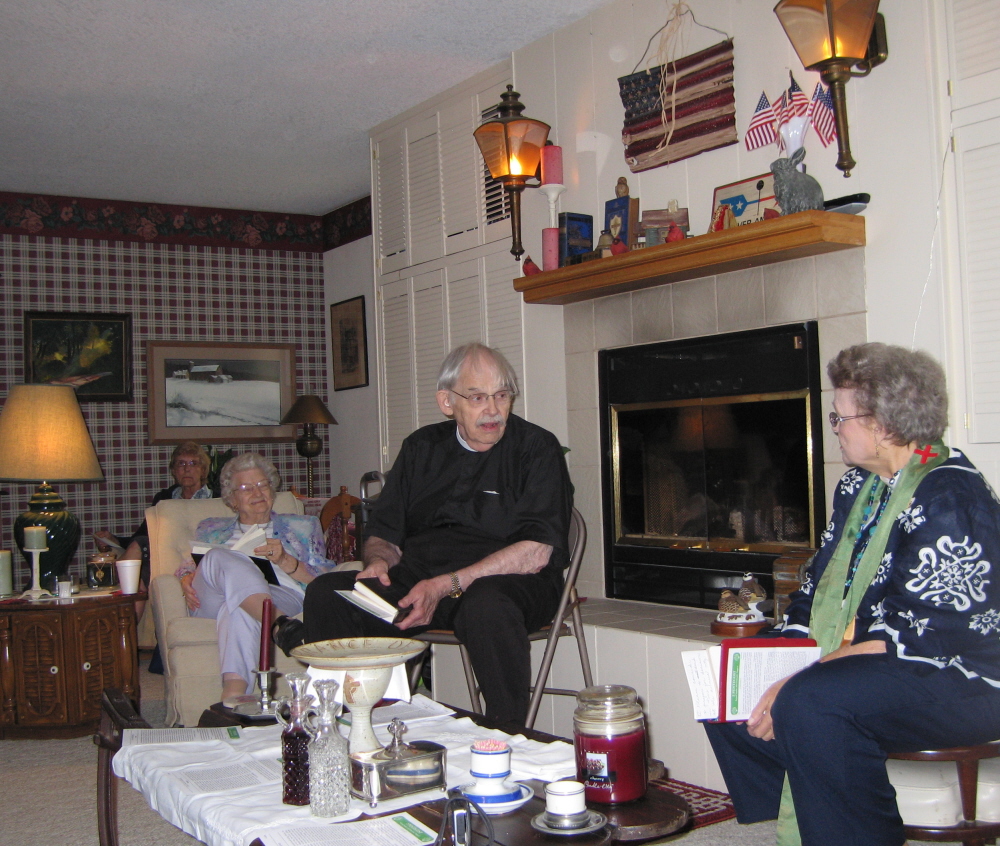
One of the advantages of a small parish is the fact it's portable, so we take the St. Andrew's show on the road once a year, leaving the church behind for an informal service and potluck picnic. For the last three years, we've gone to Corydon --- once on a beautiful June morning to a shelter house in Corydon Lake Park; the last two years, when weather hasn't been as cooperative, to Bill Gode's house.

The liturgy's the same, although spoken rather than sung, but the atmosphere is closer to what the earliest Christians might have experienced --- and which some, including our Old Order "house" Amish neighbors, still do. It's also a rare opportunity to have both our vicars in the same room at the same time, since they're usually in different places on Sunday mornings. That's the Rev. Canon Richard Lintner at left and the Rev. Sue Palmer at right.

Anyhow, the service was great --- and so was the food. But the same couldn't be said for the weather, which has been rambunctious around here all week.

Corydon had between three and four inches of rain on Saturday, while Chariton just had morning-long drizzle, but we're all saturated.

Sunday was actually dry until late afternoon, but as I was headed for a 4 p.m. prairie walk at Humeston, Department of Transportation workers were moving barricades into place to block U.S. 65 at the Derby corner --- White Breast Creek had gone over the highway at Lucas again.

The prairie walk went fine, but one of our party monitored weather radar on his cell phone and watched a system moving in from Weldon, just to the west.

We were back in our cars and headed home before the rain started, but it began to look more ominous the closer to Chariton I got --- made it into the garage just as a brief outburst of hail hit. By 6 p.m. it was black and pouring, black clouds just starting to roll away on the western horizon now.

Just another day on the prairie --- but I sure wish we could figure out how to send some of this moisture southwest, where it's needed.


Graveyard ghosts


I intended a drive out to Last Chance Cemetery to catch graveyard ghosts in the act Saturday, but it rained.

So these ghosts, marching uphill alongside a set of steps marooned mid-lawn at the Stephens House and just beginning to bloom, will have to do. I pulled the weeds and cut the volunteer walnuts out of them Thursday, went back Friday to see if they could be artistically photographed (they couldn’t). The cemetery would have been better.

But you can see why yuccas are called graveyard ghosts sometimes.

Think of a moonlight night at Last Chance, deep in the country, some distance off the road. It’s too dark to see the spiky foliage, just the shapes of these these disembodied masses of bloom, faintly illuminated, moving in the breeze among the tombstones.


Yuccas are not native to this part of Iowa --- only to the loess hills along our western coast --- but many old gardens and graveyards around here once had them, passed from gardener’s hand to gardener’s hand, and many still do.

Once established, a charge of dynamite is required to dislodge a yucca.

My cousin the alternate Frank stopped by as I was taking pictures Friday and got to talking about a ghost he and his brother had exorcised from an ancestral grave at Last Chance one time. They drove out lightly armed --- and couldn’t budge it. Went back again, armed this time with heavier gloves, a heavy-duty shovel and a pickaxe.

My bet is the yucca’s back, one of the reasons I wanted to get out to Last Chance.

The worst case of haunting I’ve ever seen was at the ghost-town cemetery of Mendota, just across the state line in Missouri south of Cincinnati (Iowa, not Ohio).

Once you figure out that the stub of a road leading off through the woods where Mendota used to be is not just someone’s driveway and cross a rickety bridge, you find the graveyard climbing a hill so steep some of the occupants are going through eternity hanging on for dear life.

The first impression is that practically every old tombstone has a companion yucca --- or a clump of them.

The last time I was there, visiting Tommy and Mary (Brown) Demack, a great-uncle and great-aunt, I ran into an elderly couple from Unionville equipped with shovels and empty feed sacks.

They were on the cemetery board and had been told by the lawn mower that he wasn’t going to submit a maintenance bid unless something was done about the ghosts --- he was getting battered every time he tried to get near them.

So there they were, like Sisyphus contending with his boulder, trying to remove yuccas --- a task that looked as if it would take a small army to handle.

I’m not sure how that turned out --- I’ve not been back since. But my money’s on the graveyard ghosts.


Saturday, June 25, 2011

New York marriage & my gay lawn


The Empire State Building lighted in rainbow colors for Pride weekend in New York.

The Republican-controlled New York Senate Friday evening passed marriage equality legislation 33-29, making the Empire State the sixth to open the institution unreservedly to same-sex couples. New York joins Iowa, Connecticut, Massachusetts, New Hampshire and Vermont --- plus the District of Columbia.

Although unintentional, the vote (and signing into law by Gov. Andrew M. Cuomo) launched Pride Weekend in New York, commemorating the June 28, 1969, Stonewall uprising, generally considered the start of the gay rights movement. The Lord moves in mysterious ways ….

Out here on the prairie, as negotiations on the bill continued, I lived my edgy gay lifestyle, after taking a nap, by mowing the back 40 in what I think is a highly creative circular pattern.

That was the lawn guy’s fault. He showed up to spray poison on the front and side yards Friday morning, where I usually begin mowing, confining me for 24 hours to the back yard. Once I started mowing in circles around the medicine wheel garden, I couldn’t stop.

After that, I came inside and watched the New York vote via live streaming. Pretty subversive stuff.

+++

The loser, after all was said and done, probably was the religious community. Not because of its advocacy on the conservative end for a traditional concept of marriage --- understandable --- but for many of its tactics and outright exaggerations and lies.

The images I carried away from watching the goings-on in Albany off and on during the last week included video of a member of a delegation of Orthodox Jews spitting on a Reform rabbi, delaring her “not a Jew,” because of her advocacy for equality --- and probably because she was a woman.

And comments Thursday from Archbishop Timothy Dolan of New York, among leading campaigners against the legislation: “You think it’s going to stop with this? You think now bigamists are going to want their rights to marry? You think somebody that wants to marry his sister is going to now say ‘I have a right’? I mean, it’s the same principle, isn’t it?”

Well, not quite.

The curious thing about the ongoing fuss about marriage equality, and it’s far from over, is that LGBT people have moved increasingly to the fore as leading proponents of the institution as heterosexual people have come increasingly, if actions speak, to devalue it. Go figure.

There’s no guarantee same-sex couples will be better at marriage than opposite-sex couples --- but it’s kind of nice to know that some among us at least still have faith in it, expressed by action rather than by empty, hypocritical and inflammatory rhetoric.

+++

Thunder’s rumbling in the hills this morning and the sidewalk’s getting wet. I had planned to finish off the lawn today with a series of straight cuts and carefully calculated angles, all very butch. That may not be possible now.

Friday, June 24, 2011

The Stanton Vault Revisited: Part 3


This is the third and final post about the Chariton Cemetery’s Stanton Vault and the 16 people whose remains were interred in its footprint after demolition. The first post covered general history of the vault; the second, 10 members of the extended Stanton family buried in it; and this post, five adults and one stillborn infant who had little in common other than their final resting place and the fact no one claimed their remains for burial elsewhere when the vault was destroyed.

Andrew Swan was an immigrant from Sweden who farmed in Whitebrest Township; Henrietta and John Perry, a once-prominent and widely known couple; Henry Van Werden, a physician from Leon who, his obituary implies, may have insisted on interment some distance from home because the prospect of in-ground burial frightened him; Louise Mallory, an infant who would have enjoyed advantages the others could only imagine had she lived; and Minnie Kirk, a young woman cut down by tuberculosis, the great killer of that era.

ANDREW SWAN
East Row, Grave No. 1 (from the north)
The Chariton Herald, 3 December 1903

Mr. Andrew Swan died at his home in Whitebreast township on Saturday evening, November 21, 1903, at the age of seventy-seven years. Funeral services were held at the Swedish Mission church on Thursday afternoon at two o'clock, conducted by the pastor, Rev. A. J. Johnson, assisted by Rev. B. F. Miller of the M.E. Church, who spoke in English. At the close of the services a large concourse of sorrowing friends followed the remains to the Chariton cemetery where they were laid to rest in the vault by loving hands.

Andrew Swan was born in Jonshopings Lan, Sweden, in 1826. On June 23, 1853, he was married to Miss Mary Swan who survives him. On June 23 of this year they celebrated their golden wedding.

They came to America in 1861 and located in Henry county, Illinois, and in 1862 went from there to Paxton, Ford county, Illinois. In 1876 they moved to Lucas county where they have since resided. The death of Mr. Swan was a great shock to his family as he was not thought to be seriously ill until a few hours before he died, but he had been slightly ill for a week. Heart trouble was the immediate cause of his demise. He passed away at sunset and before some of his near relatives could be summoned to his bedside. Deceased was one of the most highly respected residents of this county. He was honest and upright in all his dealings and made warm friends of all with whom he came in contact.

He is survived by his wife and six children. They are Charles E. and Anna Swan of Whitebreast township; Mrs. Christena Lundgren, S. J. Swan and Mrs. Sophia Anderson of Wausu, Nebraska; and Rev. N. P. Swan of Fresno, California. These sorrowing relatives have the sympathy of the community in their sorrow.


HENRIETTA PERRY
East Row, Grave No. 2 (from the north)
The Chariton Patriot, 13 October 1898

Tuesday, October 11th, the sad news came by telegram, to her parents here, of the death of Mrs. J. W. Perry which occurred on the above date, at 11 o'clock a.m. at the home of her daughter, Mrs. G. W. Schwartz in St. Louis, Missouri.

The body arrived in Chariton at 4:30 p.m. and was met at the station by relatives and friends and taken direct to the cemetery for interment.

Henrietta Stewart Perry was born May 20, 1851, near Lattasburg, Wayne county, Ohio, and came to Lucas county in 1861, with her parents, Mr. and Mrs. J. B. Funk.

She was married to J. W. Perry at Chariton in March, 1870, surviving her husband several years. Two children, both living in St. Louis, are left to mourn her loss.

Mrs. Perry had been an invalid for several years, having suffered from a stroke of paralysis some years before her death.

She was well known and highly esteemed in Chariton where she grew to womanhood and was married. The many friends in Lucas county will hear of her death with deep regret, remembering her worth and bright cheerful disposition.

The Chariton Democrat, 21 October 1898

Mrs. J. W. Perry, a former resident of this city, died at the home of her daughter, Mrs. May Schwartz, in St. Louis, on Tuesday, October. 11, at eleven o'clock a.m. after an extended illness. A few years ago she suffered a stroke of paralysis and later was afflicted with dropsy. The remains were brought to this city Wednesday evening and placed in the vault at the cemetery. Henrietta Stewart Funk, daughter of Mr. and Mrs. J. B. Funk of this city, was born near Lattasburg, Wayne County, Ohio, on May 20, 1851, and with her parents came to Chariton in 1861. Here she grew to womanhood and was married in March, 1870, to Mr. J. W. Perry. They were the parents of two children, Charles and May, both of whom are living. The family resided in Chariton until after Mr. Perry's death eleven years ago, when they moved to Des Moines, thence to St. Louis. Deceased was held in high esteem by a large circle of friends here who learned of her death with heartfelt sorrow.

Note: Henrietta apparently was born during 1851, rather than 1850 --- the date on her grave marker.


JOHN W. PERRY
East Row, Grave No. 3 (from the north)
The Chariton Democrat, 22 September 1887

Professor John W. Perry died at his residence in this city about six o'clock last evening. For more than a year he had been suffering from a cancerous tumor of the stomach which defied all human skill. For several months his life has been a living death, the only question being how many weeks or months he could live.

The doctors will hold an autopsy of the remains this afternoon. The funeral will take place tomorrow at two o'clock under the auspices of the Masons and Odd Fellows. A more extended notice of his life and death will be given in our next.

The Chariton Democrat, 29 September 1887

In last week's issue we briefly noticed the death of John W. Perry, which occurred at his home in this city Wednesday evening, September 21st, 1887. His worth as a Christian gentleman entitled him to a more extended notice than we could give at that time.

Deceased was born Dec. 7, 1836, at Putnamville, Putnam County, Ind. His education was acquired at Asbury University, Greencastle, Ind., from which institution he graduated with the degree of A.M. About twenty-five years ago he was licensed to preach by the M.E. church, but followed the avocation of a teacher. He came to Chariton twenty-one years ago. March 6, 1870, he was married to Henrietta S. Funk, daughter of Mr. John Funk of this city.

Mr. Perry had occupied the position of principal in several of the leading educational institutions of Indiana, and since coming to Iowa has been elected superintendent of schools in this county, and clerk of courts.

His life was one of rigid integrity and unsullied honor. His death was calm, peaceful and confiding, a fitting close to an honorable career.

His remains were laid to rest in the Stanton vault, newly erected in our beautiful Chariton cemetery, last Friday afternoon. Rev. M.D. Collins, of Des Moines, preached the funeral sermon. The funeral was under the direction of the Masons and Odd Fellows, and was largely attended by the general public.


HENRY C. VAN WERDEN
East Row, Grave No. 4 (from the north)
The Chariton Herald, 8 August 1895

The remains of Dr. Henry C. Van Werden, of Leon, who died Monday evening after a short illness, were brought to Chariton Wednesday and laid to rest in the vault at the Chariton cemetery. Deceased was a brother-in-law of Mrs. W. H. Hemphill of this city. A large concourse of our people met the funeral party at the train and joined in the journey to the city of the dead. The members of the A.F. and A.M. and K. of P. lodges of Leon and members from Chariton attended in a body. Dr. Van Werden has lived at Leon about sixteen years."

The Leon Reporter, August 8, l895

Dr. H.C. Van Werden was born in Lee County, Iowa, Sept. 29, l854, and died at his home in this city Monday evening, Aug. 5, l895, aged 40 years, l0 months and 6 days.

Monday morning the news was flashed to friends in this city and out of town that Dr. Van Werden was in a critical condition and could not live many hours. The news came like a thunder bolt, for it had only been a week since he was taken sick, and few knew that he was dangerous. He had been a sufferer from a complication of diseases for several years, but was thought to be getting better and was arranging to go to the lakes to spend the summer with his family when he was taken down. The end came peacefully and quietly Monday evening, and at twenty minutes past seven he passed away surrounded by his family.

Few men were better known and had more friends in Decatur County than Dr. Van Werden. He studied medicine under Dr. J.C. Hughes at Keokuk and graduated from the Keokuk Medical College in l878. He located in High Point, where he practiced for two years, and then resided at Garden Grove for a short time. In l879 he came to Leon, where he had since resided, and built up a large practice. No one knew him but to like him. Whole-souled and generous, a person in need never appealed to him in vain. As a citizen he was always ready and anxious to do anything he could for the benefit of the town and its people.

He was married to Jennie L. Rush in this city December 6, l880, and she with one daughter, Marie, is left to mourn his loss, which can never be replaced. He was a most kind and affectionate husband and father and was completely wrapped up in his home and family.

The deceased was a prominent member of the Masonic, Knights of Pythias and Odd Fellows Lodges. The funeral services were held at the residence yesterday at l o'clock, conducted by Rev. Hughes and the remains taken to Chariton on the afternoon train for interment in the vault there, Dr. Van Werden having exacted a promise before his death that he should be interred there.

The bereaved family and relatives have the deepest sympathy of every citizen of Leon in their dark hour of affliction.


LOUISE MALLORY THAYER
East Row, Grave No. 4 (from the north)

Louise Mallory Thayer, stillborn at the Ilion on 3 February 1888, was the only child of Deming J. and Jessie O. (Mallory) Thayer and the only grandchild of Smith H. and Annie Louise (Ogden) Mallory, at that time Chariton's most prominent and wealthiest citizens. The stillbirth was not recorded, as Iowa law required. However, Chariton Cemetery record-keepers carefully noted the date and circumstances. The year of stillbirth on the grave marker is wrong.

Louise was stillborn two years after her parents' marriage, which occurred on June 9, 1886. There were no other children. Deming killed himself on June 21, 1898, and was buried on a lot that was intended to contain the Mallorys' final monument to themselves at the far west end of the Chariton Cemetery, where his body remains. Jessie died Nov. 16, 1923, in Orlando, Florida, where she is buried.


MINNIE GRAY KIRK
East Row, Grave No. 6 (from the north)
The Chariton Herald, 7 May 1896

Died, at Las Vegas, New Mexico, Saturday, May 2, 1896, Mrs. Minnie Gray Kirk, aged 29 years, 8 months and 15 days.

Seldom does an event take place that causes more sympathy and sorrow than did the "passing away" of this esteemed woman. Several months ago Mrs. Kirk became afflicted with a bronchial trouble which became more aggravated and painful as the time advanced until last October she went to New Mexico in the hope of being benefitted. She apparently became better and was about returning to Chariton when with a little fresh cold the grim reaper seemed to fasten his grasp upon her. Her husband was telegraphed for, and two days after his arrival, her journey of life drew to a close, and the husband, sister and cousin could scarcely realize that her lips were forever silenced. She remained conscious until a short time before death and the end came peacefully as of a "blessed sleep."

Minnie, the name by which she was known by nearly all her friends, was the eldest daughter of our estimable and old time citizens, A.D. Gray and wife, and was born in Liberty township this county. She had passed her life, except that portion of time spent in traveling, (she had seen considerable of the United States and Europe) in Chariton and was a graduate of the High school in 1884, being one of a class of eight.

Mrs. Kirk became the wife of Chas. R. Kirk December 20, 1886, and during the years that succeeded he probably enjoyed as much happiness and sunshine as it is given man to enjoy in this life, and with the hearbroken parents, sister and brother, is left to grieve her departure.

The funeral was held from the home of her father, A.D. Gray, Tuesday afternoon, Rev. A. H. Collins being assisted by Rev. W.V. Whitten in conducting the services, and the remains deposited in the vault at the Chariton cemetery.

The respect shown to the remains of the deceased, the bountiful tributes paid to her memory and the vast concourse of friends and neighbors who attended the funeral attest the high esteem in which Mrs.Kirk was held.

Thursday, June 23, 2011

A grand old Lucas County flag


We have given a respectful salute this week to the oldest flag in the Lucas County Historical Society collection, hand sewn during 1860 by five Liberty Township women, and retired it to safe storage, the only option when its long-term survival is the primary consideration. If you'd like to read more about the flag, go to the Lucas County Historical Society blog, which is here.

God, Southern Baptists & Gannett


Albert Mohler, president of Southern Baptist Theological Seminary.

I’ve been reading a little about last week’s annual convention of the Southern Baptist Convention, held in Phoenix, mostly because Ben Alley --- the young Iowa man from Marshalltown (left) who recently was awarded a $40,000 Eychaner Foundation scholarship --- was there as part of an LGBT contingent that participated in an historic meeting with the Rev. Bryant Wright, SBC president.

Historic because the Baptists didn’t call the cops and have the queers dragged out of the convention center, but actually invited them in for a visit. The talk wasn’t productive, but at least no one was yelling.

The SBC, with 16 million members the second largest religious denomination in the United States (Roman Catholics are first), dates from 1845. Its founders split from northern Baptists so they could keep their slaves --- and their religion --- with a clear conscience. It was all very biblical, classic situational interpretation of the holy writ.

Those guys who wrote the Bible, inspired or not, took slavery for granted --- you’ll find nothing there condemning it. So on the one hand, southern Baptist literalists were justified.

On the other hand, if they’d focused on what that guy Jesus said, although he didn’t mention slavery specifically, they’d have freed ‘em right then and there and maybe spared us that awful war.

The big difficulty with Biblical literalism is that you dig yourself into awful deep holes sometimes.

The official apology came 150 years later --- in 1995 --- some years after the SBC had an official change of heart --- and mind --- regarding which Bible verses to take seriously.

Anyhow, representatives of LGBT advocacy groups gathered in Phoenix alongside the Baptists to suggest that it might be smart not to wait 150 years to apologize to gay, lesbian, bisexual and transgender folks for some of the hurtful things the good old boys in the pulpits, pews and amen corners have said and done. Get it over with and do it now, they suggested.

Alley was involved because his father, a Southern Baptist preacher on the staff of First Baptist Church in Marshalltown a couple of years ago, kicked him out because he was gay, then headed home to Tennessee without him.

Wright allowed that Ben’s dad had been a little harsh, but no apology was forthcoming. As if anyone expected one.

+++

More interesting than the meeting, however, were comments from the Rev. Albert Mohler, president of Southern Baptist Theological Seminary and a leading denominational apologist, who suggested that Southern Baptists need to repent of a “form of homophobia.” That’s pretty edgy for a Southern Baptist.

Here’s a portion of an Associated Baptist Press account of Mohler’s comments:

“… Mohler responded during his report to the Southern Baptist Convention to a question from Peter Lumpkins, a Southern Baptist blogger, about whether comments attributed to him in a March 24 Christian Science Monitor article were accurate.

“Writer Jonathan Merritt, a Southern Baptist minister and well-known social critic, quoted Mohler as saying ‘We’ve lied about the nature of homosexuality and have practiced what can only be described as a form of homophobia,’ and ‘We’ve used the choice language when it is clear that sexual orientation is a deep inner struggle and not merely a matter of choice.’

Mohler was quick to say that the 200 articles he’d written on gay issues proved he hadn’t gone soft on queers, but added that “the reality is that we as Christian churches have not done well on this issue.”

He then covered his ass:

“Evangelicals, thankfully, have failed to take the liberal trajectory of lying about homosexuality and its sinfulness,” Mohler said. “We know that the Bible clearly declares – not only in isolated verses but in the totality of its comprehensive presentation – the fact that homosexuality not only is not God’s best for us, as some try to say, but it is sin.”

And then went all edgy again:

“But we as evangelicals have a very sad history in dealing with this issue,” he continued. “We have told not the truth, but we have told about half the truth. We’ve told the biblical truth, and that’s important, but we haven’t applied it in the biblical way.”

“We have said to people that homosexuality is just a choice,” Mohler said. “It’s clear that it’s more than a choice. That doesn’t mean it’s any less sinful, but it does mean it’s not something people can just turn on and turn off. We are not a gospel people unless we understand that only the gospel of the Lord Jesus Christ gives a homosexual person any hope of release from homosexuality.”

It’s tempting to put words into Mohler’s mouth and add, “only the gospel of the Lord Jesus Christ gives a Southern Baptist any hope of release from homophobia.” Obviously, he wouldn’t say that, however.

But it’s fascinating. He’s getting dangerously close to implying that being gay is not a choice made primarily to aggravate Southern Baptists.

And a Southern Baptist can under no circumstance even imply that or his ass will hit the grass --- and soon. I’d guess Mohler is experiencing a change of heart --- and wonder how long he’ll last.

The interesting thing about biblical interpretation, literalist or otherwise, is that it rarely has much to do with what the Bible says or doesn’t; everything to do with the personal baggage we bring to it and what we want it to say. And that’s as true for a Southern Baptist as it is for an Episcopalian.

+++

Gannett, owner of The Des Moines Register, has sliced into that once-great (now second-tier sliding into third) newspaper’s operation again, cutting 13 staffers, most of them from the newsroom.

Included were John Gaps III, veteran award-winning photographer, and Pulitzer Prize-winning reporter Jane Schorer Meisner. I believe 700 jobs were cut corporation-wide.

You understand why Gannett and others have to keep doing this --- news is a luxury newspapers are discovering they really can’t afford any more. It’s too expensive to hire qualified people to cover it.

Too darned inconvenient to come up with the few thousand dollars it takes to care for and feed a reporter, photographer or editor when you’ve got all those needy CEOs out there.

Gannett, for example, upped the salary of its chief, Craig Dubow (left), from $4.7 million in 2009 to $9.4 million in 2010 --- and paid him a $1.75 million bonus on top of that for cutting costs (firing staffers farther down the food chain).

You gotta love it.

Wednesday, June 22, 2011

The Stanton Vault Revisited: Part 2


Ten of the 16 sets of remains reinterred in the Stanton Vault footprint after it was demolished were  members of the extended Stanton family, headed by Dr. James Eddington Stanton and Mary Jane (Hobbs) Stanton, who brought their family from Indiana to Chariton in 1862.

Although Stantons no longer live in Chariton, at least three of their buildings remain, including the Stanton Building on the west side of the square where Edwin Stanton, the family dentist when I was small and a son of Dr. Theodore P. and Helen Stanton, had his office. Edwin lived at that time with his mother in the old Theodore P. Stanton home on East Auburn Avenue, rejuvenated in recent years and still standing in a good state of repair. Both Edwin and Helen Stanton died during 1956.

The Dr. John Henry Stanton home on East Court Avenue became Downs Funeral Home, then Mosher Funeral Home, and now is a private dwelling again. It, too, is in a good state of repair.

 Obituaries or alternate informabout about the 10 Stanton family members follow. All sources other than the tombstone give James E. Stanton's middle name as "Eddington" rather than was "Edward," as inscribed on the tombstone.

JAMES EDDINGTON STANTON
West Row, Grave No. 6 (from the north)
The Chariton Patriot, 12 November 1908

Another one of Lucas county's pioneer citizens has gone to his eternal home. On last Friday morning about seven o'clock, Dr. J. E. Stanton passed away at his home on north Main street after an illness of only about twenty-four hours with paralysis. Largely attended funeral services, under the auspices of the Masonic and I.O.O.F. orders, were held at the home of his son, Dr. T. P. Stanton, on Sunday afternoon at 2:30 o'clock. A male quartette composed of Dr. Walter Anderson, Fred Larimer, Prof. W. E. Hays and S. C. Hickman, rendered several appropriate selections. The floral offerings were profuse and beautiful, and were expressive of regard for the dead and sympathy for the living. At the close of the service the remains were laid to rest in the vault at the Chariton cemetery.

James Eddington Stanton was born in Belmont County, Ohio, on May 15, 1828. He had a twin sister who died at West Liberty, Iowa, in 1892. At the age of twenty-eight years he moved to Indiana. His professional education was obtained at the Keokuk Medical College. He began practice in Belmont county, Ohio, the place of his birth, in 1852. While residing there he was united in marriage to Miss Mary J. Hobbs, on November 14, 1850, at Summerton. To them were born six children, four of whom, Mrs. Allie Lockwood, Mrs. Ruthana Boyles, and Drs. T. P. and J. H. Stanton, all of this city, are living. One daughter, Mrs. Minnie Guylee, died a few years ago, and one son (sic.; this actually was a daughter, Mary, who died during 1865 at age 7) died when quite young. Mrs. Stanton passed away about ten years ago. Dr. Stanton and family came to Chariton in 1862, and engaged in the practice of his profession. At that time he endured many hardships in traveling across the unbroken prairies to minister to the sick. During his residence here of nearly half a century he became widely known and in many homes his name was a household word. He was generous to the poor, not only giving them his services and medicine when there was no hope of renumeration, but he frequently purchased provisions, clothing and fuel for them. He was one of the charter members of the Masonic order and also belonged to the Independent Order of Odd Fellows. He was not a member of any church, but was of Quaker descent. In later years he retired from active practice and devoted himself largely to beautifying and caring for the city of the dead. He was the principal stock holder in the Chariton Cemetery Association and God's acre was his special pride. He possessed a kindly heart and his many noble deeds will be gratefully remembered. His innumerable friends throughout southern Iowa will learn of his demise with heartfelt sorrow and will extend sincere sympathy to the sorrowing children.

MARY JANE HOBBS STANTON
West Row, Grave No. 5 (from the north)
The Chariton Democrat, 29 November 1900

Mrs. Mary J. Stanton, wife of Dr. J.E. Stanton, departed this life on Wednesday evening, November 21, a few minutes before midnight, after an illness of several weeks with paralysis. Largely attended funeral services conducted by Presiding Elder W. B. Thompson were held at the M.E. church on Friday afternoon at two o'clock after which the remains were placed in the family vault in the Chariton cemetery.

Mrs. Mary J. Hobbs was born near Baltimore, Maryland, on January 2, 1825. When quite young she moved with her parents to Belmont County, Ohio. On November 14, 1850, she was married at Summerton, Ohio, to Dr. J. E. Stanton. They came to Chariton in 1863 where they have since resided. They were the parents of six children, four of whom are living. They are Drs. T. P. and J. H. Stanton, Mrs. Allie Lockwood and Mrs. San Boyles, all of this city. Mary, a daughter of seven years, died in 1865, and Mrs. Minnie Guylee passed away about three years ago. The surviving husband and children have the sympathy of the entire community in their sorrow.

Mrs. Stanton was a lady of strong mind, well read and a character most excellent. Her religious life was simple, devout and practical. For many years she has been a faithful member of the Methodist church. Her death has caused extreme sorrow. She was loved by all who knew her and her pleasant disposition carried sunshine and joy wherever she went. An affectionate wife, devoted mother and beloved neighbor has gone to her reward.

JOHN HENRY STANTON
West Row, Grave No. 3 (from the north)
The Chariton Herald Patriot, 1 June 1922

DEATH CALLS DR. J. H. STANTON
End Came Suddenly at Home at Midnight on Thursday, May 25, 1922
Funeral Held Monday
Immense Crowd Attended Last Sad Rites; Dr. Stanton Had Practiced Here for Over 30 Years

The entire community was shocked and deeply grieved to hear of the unexpected and very sudden death of Dr. J. H. Stanton at his late home in Chariton at midnight, Thursday, May 25th, at the age of 60 years, 1 month and 1 day. Dr. Stanton was born at Spearsville, Brown county, Ind., on April 24th, 1862. When but an infant he came to Lucas county with his parents, the late Dr. and Mrs. James E. Stanton. He grew to manhood in Chariton, received his medical education as a physician and surgeon at Rush Medical college in Chicago, graduating in 1892, and practiced a short time in Nebraska, but soon returned to Chariton, where he has been engaged in a wide and successful practice for the past 30 years. After his return from school he and his brother, Dr. T. P. Stanton, spent a year in visiting European hospitals and colleges, to more fully equip themselves for their professional careers.

On June 30th, 1894, he was united in marriage to Miss Gertrude Aughey, the daughter of the late Rev. and Mrs. John A. Aughey, who was for a number of years the pastor of the local Presbyterian church. To this union were born four daughters, all of whom, with the mother, survive. They are Mrs. Lester Combs of Charitoon and Jessie, Elizabeth and Martha at home. In addition to the immediate family he is survived by two sisters, Mrs. Alice Lockwood, Mrs. San Boyles, and one brother, Dr. T. P. Stanton, all of Chariton. The following nieces and nephews also survive: Mary Lockwood, Ida Boyles, Mrs. Ed Northington, Mrs. Robt. Larimer, Mrs. Harold Leonard, Edwin, Lucien and James Stanton, all of Chariton.

Dr. Stanton was a man of strong convictions and firmness of character, and as a consequence he had a host of firm friends. His long residence in Chariton gave him a wide range of acquaintance and by virtue of his profession he was brought into close fellowship with multitudes of people as through the years of faithful, untiring ministry he went from home to home to bind up the broken bodies and pour in the oil and wine of his sympathetic healing ministrations.

To those in distress and trouble he always had a word of cheer and encouragement that came from a kind fatherly heart. It is the testimony of multitudes to whom he came that there was a healing in his sympathetic touch and genial presence. His home life was especially noteworthy as being all that a loving and thoughtful husband and father could make.

The home life was knit together by those tender ties of love which death alone can break and then only for a short time.

His going will be mourned, his presence will be missed and his memory will live in the hearts of the many who named him among their friends and acquaintances. He confessed his faith in Christ and was confirmed in the Episcopal church of Chariton. He was a member of the American Medical Association and also the Iowa State Medical Society. He was an active member of the American Association of Cemetery Superintendents and has attended the annual meeting for the past several years in his effort to obtain knowledge and information as to cemetery affairs that would assist him in his untiring efforts in beautifying and improving the Chariton Cemetery to which he devoted a great deal of care and attention and of which he was superintendent.

For many years he had been a member of the Masonic order, being a Knight Templar, a Thirty Second Degree Mason and a member of the Za Ga Zig Shrine. The funeral service was conducted from the home on East Court Ave. on Monday afternoon, May 29th, at 3 o'clock, by the Rev. C. W. McClelland of the First Presbyterian Church and the local Masonic order. Miss Jessie McIntire sang two beautiful and appropriate selections. The spacious home could not accommondate half of the number who came to pay their last tribute to the memory of their departed friend. The floral tributes were profuse and very beautiful, mute testimony of the esteem in which Dr. John Stanton was held as well as sympathy for the grief stricken wife, daughters and other relatives. Drs. A.L. Yocum Sr.,H. D. Jarvis, R. C. Gutch, D. Q. Storie and A. L. Yocum Jr., all of this city, and Dr. J. B. Robb, of Russell, all of whom were not only brother physicians but were brother Masons, acted as pall bearers. At the conclusion of the services at the home the remains were laid to rest in the vault in the beautiful little city of the dead, the care of which had been his pride for so many years.

GERTRUDE E. AUGHEY STANTON
West Row, Grave No. 4 (from the north)
The Chariton Leader, 2 April 1940

Mrs. Gertrude Stanton, aged about 75 years, widow of the late Dr. John H. Stanton and for many years a resident of Chariton, died Friday night in Chicago, Ill., following a stroke of paralysis last Tuesday.

Mrs. Stanton was formerly Gertrude Aughey and was a daughter of Rev. and Mrs. John H. Aughey. Her father was pastor of the Presbyterian church in Chariton many years ago. She was married here to Dr. John H. Stanton and to them four daughters were born, all of whom are living. They are Mrs. Elizabeth Schubert of St. Louis, Mo.; Mrs. Sarah Combs, Mrs. Jessie Hallberg and Mrs. Martha Mutcham (surname is unclear on microfilm), all of Chicago, Ill. Five grandchildren also survive her.

Mrs. Stanton was one of the early members of the P.E.O. society at this place and was active in a number of organizations. Dr. Stanton preceded her in death about eighteen years ago. Several years ago she went to Chicago to reside.

Funeral services were held in Chicago and the body was cremated.

Note: Cook County, Illinois, death records show Gertrude Stanton's date of death to have been 29 March 1940, as affirmed by the preceding death notice, so the tombstone date is wrong. She may have been born during 1867 rather than 1868 as well.


MINNIE STANTON GUYLEE
West Row, Grave No. 2 (from the north)
The Chariton Patriot, 24 December 1896

Died in Chariton at 4 p.m. Friday, December, 18th, 1896, Mrs. Minnie Stanton Guylee, in the forty-fifth year of her age. Her illness of eleven weeks of acute suffering was borne with a resignation and courage befitting the character of a noble christian woman. She was the eldest child of Dr. J.E. and Mary Stanton and was born in Somerton, Belmont county, Ohio, November 23d, 1851. Dr. Stanton removed with his family to Chariton in 1863 and have been residents of the city since. The deceased was a successful teacher for several years, and enjoyed the confidence and affection of her pupils. She was married to T. J. Guylee in May 1879. For twenty years she was an active, consistent, christian worker in the M.E. church, and following the example of the Divine Teacher, she devoted her life to doing good. She taught a class of young men in the Sunday school for ten years and was untiring in her efforts to develop and strengthen christian character among them. Organizing a Lyceum League, outside of her church work, for the benefit of the youths of the city, she was earnest and untiring in the noble purpose of imparting instruction and upbuilding all the manly virtues among them. In unselfish effort for the good of others, she was also a prominent and loved member of the Women's Relief Corps, Eastern Star and Woman's Suffrage Societies. Unassuming in manner, her strong individuality of character commanded respect and made her influence felt, not only in society and the church, but in the home circle as well. A clear head and honest heart made her a wise counsellor and valued friend. For the bereaved husband, parents, brothers and sisters, the loving sympathy of all is expressed.

The funeral took place on Sunday afternoon, December 20th, from the M.E. church at 2 p.m. The services which were of the most impressive character were conducted by the pastor, Rev. Rhoderick. Attesting their love and esteem for their departed sister and co-worker, the members of her Sunday school class, Eastern Star and Women's Relief Corps, attended the funeral in a body. All that was mortal of the beloved wife, daughter and sister was placed in the vault in the Chariton cemetery by loving and reverent hands, and she who so brightened the lives of others will live in their hearts, a cherished and tender memory.


Note: According to a Stanton family Bible in the Lucas County Historical Society collection, Minnie's given name was Arminda W. Stanton. The birth date on her marker is wrong. The Bible record gives her birth date as Oct. 23, 1851, rather than Nov. 23, 1851, as reported in her obituary.


TOM GUYLEE
West Row, Grave No. 1 (from the north)
No information other than name on marker; Chariton Volunteer Fire Department flag holder beside his marker.

Lucas County marriage records show that Tom J. Guylee and Minnie Stanton were married 3 May 1879. They had no children. His occupation in the 1880 census was given as tinner. Minnie died during December of 1896 and Tom survived her, but what became him isn't clear. He still was living in Chariton, apparently retired with "private income" during 1900. Although his remains were found in the vault, I've been unable to find an obituary or death notice for him in Chariton newspapers. There are no dates on his Fielding Funeral Home marker.


MARY E. STANTON
West Row, Grave No. 7 (from the north)
Mary E. Stanton is identified in the obituaries of both her parents as a daughter of James Eddington and Mary Jane (Hobbs) Stanton who died during 1865 at the age of 7. It seems likely that Mary was first buried conventionally elsewhere in the Chariton Cemetery, that her body was disinterred and placed in the vault when it was constructed during 1881 and that upon demolition of the vault, her body was reburied. The Stanton family Bible gives her date of birth as June 11, 1857.


EMMA J. (SMITH) STANTON
West Row, Grave No. 8 (from the north)
Emma J. (Smith) Stanton was the wife of James Eddington Stanton's nephew, Lindley M. Stanton, undertaker and merchant at Humeston in Wayne County. Belmont County, Ohio, marriage records show that Lindley M. Stanton and Emma J. Smith were married on 28 September 1876. The only Chariton newspaper reference to Emma's death is the following item, which mischaracterizes Emma's relationship to her her father-in-law, William Stanton, published in The Herald of 20 November 1890:

"Wm. Stanton of Somerton, Ohio, arrived in Chariton last Wednesday night on a visit to his brother Dr. J.E., going to Humeston Saturday to the bedside of his sick daughter (acutally daughter-in-law), Mrs. L.M. Stanton, who died on Monday. The remains were brought to Chariton on Tuesday afternoon and laid to rest in the Stanton vault, where services were conducted."


Lindley M. Stanton continued to live at Humeston until 1913, when he became ill and was taken to Chariton and cared for by his cousins there. Rather than bury him with Emma in the Stanton vault, he was buried to the rear of the Theodore P. Stanton lot quite a distance southwest where the inscription on his small tombstone reads, "L.M. Stanton, Sept. 27,1840-Aug. 13, 1913." The date of death inscribed on the tombstone is incorrect. He actually died 6 August 1913. Lucas County death records identify him as a son of William and Sarah (Burr) Stanton.

The only Chariton newspaper account of L.M. Stanton's death was the brief item that follows, published in The Herald Patriot of 7 August 1913, as follows:

"Mr. L. M. Stanton, of Humeston, a cousin (actually nephew) of the late Dr. J.E. Stanton, passed away in this city last evening at 8 o'clock at the home of his cousin, Mrs. Ruth Boyles, after an extended illness with Bright's disease. He was brought to Chariton a few weeks ago where he could be cared for. He was seventy-three years of age. The only near relative surviving is a brother in Columbus, Ohio. Funeral services will be held tomorrow afternoon at 2:30 o'clock, at the home of Mrs. Boyles after which interment will take place in the Chariton cemetery."

A complete obituary was published in The Humeston New Era of 13 August 1913, as follows:

L. M. STANTON DEAD
Well Known Citizen and Business Man of Humeston Died Wednesday Night. Funeral at Chariton.

Linley (Lindley) M. Stanton, aged seventy-three years and a well known resident of Humeston, died Wednesday night at the home of his cousin, Mrs. Ruth Boyles, in Chariton. His death was due to a complication of diseases. His friends had been aware of his failing health for several weeks yet the news of his death came as a severe shock to the many who had known him well.

Mr. Stanton fell off the second-story porch at his home some weeks ago and since that time he had not been feeling well, although he had recently completed two jobs of painting. On July 21 he went to Chariton to visit relatives and was at once confined to his bed.

He was born in Belmont county, Ohio, September 17, 1840. He had been a resident of Humeston since 1885. For many years he was engaged in the furniture and undertaking business. He erected the opera house in 1898. He had been assessor of Humeston for the past six years. He was a member of the M.E. church and the Masonic lodge. He had been married three times. His third wife died in September, 1911. He is survived by an aged mother in Ohio, and a brother, Isaac Stanton, of Columbus, Ohio.

Mr. Stanton was good, honest and industrious. He was a most courteous and friendly man, always a gentleman and willing to do anything to oblige a friend. He had won what is better than great wealth --- the respect and friendship of all who knew him.
The funeral services were held at Chariton Friday afternoon, conducted by the Masonic lodge of which he was a prominent member. Rev. R. Burton Sheppard of Humeston preached the sermon. About twenty-five Masons attended the funeral and paid last honors to the good man. Burial was made in the Chariton cemetery.


RUTH STANTON MEAD
West Row, Grave No. 9
The Chariton Herald, 19 November 1891

Died, at the family residence on 5th street (in West Liberty, Iowa), on Tuesday night, Nov. 10th, Mrs. Ruthanna Stanton Mead, age 63.

The simple modesty of her life forbids a public exhibit of her many virtues now that she is dead. It is sufficient to say that as a woman, a wife, a mother and a friend, she was good, wholly good. She leaves a family of one son and three daughters, toward whom since their infancy, she has filled the double part of mother and father. To them her loss is a terrible bereavement, in which the deep sympathy of a community of friends is freely expressed.

The funeral will occur this afternoon (Thursday) at 3 o'clock at the M.E. church, Rev. Kendrick officiating with a brief service. The remains will be taken tonight to Chariton, Iowa, and ladi to rest in the family vault of her brother, Dr. Stanton.

Busy through all her life with deeds of love,
She held a trusting faith in One above;
She went where duty led, without complaint,
And died as she had lived, a patient saint.

Weep not for her; her earthly troubles o'er,
She rests in peace upon the shining shore;
Her labor done, she sweetly wears the crown
The Savior gives to those He calls His own.
Wapsie Index, West Liberty, Ia.

Mrs. Mead was a sister of our esteemed fellow townsman, Dr. J.E. Stanton, and formerly resided in Chariton, where she had many friends. The remains arrived here last Friday morning and were followed to their final resting place, as above indicated, by many sympathizing friends.


CLARA MEAD
East Row, Grave No. 7
The Chariton Patriot, 21 August 1913

Clara Mead was a daughter of Ruth Stanton Mead (1828-1891), twin sister of James Eddington Stanton. Ruth also was buried in the Stanton Vault, then reburied in its footprint. The most likely explanation for identical dates on markers for both Ruth and Clara is that Clara's remains were cremated after her 1913 death in Minneapolis and the ashes interred with her mother's coffin. That apparently resulted in some confusion when the Mead crypt was opened prior to demolition of the vault (perhaps Clara's name and dates were not inscribed on the crypt door; her interment only noted in cemetery records). Lacking better information, perhaps, the same dates then were placed on the Fielding Funeral Home markers of both.

The 1900 census of Minneapolis shows Clara and her sisters, Mary E. and Ella D., sharing a home there. All were school teachers; none married. That census gives Clara's month, year and place of birth as August 1865 in Ohio. She apparently died during July or August 1913. The following brief item is the only account of her death and burial in Chariton newspapers (the name is incorrectly spelled Meade in this article):

MISS CLARA MEADE

The remains of Miss Clara Meade, of Minneapolis, Minn., who died a few weeks ago, were brought here last Friday and placed in the vault in the Chariton cemetery by the side of her mother. Deceased was a cousin of Drs. T.P. and J.H. Stanton and Mrs. Ruth Boyles and Mrs. J.H. Lockwood, all of this place. The remains were accompanied here by her sisters, Misses Mary E. and Ella Meade.