Monday, January 31, 2011

Bring it on


You've gotta understand that in Iowa, when faced with the forecast of a major winter storm, everyone goes to the grocery store. Actually, we go to the grocery store any time we want to find someone to visit with, too --- and stand in the aisles and block traffic. And sometimes to buy groceries. But an anticipatory visit when faced with potential snow is mandatory.

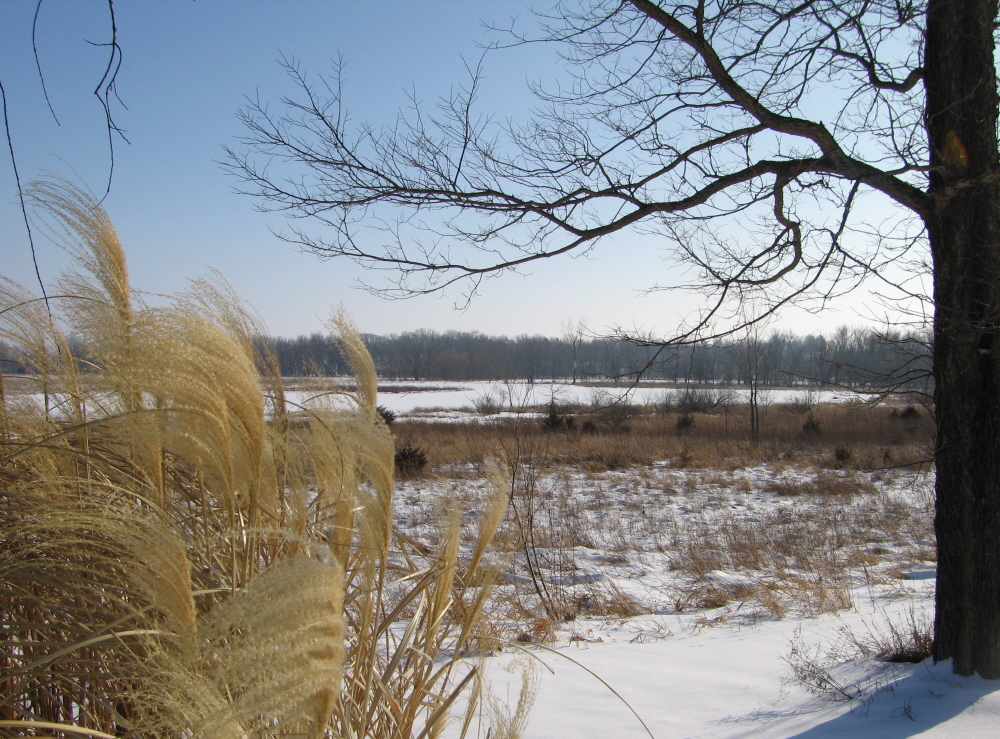
The crowd was a little sparse at Hy-Vee this morning --- so far we've had only a little freezing drizzle followed by a dusting of snow. But it's early. The weather map has a giant purple, pink and blue bruise on it, stretching from the Utah border through Illinois and from central Texas north to North Dakota. Traffic will pick up a little later when the snow gets serious.

I usually buy milk --- on general principles; but having done that Saturday, bought sunflower seed for the birds instead.

It's supposed to dump quite a bit of snow on us beginning tonight and continuing through Tuesday --- and get down to minus-10. I'll keep you posted. And I think I'll go back to the store after lunch just in case.

Sunday, January 30, 2011

Buffalo Bill comes to town


That good old Iowa boy William F. “Buffalo Bill” Cody brought his “Rough Riders of All Nations” Wild West Show to Chariton during September of 1900.

And down in Benton Township early that Saturday morning, the 15th, my grandfather, Irwin Myers, then 18 and the eldest of Daniel and Mary Belle Myers’ six children (Nolan wouldn’t come along until 1902), helped hitch some horses to the spring wagon and saddle up others so that the whole family could head up the New York Road and into town together.

The goal was to get to Chariton, find a place to hitch the horses and be in place along the parade route before the “Grand Street Cavalcade and Review of the Rough Riders” began at 10 a.m. (a half hour later than originally advertised).

This was not an event that anyone in south central Iowa wanted to miss and by the time the parade started an estimated 12,000 people lined Chariton’s streets. City slickers for the most part had walked to avoid the congestion, folks from the country arrived by horse and hundreds more poured in by train.

Extra cars had been added on the main line --- No. 3 from the east and No. 10 from the west --- as well as to the north branch passenger steaming down from Indianola through Milo and Lacona. A special train on the southern branch departed Davis City early with stops in Leon, Garden Grove, Humeston and Derby before chugging up the current Cinder Path route to arrive at 9:15 a.m.

The weather was wonderful. “Saturday was an ideal day for the great Buffalo Bill show,” The Chariton Herald reported, ” and by eight o’clock the largest crowd that has been in Chariton for some time (something of an understatement) had assembled in the streets.”

The Wild West Show troupe itself had traveled by special train early Saturday morning from Clarinda, where it had performed twice on Friday, allowing weary performers and support staff to catch a few hours of sleep. As a rule, the show was performed rain or shine twice daily, arriving, setting up, performing, tearing down and traveling on within 24 hours. Performances had been held in York, Nebraska, on Wednesday and in Nebraska City on Thursday before the mythic Wild West crossed the Missouri and headed into Iowa early Friday.

Upon arrival in Chariton, the show train was pulled onto a siding, unloaded by support staff and performers, and equipment and animals hauled or walked to the fairgrounds, then located just north of the city on the west side of what now is Highway 14 (or North 7th Street), for setup. It seems likely that Buffalo Bill himself, the faithful Annie Oakley and other stars slept a while longer.

By early morning, much of the work had been done, breakfast was served in the mess tent and everyone began to get their costumes sorted out and their gear in order. The big parade, organized at the fair grounds, would proceed south on North 7th, then turn west on Lucas Avenue to Grand.

“Promptly at 10 o’clock,” The Herald reported, “the parade formed and started (south) down Grand street, crossing over to Main at Stewart’s lumber yard and proceeded down Main street and around the square back to the (fair) grounds ….”

Here’s the lineup, as reported by the Herald. Imagine if you can what the day must have been like.

Martial band composed of five fifers, three snare drums, one bass drum and cymbals.

Col. Cody seated in a trap with footman behind.

Nine German cuirassiers (mounted cavalry soldiers) in charge of a lieutenant.

Nine Bedouins.

Band of ten pieces seated in a band wagon drawn by eight horses.

Seven Indians.

Six Japanese.

Nine Cossacks.

Electric light plant drawn by six horses.

Three nondescript.

Thirteen soldiers.

Seven Mexicans.

Seven Indian squaws.

Two Indian men.

Mounted cowboy band of eighteen pieces.

Eleven Rough Riders.

Troop of colored cavalry, numbering eight men.

Electric light plant drawn by six horses.

Troop of Cubans, numbering eight.

Seven Indians.

Stage coach drawn by eight mules and filled with women and papooses.

Twelve cowboys.

Nine Indians.

Band of twelve pieces seated in a band wagon drawn by eight horses.

Troop of United States cavalry, numbering fourteen.

Field piece drawn by four horses.

And finally, caisson drawn by the same number followed by another field piece and a second caisson, three outriders with each.

That was the parade, but by now nearly everyone who had lined the streets had fallen into line behind it to form an even grander cavalcade --- back to the fair grounds where a “free open air exhibition” was given before the 2 p.m. performance.

It’s not clear exactly what the “exhibition” included, but most certainly teepees had been erected, other tents and other attractions put into place and the performers deployed so that the crowd could interact with them. Food also would have been available on the grounds --- and souvenirs. This is where my granddad purchased the card bearing Buffalo Bill’s image and printed autograph at the top here (he held onto it until the day he died). The advertisement for the show itself, below, had been published in Chariton newspapers for two weeks prior to the event.


Tickets for the performances (50 cents for adults and 25 cents for children) --- one at 2 p.m. and the other at 8 p.m. --- were available on the grounds. Those who had wanted reserved seats could have purchased them Saturday morning at Dougherty’s Drug Store on the west side of the square for $1.

The show itself seems to have rendered the editor of The Chariton Patriot speechless. “No elaborate description is adequate to fully depict the many interesting and instructive attractions,” he wrote. “It must be seen, in all its comprehensive and realtistic features to be fully appreciated.”

The editor of The Herald was not intimidated, however.

“The performance in the afternoon at two o’clock was largely attended,” he wrote, the seats being all taken; it was estimated they showed at this performance to 11,000 people.

“The program given consisted of 26 numbers, each one entirely different and original. Rough-riding by men of all nations, fancy shooting by Miss Annie Oakley, Mr. Johnny Baker, and Col. W.F. Cody himself.

The Col., despite the fact of his advancing years, has lost none of the skill which has made his name famous, and can break the little glass globes with a Winchester as easily as he could in his younger days.”

After the 2 p.m. performance ended, most people headed home. The Myers family and many others had chores to do and others had trains to catch. Most wanted to be home before dark.

The crowd at the 8 p.m. performance, designed primarily for cities but given in country towns nonetheless, was much smaller. The attendance was “still fair,” however, the Herald reported. “It is emphatically a daylight show,” according to The Patriot.

The Patriot editor summed it all up this way: “There are no illusions, but you just see before you an assemblage of representative native groups from every county (a slight exaggeration). It is like taking a trip around the world, to visit the ‘Wild West’ show.”

After the last of the 8 o’clock crowd had departed, Wild West Show show staffers tore down and packed up and by early morning the show train had been loaded, pulled off its siding and pointed east to steam through the night to Ottumwa. Sunday was a day of rest and perhaps crew members slept a little later.

But on Monday, the Wild West Show was ready to wow Ottumwa before moving onto Keokuk for Tuesday shows. Early Wednesday, the Wild West train crossed the Mississippi and headed down to Quincy, Ill., then on Thursday back across the river for performances at Louisiana, Missouri, and as the days passed many more small Missouri towns before settling in at Kansas City for a longer stay.

The Wild West Show's stay in Chariton may have been brief, but those who attended seem to have remembered it for as long as they lived --- my granddad certainly did.

More about Buffalo Bill and his appearance in Ottumwa next time.

Saturday, January 29, 2011

Honored by association


Mark Ketterson holding his late husband's photo and funeral presentation flag.

Finally (for today), follow this link if you like (it will be temporary) to a story in this morning's Chicago Sun-Times about one of the gay couples married in Iowa after the Iowa Supreme Court ruled unanimously two  years ago that our Constitution's equal-rights clause guaranteed that right.

You may remember the shrill voices on the Christian-Republican right after that decision, warning us about the homosexuals who would destroy the state morally by traveling here to get hitched.

Although this story is bittersweet (one of the husbands has died), the characters of these guys probably are representatives of the LGBT men and women who have taken advantage of Iowa's marriage laws --- a far cry from the cariicatures sketched by the wicked lies of self-appointed holy warriors.

John Fliszar was a 1971 graduate of the U.S. Naval Academy at Annapollis who served two tours as a Marine aviator in Vietnam. His surviving husband is Mark Ketterson, a Chicago social worker.

The other part of the story involves how well and with what respect Ketterson was treated by the U.S. Navy and the Naval Adademy as he worked, with marriage license in hand, to fulfill his husband's last wish --- that his ashes be interred in the Academy columbarium, which they now have been.

That respect probably is indicative of reaction among our troops as Don't Ask Don't Tell is erased in the military during upcoming months. What an insult to men and women in the military to imply, as some have done, that they will behave in any manner other than honorably.

Remembering that racial integration was imposed on the military by Harry S. Truman's 1948 executive order rather than by legislation, I got to thinking about how Iowans would have voted on that issue if given the chance. My guess is that it would have been "no" to integration. What a stain on our character that would have been. It'll be interesting to see what happens if  Iowans get the chance to vote on another civil rights issue, the right to marry.

Best free show in town ...


... at the moment. My first thought, looking out the kitchen window a while ago, was that the neighbor had decided to burn down the family travel trailer parked in the side yard.

Then I remembered that signs had been pointing lately to an impending fire at the derelict little house on Armory a half block southwest of here --- killing two birds with one stone: getting rid of a hopeless building and providing a training exercise for the Chariton Volunteer Fire Department. And that's what it was.


The firefighters were careful to water down nearby trees, hoping that the end of the house wouldn't end their lives either. But there's nothing left of the old building by now.

This was kind of a neat little house and fairly well maintaned when my late parents bought and moved into this new house at an old location several years ago. I wish I'd had the presence of mind to take a photo of it while it still looked good. There had once been a cobbler's shop in the side yard --- a small stuccoed building with innovative roofline above a raised basement. That was taken down as a nuisance some years ago. Now it's all gone.

The poor old thing had bad luck with owners, including if I'm not mistaken some associations with illegal drugs. Then it was left to just sit and rot until the city acquired it as a public nuisance.

Although you might not think about it, this is actually one of  Chariton's earliest neighborhoods. The first in-town city cemetery was a half block northwest on the Columbus School block --- the building there now the third on a site where Chariton's first substantial school was built (the cemetery was moved before the school was built --- we hope).

The neighborhood has been extensively built over within the last thirty years as old houses were torn down and new ones built. When my parents looked at the abstract for this house, they discovered my great-great-grandfather, Jacob Myers, had owned the lot in the 1880s after acquiring a mortgage on it as an investment and then foreclosing.

John Rosa, my uncle several generations removed, owned the little valley to the south where the Woodlawn Apartments now are located, prior to his untimely death from typhoid in 1867. It's not clear if he actually lived there, or just farmed on a small scale, since he also operated a tobacco shop in a log building just north of the current Charitone Hotel.

Whatever the case, another part of the old neighborhood just went up in smoke. A little sad, but inevitable.

Liturgically green jello


I've been fussing about the need to cook something for the potluck that will follow the annual parish meeting tomorrow at St. Andrew's (at which I expect my sentence as junior warden to be renewed for another year). After some deliberation this morning, I've decided on Green Magic Salad. You will find the link to that recipe, published earlier on the occasion of another Episcopal potluck, under the sidebar heading, "Food Channel."

Episcopalians share the universal fondness for Jello found among all Christians in the Americas. But we do try to match it to the appropriate liturgical color of the season, in this case post-Epiphany green. This way it will match the altar frontal and the stole around the lectern eagle's neck --- although we will be eating some distance away in the parish hall.

I've been trying to express my love-hate relationship with institutional Christanity lately, coming down for the most part on the negative side. What in the world is there to like then in this most elaborate of protestant expressions of faith?

I found a commentary by Theo Hobson in The Guardian the other day that goes a long way toward explaining it. He is English, a disgruntled refugee from the Church of England --- so emaciated by its position as a government-established church it's been relegated to a shelf where its bishops sputter ineffectually about dreaded women clergy and bishops, awful homosexuals and persecution in an increasingly secular state that will not allow it to discriminate.

One thing often forgot here by American Christians eager to blend church and state is that in the end you will end up doing what the state tells you to do --- and may not like the outcome as much as the anticipation.

Here's part of what Hobson had to say:

"It was a catch-22. Organised religion was intolerably illiberal, but only organised religion seemed able to organise Christian ritual – without which Christianity is just a bunch of vague ideas. My desire was for ritual to be liberated from the institutions but, frankly, I didn't know how this could happen. After a few years staring at this question, I was no nearer to answering it.

"Then, last year, I moved to New York. I wanted to see if there was a stronger post-institutional Christian culture here, a more substantial "emerging church" movement. There is, but I'm not yet sure what I make of it. I was also curious to see what I would make of the Episcopal church, the American branch of Anglicanism. It is proudly disestablished, and has broken with the homophobic legalism of the rest of the communion, so would I find it a model of liberalism, or still complicit in the various ills of organised religion? I was assuming the latter. But, to my surprise, a taste of Episcopalian worship got me asking: "What's not to like?"

"Looking back at the crisis in the Anglican communion, I find that I am impressed by the boldness of the Americans. Instead of backing down over Gene Robinson's consecration, they insisted that a basic Christian principle was at stake: the need to oppose moral legalism, and spread the good news to everyone. This was Paul's project – which is why it is so ironic that Paul also supplies the conservatives with their main ammunition. You could say that the crisis is an argument within the mind of Paul...

...The air is fresher here. The American branch of Anglicanism has emerged in the past decade as the global pioneer of liberal Christianity. It has persuaded me not to give up on the church just yet."

That fairly well says it, although it does need to be pointed out that The Episcopal Church still is shaking out communicants who prefer illiberalism, many of whom have bailed out to align themselves with draconian African and other bishops still mad at women and queers and progressive causes in general.

You'll find a good number of those in parts of Texas, Pennsylvania, Virginia and Illinois as well as scattered pockets elsewhere. Rarely in Iowa, however.

Friday, January 28, 2011

Nelson Davenport's letter home


This effort to list and then track down Lucas County’s Civil War dead takes interesting twists some days. And also serves as a good reminder of how soon we forget (150 years isn’t that long after all).

Take Nelson Davenport, for example. Although among the 150 or so young men from Lucas County who died during Civil War service, there seems to be no explanation of why he was here in the first place. He was not listed in the 1860 census of the county and I’ve been unable to determine if any of the Nelson Davenports enumerated elsewhere might have been him. He did not own land here, nor did he marry here. He does not seem to have been related to anyone who lived here after the war.

Basically all official Civil War records tell us is that he was born in Ohio and was 24 and a Lucas County resident when he enlisted for service in Co. G, 34th Volunteer Iowa Infantry on Aug. 12, 1862. He was part of the regiment’s original muster at Burlington on Oct. 15, 1862.

The regiment, which moved through St. Louis to Helena, Arkansas, during late November and early December of 1862, had participated in a couple of engagements and escorted prisoners of war to Chicago before returning to St. Louis in early February 1863. Nelson became ill then with smallpox and died on the 20th of February.

Soldiers who died at St. Louis during the war were buried quickly in various locations and after the war, those scattered remains were disinterred and reburied in the newly-designated Jefferson Barracks National Cemetery. Most bodies by that time, however, were unidentifiable --- and that seems to have been the case with Nelson. He has no locatable grave.

That might have been all there was to know about Nelson if it weren’t for a rare survival --- a letter he wrote to his wife, Rebecca, then living in Oskaloosa, shortly after the 34th arrived in St. Louis en route to Helena during late November 1862.

That letter, nearly 150 years later, ended up for sale on eBay and was located there by Jim Miller of Murfreesboro, Tenn., who did not buy it --- but did download the images that accompanied the sale offering. He then posted a transcript and the images on his excellent “Civil War Notebook” blog, which is where I found them with a quick “Google” search. I’m reposting them here with his permission.

Jim, by the way, is a native of Murray just over west of here in Clarke County and lived in Osceola before moving to Murfreesboro some years ago.

The letter, in addition to providing the name of Nelson’s wife, offers a little insight into the very early history of the 34th Iowa. Here’s the transcript (images are at the end of this post).

Saint Louis Nov. the 25, 1862

Dear wife I take my pen in hand to let you know that I am well at present and hope that these few lines will find you and the children all well. We landed here yesterday morning after a long and tiresome ride on an old steamboat. We left Burlington on Saturday morning and come to Montrose and stayed there and expected to stay there until morning but all of the regiment but three companies was on another boat and they got to Keokuk about the same time that we got to Montrose and the boat was ready to start for this place and the colonel sent the cars for us about twelve o’clock at night and we had to get up and get on the cars and go to Keokuk. I must tell you now that our captain fell into the river at Montrose but he had good luck to get out again there was three or four boys fell into the river but there was none drownded, one man lost his gun. The thirty third reg. is here in St. Louis but I have not had a chance to see any of the boys that came from thare, but if we stay here long I will go and see them if I can. The thirty six will be here in a few days. There was a man come down on the boat with us that belonged to the company that the boys is in that come from Montrose and he says that Henry Andrews is dead he had the measles and went home and he took cold and died. No more at present but write as soon as you get this and let me know how you are getting along direct your letters to

St. Louis 34th Iowa regiment company G.
Nelson Davenport

The online index to pension records held by the National Archives shows that Rebecca Davenport filed for a widow’s pension during 1865 and that a dependent’s pension in the name of Samuel Shepherd had been granted a year earlier. Following up by ordering those files from the National Archives would no doubt tell us more about Nelson as well as clarifying the relationship between Samuel, Rebecca and Nelson.

I’m not going to do that because I really want to get this roster of Civil War dead done this winter and detailed research is beyond the scope of the project. But at least we know that a fairly amazing document somehow managed to survive to tell us a little more about Pvt. Davenport --- as well as providing a research route for anyone who wants to learn more.


Thursday, January 27, 2011

Oliver W. Coffman revisited


This post pulls together information scattered haphazardly elsewhere in The Lucas Countyan in order to give a little coherent recognition to Oliver W. Coffman, a First Iowa Cavalry saddler distinctive because he is among the few Civil War fatalities buried here.

Although his grave in Douglass Cemetery, just southwest of Chariton along the Blue Grass Road, has been lost, a substantial fragment of his tombstone was located when the cemetery was restored some years ago and now is mounted with others in its memorial area.

The U.S. flag carved into the crown of the broken stone honors his service. The inscription below reads, "Oliver W. Coff(man), Died Dec. 26, 1863, Aged 32 ys. (age in months and years also was inscribed, but that portion of the stone is lost).

Oliver, born in Ohio, arrived in Chariton about 1854 and Lucas County records show that he married Elizabeth J. Ross here on 14 August 1855.

Oliver and Elizabeth were enumerated in the 1856 census as Chariton Township residents, probably living within the city. Oliver, 24, was by occupation a painter. Elizabeth, 21, also born in Ohio and a one-year resident of Iowa, was a milliner by trade.

By 1860, the Coffman household in Chariton included Oliver, now identified as a painter and plasterer, Elizabeth, and their daughter, Dora, age 3. Martha M. Ross, 19, perhaps Elizabeth's sister, was a boarder in the Coffman home.

Oliver enlisted on 31 August 1862 as a saddler for service in Co. C, 1st Iowa Cavalry. His enlistment came at a time when the 1st Cavalry was engaged in campaigns in Arkansas and southwest Missouri. His final engagement would have been the Little Rock Campaign, which ended when that city fell to Union forces on 10 September 1863. His unit, encamped near Little Rock during the following winter, sustained few casualties but was hit hard by illness. Oliver was one of those who became of ill.

A victim of “chronic diarrhea,” he was sent home to Chariton to recuperate or die. That seems a little odd today, but was a fairly common and well-intentioned practice during the Civil War. Unless the disease was communicable, military physicians felt quite rightly that if a soldier were able to travel better medical care  would be available at home and that even if a disorder proved fatal, the solder would prefer to die among family and friends. Roughly two-thirds of those who died during the Civil War did so because of disease or infection.

Oliver died at home in Chariton on 26 December 1863 and was buried by his family in Douglass Cemetery, then the principal burial place for residents of Chariton. Online database entries credit Oliver with "distinguished service," but it would be necessary to obtain his military records to determine why he is so recognized.

After the war was over, Oliver's widow, Elizabeth, then 35, married  John Alexander, age 52, on 9 April 1867 in Lucas County. Then John and Elizabeth disappear from Lucas County records.

Although a U.S. flag flies 24/7 at Douglass Cemetery now, Oliver has never had a flag-holder of his own, probably because none of his family remained in Lucas County to tell his story and Douglas Cemetery was virtually lost for more than a century. Perhaps that can be remedied before Memorial Day 2011.

Wednesday, January 26, 2011

Episcopalian, please; not "Christian"


Hot damn I’m sure glad some days I’m an Episcopalian --- and not a Christian.

Now don’t get your feathers ruffled or your hopes up. This doesn’t mean the tenets of my faith or those of The Episcopal Church have changed (see the Nicene Creed for details). Just that one of my new year resolutions was to turn the designation “Christian” over to the toxic-Bible crowd and move on.

OK. OK. That’s a slight exaggeration.

But the approach almost seems logical when you start following the trails leading to and from Iowa’s new The Family Leader, a Christian hate group umbrella for older Christian hate groups, including the Iowa Family Policy Center (IFPC).

Bob Vander Plaats, self designated holy warrior, heads up The Family Leader with lieutenants Chuck Hurley and Danny Carroll, of the IFPC. The gay media have an irritating habit of referring to these guys as wingnuts, which is unfortunate. They’re not. They’re poison wrapped in a gooey Christian frosting laced with strychnine and should not be trivialized.

Also sheltered under The Family Leader umbrella is the Iowa Family PAC which, according to its Web site, “exists to elect pro-family lawmakers.” Pro-family, of course, is Christian shorthand for hater. Iowans for Freedom, devoted to stopping “judicial tyranny,” defending marriage and protecting freedom, is there, too, as is Let Us Vote Iowa --- on a constitutional amendment banning same-sex marriage of course. And Marriage Matters, a program allegedly fostering sound (heterosexual) marriages that got its skirts scorched last year when it became evident $3 million in federal funding had been sunk into it before it was decided, whoops, to withdraw sticky fingers from the public till.

It’s not clear who is funding all of this, but many guess it is for the most part not Iowans. Whatever the case, it’s a fascinating pile of manure --- draped in the Christian flag.

+++

As expected, Iowa’s proposed constitutional amendment banning same-sex marriage, a Family Leader favorite, cleared the House Judiciary Committee 13-8 Monday with one Democrat, good old Kurt Swaim of Bloomfield, joining 12 Republicans to push it forward. Debate in the House will be held later, but there never has been a doubt that it would pass in a House chamber controlled 60-40 by Republicans. It probably will founder in the Senate, controlled 26-24 by Democrats, but one never knows for sure about these things.

Should the amendment ever advance to voters in this form it carries substantial problems because, just to be mean, the Republicans stuck in provisions to forbid not only same-sex marriage but also any form of civil union or domestic partnership. That moves beyond a “traditional” definition of marriage (for some reason everyone keeps ignoring the fact polygamy is Bible-based, too) into more obvious discrimination that might be frowned upon by those darned activist judges.

The absolute tip-top best part of the amendment process involved a prayer meeting at the Capitol (for the amendment of course) sponsored by The Family Leader. “Several of us plan to bring a token of Christian love (like a small bag of cookies or other treats) to share with homosexual activists who we'll be encountering Monday,” a Family Leader newsletter reportedly read. “It's time we dispel lies about Christians, by tangibly showing love to people who struggle with homosexuality.”

You’ve gotta love em. It’s not homosexuality we struggle with, bud, it’s the damn Christians. You just couldn’t make stuff like this up.

+++

Beginning with the base point that gay marriage now is legal in five states --- Iowa, Massachusetts, Connecticut, Vermont and New Hampshire --- its turning into an interesting week legislatively.

A civil unions bill is currently under consideration in the Hawaii Legislature. A similar authorization bill passed both houses there last year but was vetoed by Republican Gov. Linda Lingle. If the current bill clears the Legislature this year, and the outlook is good, Lingle’s Democrat successor, Neil Abercrombie, says he’ll sign it into law.

And in Illinois, Gov. Pat Quinn is expected to sign Monday a bill authorizing civil unions that passed this legislative session.

Wyoming --- a state not dissimilar to Iowa and with a New Republican legislative majority --- is attempting to do something but it’s not clear exactly what yet. A bill to ban recognition of same-sex marriages performed elsewhere was sailing smoothly through when the Senate decided to introduce a constitutional amendment banning same-sex marriage outright (although unlike Iowa Repblicans leaving the door open to other civil arrangements). So it’s not clear what’s going to happen there.

And gay marriage authorization bills have chances of becoming law that range from fair shot to very good in Maryland, Rhode Island and New York. So it’s going to be an interesting legislative season from coast to coast and border to border.

And of course up in Canada, where gay marriage has been fully legal since 2005, our more civilized neighbors just look south with bemusement.

The most recent Iowa Poll indicated that roughly 42 percent of Iowans favor gay marriage --- a fairly amazing figure considering who we are and where we’re at.

I imagine that percentage will grow. And when everything settles down, as it probably will, the battered old church will have a new mission field --- among the disaffected who have turned away from it with indifference or in disgust during the holy wars that opened the 21st century.
+++

Also in the you’ve-gotta-love-those-Republicans category, here’s the GOP gun wish list as represented in a series of Legilsative bills, most introducted by Rep. Clel Baudler of Greenfield:

1. A measure that would allow Iowans to shoot to kill without penalty if they felt threatened. Currently, Iowans are expected to explore other options before blasting away unless the threat is clearly imminent and evident.

2. A measure that would remove the need for a permit to carry a concealed handgun.

3. A constitutional amendment that would enshrine the right to bear arms in the Iowa Constitution.

4. A measure that would forbid confiscation of firearms during states of public disorder or disaster emergency proclamations.

5. A measure that would prevent cities, counties and other entities from banning weapons from public property.

There seems to be wide GOP support for the first measure, but it’s unclear if all will buy into items 2-5.

Whatever the case, let’s vilify ‘em, lie about ‘em, then shoot ‘em, I say. Onward Christian soldiers!

Tuesday, January 25, 2011

Dodging bullets


Well, not really. But the fact center-fire rifles are allowed as a population-control measure (for deer, not people) in Lucas and several other southern Iowa counties during the January antlerless season causes hikers to pause for thought before setting out. Those rounds travel considerable distances with considerable velocity.

I started out here yesterday alongside the southernmost reaches of Shelton Marsh in perfect clear crisp snowy silence, then headed down the Cinder Path to see how far I'd get before deciding to turn back.


That decision was made for me here, about a mile and a half in, when firing started off to the west and it seemed like a good idea to high-tail it out of there, so I headed back.


The firing continued sporadically all the way back, so it most likely wasn't highpower anyway (or the shooters sure were wasting a lot of expensive ammunition). But better safe than shot.


Antlerless season ends Jan. 30, and I doubt I'll make it much farther than this before it does. Which is too bad because I'd really have liked to have seen what was going on a little farther in.

Monday, January 24, 2011

More doves and small mercies


As it turns out, the dove population ground-feeding out front here in the snow actually includes two varieties. When I glanced out the kitchen window yesterday afternoon, the pair of bigger collared doves had been joined by three smaller Iowa-native mourning doves, all downing seed companionably on the sidewalk. The mourning doves are smaller, slightly darker and have more black in their wings --- but lack the distinctive collar of their Eurasian companions. The image here is from Wikimedia Commons.

Both collared and mourning doves make a similar sound (because of the way their feathers are configured) --- something like a very small jetliner taking off --- when they take off, however --- and that's kind of neat to hear.

+++

Another piece of information shared during yesterday's Nonprofit Roundtable was that the Missoula Children's Theater will make a second visit to Chariton this year --- during July --- thanks to a grant from the Vredenburg Foundation to the Chariton Valley Players. The visit will allow up to 60 local kids to be involved in a production during the theater's week-long stay. The theater also will be here for a week during late February-early March for a residency in the Chariton schools and, during July, also will spend a week in Corydon.

The Vredenburg Foundation honors the late Dwight and Ruth Vredenburg (Vredenburg is the "Vee" in Hy-Vee food stores), a couple widely liked and admired in Chariton and southern Iowa in general. Integral parts of the community, they remain kind of representative of a time when many corporations --- now remote --- had human faces and it was possible to share lunch with the CEO of one of the region's (and state's) largest employers at an uptown cafe or, for that matter in later years, at the Senior Center.

The Vredenburg Center (Hy-Vee's corporate headquarters building until headquarters were moved to West Des Moines after Dwight's retirement) and the Vredenburg Aquatic Center also commemorate the Vredenburgs. The family foundation's current emphasis includes the performing arts and it is responsible for bringing some fairly remarkable events to the community every year.

+++

Life tends to be a series of small mercies --- and there were three of those at church yesterday when snow-packed highways followed overnight precipitation.

In the first place, the guy who baked the cake to accompany coffee afterwards changed his mind and drove up from Corydon in spite of the roads. Bill had been fussing a little during Bible study earlier in the week about his "calling." Some of us told him it might include baking a cake (he's a great cook). So he baked one.

And then the organist, running late because of the roads, rolled in just in time to accompany the sequence hymn. That doesn't seem like a big deal, but if she hadn't appeared I'd have had to do it, so everyone was spared that (I play well with one finger, at the most two).

And finally, the parishioner who had notched her sixth deer (doubling my personal record of three) while driving home to the Lucas hills late Saturday made it to church, too --- driving the monster truck. Dodging deer is a regular pastime around here and those who drive regularly at dusk or after dark find it useful to have multiple vehicles so there will be something drivable available while deer-splattered wrecks are hauled off to the body shop.

Sunday, January 23, 2011

Making a Splash

Sadly, I took a Sunday afternoon nap a few months ago and slept right through the last Lucas County Nonprofit Roundtable --- so I figured I should stay awake this time and go.

The roundtable, brainchild of Chariton attorney Ray Meyer --- one of those community busybodies more cities need --- has been held more or less quarterly for a couple of years now in an attempt to address a Lucas County problem most communities share. Our various organizations and government entities quite often move mountains independently but sometimes have difficulty working together --- in part because there’s no organizational framework to encourage it.

So now we all get together once in a while, hear reports on various ongoing projects of the nonprofits represented, receive updates on grant opportunities and review upcoming programs and events. One thing you learn quickly when trying to work something into the community schedule at a meeting like this is that nearly every square inch of time already is filled --- who says there’s nothing to do in small places?

It was interesting to hear updates on Chariton’s ongoing Strengthening Communities Project, especially some signs of renewed interest in the Main Street Iowa program, used successfully by several Iowa communities to revitalize their downtowns. This has been talked about before, but requires a substantial public-private commitment and so never has even reached the point of application in Chariton.

The Chariton square (other than the Courthouse and its grounds) hasn’t been the focus of a concerted improvement effort since perhaps the 1970s when arcades that look kind of woodsy and hopelessly outdated by now were added to the entrance facades of several buildings. Now, with many vacant storefronts and the continuing problem of the old Charitone Hotel, there really does seem to be interest again in trying to do something constructive about the situation. We’ll see.

Ray gave us a brief report on the Charitone --- which the city is trying to wrest from ownership of a negligent absentee landlord as a public nuisance (although the building’s basic structure is practically indestructible, its brick facing is not --- and windows now are for the most part boarded up to keep glass from falling out and onto pedestrians below). It’s gotten to be four stories of ugly. It’s not clear what’s going to happen here, but failed attempts to develop the old building (on the National Register of Historic Places) privately are among the reasons it’s in the shape it is now.

I was actually most interested in a presentation by Chariton High School students involved in the district’s SPLASH program, a fairly unique effort to encourage young people to develop and grow as philanthropists on several levels --- not only by giving their own time and resources to worthy projects but also by administering a grants program that disburses several thousand dollars annually to worthy in-school and community projects.

SPASH is a "youth pod" of the Dekko Foundation, brain child of the late Chester H. Dekko, which funds the project and also assists it with advice and consent. The Dekko Foundation operates only in areas where he once had business interests --- including Lucas, Clarke, Decatur, Ringgold and Union counties in Iowa (it also operates in several Indiana counties and more limited geographical areas of Minnesota, Florida and Alabama).

Many of us knew about the Splash Foundation, but it was cool to watch and listen as a series of eloquent and well-organized kids told us more about it. I also had the brilliant (or so it seemed to me) idea that this might be a source for the youth advisory board member I’ve been thinking about for the historical society (student-adult partnerships are among new Splash goals). So it will be fun to see if anything can be made to develop here.

Saturday, January 22, 2011

Rebuilding feedership


I’ve had to go out and swipe a photo again this morning due to the inadequacy of my camera equipment and the pesky screen on the kitchen window that separates me from the birds.

Feeding the birds is one of pleasures of life in Iowa during the winter, especially when there’s snow on the ground and feedership expands substantially. We’re not actually doing the birds that much of a favor by feeding them, since they’re usually capable of taking care of themselves, but it sure is good inexpensive and harmless human entertainment.

Finches, juncos and a couple of alpha bluejays are the dominant feeders now, at midmorning. The small birds were here at dawn, displaced after a bit by the bigger feeders --- bluejays and doves.

My feedership still is not up to acceptable levels because I got careless during December about keeping the feeders full, but now seem to be back on track and volume is increasing.

The feeders (a mesh thistle seed feeder for finches and a cheap plastic seed feeder that squirrels love to dump) are most visible from the kitchen window --- and that means I usually keep the dishes washed. I like to scatter seed on the sidewalk, too, and that’s appreciated by the ground feeders (when the squirrels fail to dump the plastic feeder).

I especially like to watch the doves waddle around with their heads bobbing --- one pair was here this morning, but there seem to be two pair in the neighborhood (where they nest in summer, too).

I call them mourning doves (or turtle doves), but they’re really not. I’m reasonably sure, because of the distinctive black collars at the back of their necks, that they’re fairly recent arrivals in Iowa --- Eurasian collared doves (swiped photo above). They look and behave a lot like our native doves (Zenaida macroura), but aren’t.

The collared doves were introduced in the Bahamas during the 1970s, managed the flight up to Florida on their own during the 1980s and have been spreading enthusiastically from border to border and coast to coast ever since.

Although called “invasive,” they seem to be causing no damage to native species and may even be filling a niche left when damnfool humans managed to exterminate passenger pigeons.

Although subject to a variety of threats, Iowa’s doves are at least safe from hunters --- so I don’t have to worry about my feeder friends being blown away.

Dove hunting is big sport in other states, but that seems to be more a matter of pure cussedness on the part of shooters --- if it flies, kill that sucker Marvin --- than anything else. There’s not much meat there.

Adding doves to menu of things to kill comes up in the Iowa Legislature periodically and it wouldn’t surprise me if it comes up this year, too. Killing stuff seems to be a Republican preoccupation. But a majority of Iowans seem to prefer to keep their doves flying free and stand up and yell about it when potential dove seasons are introduced.

Hopefully that will continue.

Friday, January 21, 2011

The big chill


The second thing I do after arrising too early these winter morning (coffee comes first) is fire up the computer and tune into the National Weather Service Web site to assess the situation. This is one of the Iowa weather maps that greeted me this morning. In other words, it's cold.

Actually it isn't as bad as predicted down here in the southern hills --- only zero at 5 a.m. (the forecast low was minus-nine). That's probably a factor of cloud cover. I always check out my old homes up north so I can (usually) feel modestly superior from a temperature standpoint because I don't have to brave the wind chill  there. It was clear and minus-21 in both Mason City and Thompson this morning. Now that's cold.

So we don't have that much to complain about down here. The ground is covered with snow, but there's not even a foot of that (yet), it's warm inside and there's plenty to do --- if I could generate a little enthusiasm for doing it. Is this cabin fever (aka seasonal affective disorder)?

We sat around at a meeting yesterday morning complaining about the weather --- among other things --- and there was general agreement that no one had actually wanted to get out of bed in order to be there. Except me. I always arise joyfully at about 4:30 a.m. (a great time of the day), then run out of steam shortly after lunch. It's at that point I want to go back to bed and stay there until it gets dark again.

This is my morning to open the museum office and see if I can accomplish a few things there, but considering the cold I'm not sure I'm going to be quite as eager to leave the house today.

+++

It was a beautiful drive yesterday through the winter landscape and over the hills and through the woods to Mary Ellen's house down along the South Chariton for lunch and a good catching-up. She was taking a break from Des Moines where the non-profit she heads up, concerned primarily with sustainable land use, is doing battle with the new GOP House majority and a Senate only narrowly now in Democrat hands.

That new mix has endangered a number of  land use and development programs put into place over the years by progressive Republicans (Mary Ellen is one of those, a rare survival) and Democrats.

I was interested in her account of a conversation with one of the GOP legislative leaders regarding ongoing efforts to establish a rail passenger link between Des Moines though other Iowa cities to Chicago. That effort --- now a Republican target --- involves using state seed money to attract larger amounts of federal funds for the project.

Why, that leader had asked her, would we want to encourage a form of transportation that Iowans could use to leave the state? Missing, of course, the point that the goals of the project are enhanced public transportation for Iowans, to encourage people to come to Iowa (not leave) and also to make the state a more attractive place for jobs development by improving accessibility.

A majority of Iowa's best and brightest do leave the state, unfortunately, but seem satisfied to use our Interstate highways and airports to do so --- making it unlikely a passenger route to Chicago would increase the outflow. At least the new crop of Republicans hasn't bought into --- yet --- proposals to plow up the interstates and close the airports.

+++

Three of us worked Wednesday afternoon at the Stephens House, beginning the job of turning the upstairs hallway (lots of bare wall) into a display gallery.

We're a museum that works hard NOT to have piles of artifacts stuck away in storage, but huge panoramic photographs of large groups of people taken for the most part between 1900 and 1920 have always been a problem. Many of these monster photographs (our largest is nearly six feet long and depicts an entire engineering unit complete with horses and wagons in New Mexico) date to World War I --- and they're wonderful. But as a rule, only one of the often hundreds pictured in these monsters has a Lucas County connection. And they swallow lots of wall.

But now we've found a place for many of them, at least --- and there are more to be added before we open full-time again in the spring.

Thursday, January 20, 2011

Sweetness and light


To counteract the sour taste of opening rounds of the Republican holy war up there at the capitol this week, sugar cookies seemed like a good idea yesterday. That spoonful of sugar that helps the poison go down, your know (thanks, Mary Poppins).

Actually, I'm headed out to lunch today and thought something edible should go along with me. But blaming it on Republicans is more fun.

This, again, is my mother's recipe. I've flirted with others, but always come back to it. These are not the sort of cookies you cut from rolled-out dough into peculiar shapes to ruin with sugar sparkles and frosting. The result instead is two dozen (or less depending upon size) melt-in-your-mouth doses of several things nutritionists frown upon. If you want more, double the recipe.

3/4 cup butter
3/4 cup sigar
an egg slightly beaten
1 tablespoon vanilla
2 cups flour
half teaspoon baking soda
half teaspoon cream of tartar
1/4 teaspoon salt

Cream better and sugar; add egg and vanilla and mix well; add the sifted dry ingredients gradually; shape dough into walnut-sized balls, roll in sugar and press down on baking sheet with a fork. Bake at 350 degrees for about 10 minutes.

+++

One of my favorites among the cuts approved yesterday by the GOP-controlled House would eliminate state-funded preschool for all Iowa 4-year-olds as well as family-planning services and smoking-cessation programs --- among other things.

The key point to remember here is that Iowa doesn't really have a budget crisis thanks to several years of prudent management by Democrats --- although one easily could develop. So careful consideration of and measured cuts to many state programs really are in order. But that, of course, is not the Republican way.

Along the road to economic decline here, we've noticed an increase in the number of those pesky poor folks. That's been increasingly true in many of the smaller towns, like Chariton, where living costs tend to be lower (no jobs here either, of course). Included are many of those wicked unwed mothers and their evil spawn.

Now originally the Republicans hoped to find a way to just round them all up and drive 'em into Missouri, but when that proved impractical decided on a more gradual approach. Start by ensuring that their kids don't get a free boost toward educational excellence, then eliminate family planning programs in the hope an abstinence-only ethic of celibacy will take hold.

Finally, the elimination of smoking-cessation programs really incorporates the best of both worlds. Cigarette taxes, after all, help fuel the economy and since tobacco use seems to be higher among stressed people, including the poor, maybe more of the undesirables can be encouraged to smoke themselves to death.

Yesterday's House bill also eliminates previously designated funding for study and development of rail passenger traffic between Chicago and Iowa. Now that's another sensible thing to do from a Republican perspective. God knows who might get on one of those trains and come here--- they could be poor or, even worse, queer. Saints preserve us.

Wednesday, January 19, 2011

This old house


The old Miller house in English Township, now in its 112th year. This series of photographs was taken during the fall of 1999. The house looks much the same --- just older.

This is the house I think of when I hear Stuart Hamblen’s classic “The Old House.” But with some trepidation --- there are those out there who will remind me quite rightly that this particular old house is still loved and occupied, far from forgotten, and that most of the lyrics don't apply at all.

Hamblen’s lyrics also suggest that his old house is afraid of thunder, that his old house is afraid of storms. But this old house, which has pretty much seen everything and done it all, isn’t afraid of much I’d guess.

If I’m figuring this right, the old Miller house is now in its 112th year out there in English Township, still looking down its nose a little suspiciously at passersby on the road to Zion --- and Olmitz, Tipperary, Centennial and Frog Pond --- plus a lot of other former places it has long outlived.

My great-grandparents, Joseph Cyrus and Mary Elizabeth (Clair) Miller, purchased the 240 acres on which this old house stands for $5,000 from William F. Carson on June 2, 1888. The purchase was in effect a trade, since on the 15h of October 1888, Cyrus and Mary sold to Carson for $4,500 the smaller farm in nearby Pleasant Township where they had lived since 1879.

Cyrus had never liked the other farm in large part because it was entirely prairie --- not a tree to be found on it although plenty were in sight. This new farm offered the best of all worlds thought necessary at that time: fine prairie stretching west to the horizon, woods to the north and east.

It was also a little closer to home, only a mile from the big house his parents, Jeremiah and Elizabeth (McMulin) Miller, had built in the late 1860s after moving to Lucas County from Monroe County, just to the east. And to Sunnyside School, which all of the Millers always had attended.

There was a smaller, older and somewhat rickety house on the new farm for the Millers to move into. It was located to the north, farther from the road, just east of the long driveway to old barn.

The last of the Millers’ nine children were born in that old house --- Easter, Jeremiah and the infant named in death after his father. That infant’s tragic passing in August 1895 remains hopelessly entangled with the equally tragic death of Cyrus during November of the same year.

Left with eight children ranging in age from age 3 to 18 and a mortgage, someone less determined than Mary might have looked for an easier way --- but she just carried on with considerable assistance from her elder children, most notably my grandfather, William Ambrose, and his sister, Lizzie, upon whom a good deal of the burden fell.

With their help, she had paid off the $1,200 mortage and $930 in debts against Cyrus’s estate by 1898.

During the fall of 1899, because the “house upon the farm became so old and out of repair that it was unfit to live in, and not worth repairing,” Mary and her family built this house for $1,385 --- and remortgaged the farm for $1,200 to do it.

The house may have been ready for the family to move into during November or December of that year. Granddad wrote checks on Oct. 9 to J.E. Payne for brick, to H.M. Tuttle on Oct. 19 for mixing mortar, and to C.W. Peterson on Oct. 28 for lathing, plastering, chimneys and the cellar floor.

I think of this as the quintessential Iowa farmhouse of its time, but it incorporates a number of grace features that were not exactly necessary to basic farm life and I wonder how much influence Mary had in ensuring their presence --- delicate fretwork in the gable ends and elsewhere, the fish-scale shingles also in the gable ends as well as the square windows surrounded by colored lights in the attic, the beveled and leaded glass that sparkles above the big dining room window.


The Miller house from the northwest. Note the arched tile cap on the kitchen chimney, designed to deflect water and contain sparks.

One of my favorite elements, however, is more practical --- the arched tile covering of the kitchen chimney, intended both to keep out water and to prevent rising sparks from setting the roof alight.

This old house worked hard for a living and for much of its life was always full, often to overflowing. When my grandparents married in 1905, they moved in with Mary and those of her children who remained at home. They were joined later by my grandmother’s mother and niece, Chloe and Verna Brown, and my oldest uncles, Joe and Owen, were born in this house.

The old house may have breathed a sigh of relief when the Will Miller family moved into the first phase of the other house on the Miller farm after its completion during 1909.

Later on, at Mary’s request, her youngest son and his family --- Uncle Jerry and Aunt Fern and their eventual four children (Velma, Ernest, Warren and Elizabeth) --- moved in when he took over farming operations.


The Miller house from the northeast with Cousin Warren's shop/garage in the foreground.

According to my mother, deeply attached as all the grandchildren were to Mary, she reserved the big front room kind of informally for herself as well as the bedroom above it, and the young Miller family occupied the rest --- sharing of course kitchen and dining room privileges. I’m not exactly sure about this, but there are those who can fill me in.

Mary Elizabeth and Aunt Fern both died during 1933 --- Mary after a long life in October and Fern, sadly young, of breast cancer during December.

Uncle Jerry raised his family single-handedly here and for many years shared the house with his younger son, Warren, who also died before his time (or so it seemed to us). It remained Uncle Jerry’s home until his death during 1986, just two months shy of his 94th birthday. And I have to confess I sometimes wonder if Uncle Jerry ever listened to Hamblen's old song --- and identified with it.

Whatever the case, this house still is in his family and still standing strong, continuity that is increasingly rare.

Tuesday, January 18, 2011

The Battle of Athens


The Thorne-Benning House is the most interesting building left at Athens. Perched at the edge of a bluff above the Des Moines River, it was home to the Athens mill owner and his family. During the battle an artillery shell passed through the house and landed in the river --- and evidence of that still is visible. I took this series of photos during the fall of 2003, by the way.

To call the Battle of Athens a battle is stretching it a little when you consider the scale and deadliness of most confrontations between Union and Confederate forces during the Civil War. But it was the closest Iowa came to fighting on its own territory during that great conflict and therefore worth remembering later this year --- on Aug. 5, its 150th anniversary.

Even if the only damage sustained in the Hawkeye state was inflicted by an artillery shell that sailed across the Des Moines River from tiny Athens, Missouri, and struck the depot in equally tiny Croton, Iowa.

The other distinction accorded the border skirmish results from the fact it was, however minor, the most northerly of Civil War battles fought west of the Mississippi.


This is the the Thorne-Benning house from the northeast. Look down the bluff immediately behind the house and you can see remains of the Thorne Mill; across the river, Croton.


The battle is commemorated in a beautiful Missouri DNR park along the south shore of the Des Moines southeast of Farmington, Iowa, called the Battle of Athens State Historic Site. If you want to get there and are headed east across far southern Iowa on Highway 2, turn south on Highway No. 81 just before you cross the river bridge into Farmington, continue south until you see Missouri State Highway CC on your left, then wander around in an easterly direction on that road until you get to Athens. There’s not much left by now, but what is there is worth a visit.


The Townsend-Gray house (above) and the McKee house (below) are other original Athens buildings that survived and that now are part of the Battle of Athens Historic Site.


The battle grew out of the conflicted nature of Missouri in regard to secession. Missouri was older than Iowa --- and a slave state. Northern Missouri had been settled by a mixed population that became seriously divided over the issue of slavery.

Iowa had been founded as a free state and one of the first acts of Iowa’s “activist” Supreme Court, in July of 1839 during territorial days, was to establish the precedent that any slave who set foot on Iowa soil was automatically free (In Re the Matter of Ralph). Although there certainly was an active Copperhead movement in eastern and southern Iowa, there never was any doubt that Iowa was firmly Union.

By the summer of 1861, Union Gen. Nathaniel Lyon, commander of the Army of the West, had Missouri’s secessionist State Guard on the run in the southwest part of the state (he became the first Union general killed in the Civil War --- on Aug. 10, 1861, during the Battle of Wilson’s Creek).

In northeast Missouri, Union Home Guard units were organizing and secessionist State Guard units were attempting to reorganize, resulting in armed skirmishes.


Battle of Athens fatalities may (or may not) be buried in the Athens Cemetery, located alont the bluff just east of the historic site.

By early August, Union Home Guard Col. David Moore’s regiment had fallen back to Athens in large part because reinforcements and supplies were readily available just across the river in Iowa. On the day of the battle his force numbered about 330.

Col. Martin Green’s secessionist State Guard units, totaling about 2,000 men, advanced against the town with numerical advantage but poorly armed and poorly trained. Moore’s regiment, by contrast, had recently received several hundred rifled Springfield muskets.
 
 
The Union forces had no artillery, but the secessionsts’ three pieces --- including a hollowed log that exploded on first attempt to fire it --- proved to be wildly ineffective.

Eventually, Moore’s outnumbered but better trained and better armed Union troops chased the secessionists off --- and captured a substantial number of horses and hundreds of arms in the process. The defeat at Athens and subsequent pursuit by Union troops defused State Guard efforts in northeast Missouri.

Col. Moore reported three Union soldiers killed at Athens and 20 wounded. State Guard losses were never accurately tallied.

And that’s about all there was to it. In the years after the war Athens faded. Rail transport eliminated Des Moines River transport and the little town, once a port of entry to northeast Missouri, became redundant. Today only a few buildings remain, three of them part of the historic site.