Subtitle this, good neighbors are among the greatest gifts.
I've been thinking a lot this morning about Marie Linville, who died Tuesday at 73 in Chariton and who will be buried on Saturday in the Confidence Cemetery down in Wayne County.
My goodness, Marie and her husband, Richard, have been a part of my life since forever. I grew up south of Russell on the Wayne County line, and just a mile down the county line road east were Richard and Marie --- down the hill beyond Cousin Glenn and Pansy Chapman's place on the corner.
They had been married 50 years 7 August, I see --- and I remember that because suddenly later that fall the old house they had remodeled into a home was filled with light as we rattled past before dawn aboard the school bus headed into Russell.
And after that they were always there. My dad helped Richard and his son, Bruce, wrangle cattle time and time again. If we went on vacation, they did the chores and fed the dogs (my dad always called the Linvilles from wherever we happened to be to check on the dogs. God forbid they should miss us and not eat).
Time and time again, the Linvilles went up the road, then back, to-and-froming another of their farms. Time and time again, they stopped to visit.
Marie had a tough life. Rheumatoid arthritis left her twisted and in pain --- but undeterred. Pleasures were simple --- children and grandchildren, old-time country music, some travel, a piece of pie at Swan's Cafe in Promise City. A great and brave and gentle soul, hers.
I saw them last, I think, at lunch last fall down at Hardees in Chariton. Richard carried a little stool in the back of the battered old pickup so that Marie could step up as he helped her ever-so-carefully inside.
Grief is a funny thing. This is not the gut-wrenching accompaniment to the loss of a spouse, a child, a parent, someone intimately dear. It's an emptiness, a sense that there's another hole in life now. Blessed be ...
Here's Marie's obituary:
Marie Elizabeth Scheitel Linville, 73, died Tuesday September 20, 2005 at the Chariton Nursing & Rehab Center. Services will be Saturday, September 24, 2005 at 1 p.m. at the Pierschbacher Funeral Home in Chariton. Burial will be in the Confidence Cemetery. Family will receive friends from 6 to 8 p.m. Friday at the funeral home. Memorials may be made to Circle of Friends Home Care in Chariton.
Marie was born on October 20, 1931 in Potsdam, MN, and graduated from Rochester High School in 1949. After graduation, she was employed as a radio-iodine secretary at the Mayo Clinic from 1949 to 1955. She married Richard Ford Linville of Russell, IA on August 7, 1955 in Milroy, MN. Marie and Richard recently celebrated 50 years of marriage.
Those left to honor her memory include her husband, Richard of Russell; two sons, Bruce Linville of Ottumwa and Dennis Linville of Chariton; two daughters, Marceline (Dennis) Slack of Mediapolis, and Rhonda (Mark) White of Chariton; twelve grandchildren and five great-grandchildren; a sister, Eunice Hadel of Blaine, MN; a brother, Marvin Scheitel of Rochester, MN and several nieces and nephews.
Friday, September 23, 2005

Thursday, September 22, 2005

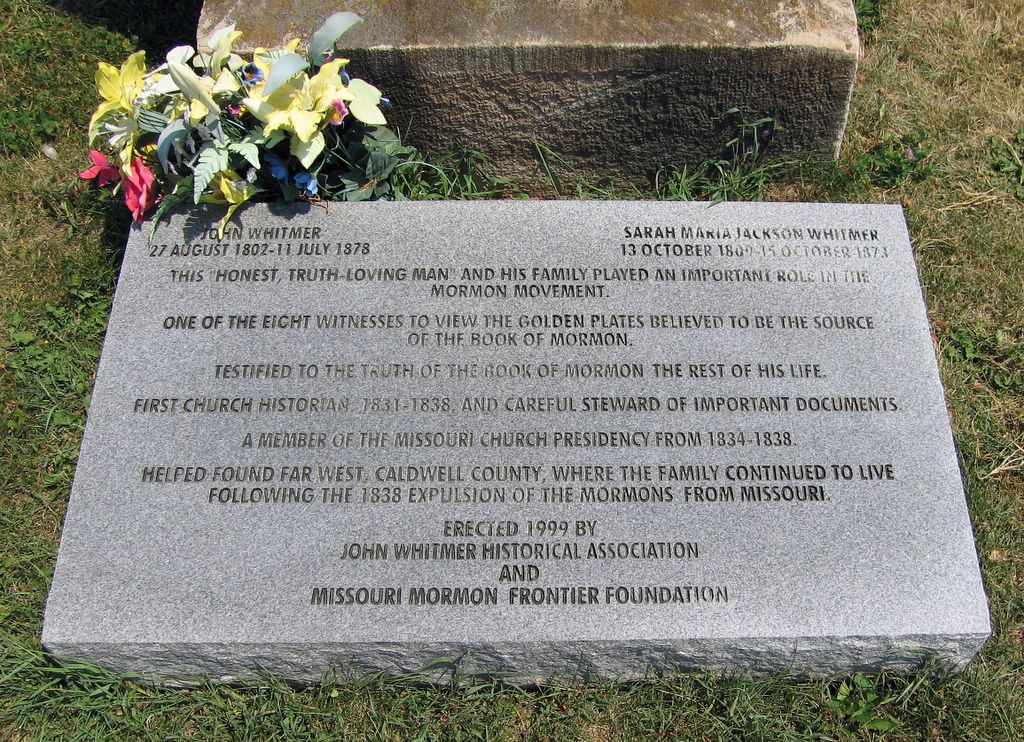
In case you're too tired to click and enlarge this photo of the granite tablet honoring John Whitmer, here's how the inscription reads, "John Whitmer, 27 August 1802-11 July 1878; Sarah Maria Jackson Whitmer, 13 October 1809-15 October 1873; This honest truth-loving man and his family played an important role in the Mormon movement. One of the eight witesses to view the golden plates believed to be the source of the Book of Mormon. Testified to the truth of the Book of Mormon the rest of his life. First church historian, 1831-1838, and careful steward of important documents. A member of the Missouri Church Presidency from 1834-1838. Helped found Far West, Caldwell County, where the family continued to live folowing the 1838 expulsion of the Mormons from Missouri. Erected 1999 by John Whitmer Historical Association and Missouri Mormon Frontier Foundation."

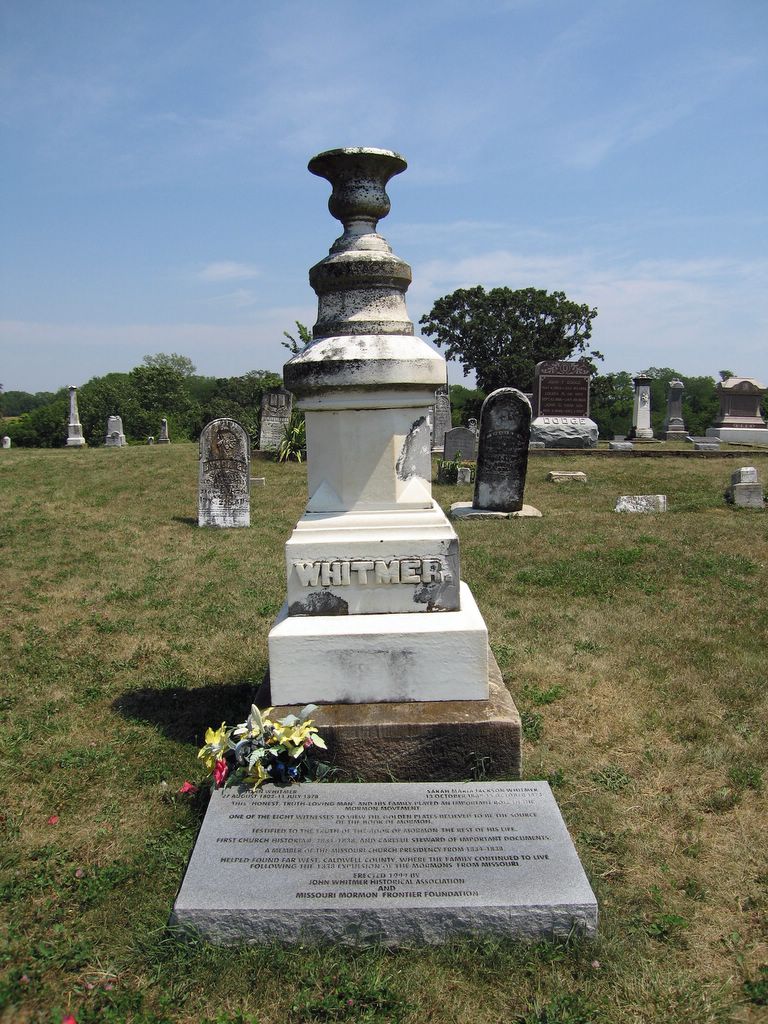
This is the Whitmer family tombstone in the cemetery at Kingston, Missouri, a few miles east of the Whitmer home at Far West, Caldwell County's original county seat. The granite tablet at its base was placed during 1999 by the John Whitmer Historical Association and the Missouri Mormon Frontier Foundation.
John Whitmer's grave at last
Now let's see, I left the Far West Temple site in Caldwell County, Missouri, several weeks ago and headed for John Whitmer's grave --- then got distracted. Well here we go again.
One of the fascinating aspect of early Mormon history is the fact that power struggles and disagreements between Joseph Smith Jr., trusted lieutenants and his successors as prophet left many of the most important early figures in development of the church rolling around in the dust along the way, excommunicated and scorned as the church reinvented itself in Utah.
John Whitmer (27 August 1802-11 July 1878) was one of the more important among these "dissidents." He, along with his parents Peter and Mary (Musselman) Whitmer, brother David Whitmer and other family members were among the earliest members of the church. Translation of the Book of Mormon was completed in his parents' home with John's brother-in-law Oliver Cowdery as principal scribe (John himself was a lesser scribe of this and other revelations). The church itself was organized in the Whitmer home. David was one of the Three Witnesses to the Book of Mormon and John, one of the Eight Witnesses.
The Whitmers, David and John, rose to places of great importance in the emerging church in "Zion" (Missouri). David eventually was named president of the Stake of Zion with John and W.W. Phelps as counselors. John was the church's first official historian.
Then, kaboom, Joseph Smith Jr. lost control in Kirtland (where church headquarters had remained) and pursued by a nasty banking scandal took himself, his lieutenants there and most church members remaining in Ohio during 1838 to Far West, founded in Caldwell County by the Whitmers, Phelps and the Missouri leadership.
A nasty leadership struggle ensued, actively encouraged by Sidney Rigdon, among the nastiest of the prophet's Ohio lieutenants. There seem to have been all sorts of motives here. One simply was that the Missouri presidency was accustomed to running Missouri, and arrival from Ohio of another leadership team generated instant conflict. The Ohioans had lost control in Ohio to dissidents, and were determined that it wouldn't happen again. The Missourians, in turn, were not happy with some things that had been going on in Ohio, including the banking fiasco and, reportedly, the prophet's new plural marriage revelation which apparently became common knowledge among top leaders. That, the Missourians felt, was adultery, not revelation.
The Missourians had opened themselves to charges by doing a few things they probably wouldn't have done had they known what was coming --- purchasing land in Caldwell County for the church in their own names, for example. That opened them to charges of profiteering.
When push came to shove, the Ohioans prevailed and all the Whitmers, Cowdery, Phelps and others were excommunicated. They remained at Far West for a time, then old Sidney delivered his "Salt" sermon, interpreted as a death threat by the dissidents and backed by the newly-organized and probably quite nasty Danites. The dissidents, including the Whitmers, fled.
After the 1838 Mormon War ended disastrously for the Saints and the majority fled east, coming to rest finally at Nauvoo, John Whitmer returned to his farm at Far West, acquired other property (including the Temple site) and settled down to life as a successful farmer. He also wrote the first history of the church, carrying it up to the point he was separated from it.
Upon his death during 1878, John was buried in the cemetery at Kingston --- created to replace Far West as the county seat because of its central location --- and he rests there today with his wife and other family members.
Kingston is one of those odd towns, not uncommon in Missouri, where the courthouse, other government offices and a brand spanking new jail seem to be the only justifications for its existence. It has a couple of hundred residents at the most.
The cemetery is located on a point of land in northeast Kingston. If you enter northward on the eastern-most drive and keep watch to your left, you'll eventually see a sign pointing to John Whitmer's grave on one of the highest points in the cemetery. The vintage family tombstone has been supplemented by a new granite tablet explaining in very diplomatic language his role in the early Mormon church.
As the years have passed nearly all historians --- including those devoutly Mormon --- have acknowledged that John Whitmer was an honest, honorable man caught up in a power struggle. You don't have to look too far, however, to discover that it's still OK to take snarky potshots at him.
It's useful to remember that John, although estranged from the church he helped to create, never questioned the legitimacy of the Book of Mormon or of Joseph Smith's prophetic stature. So in many senses, he was a Saint to the end.
It's also interesting to note that Sidney Rigdon took a nosedive into the dust himself when he decided that he, rather than Brigham Young, should lead the Saints after Joseph Smith Jr.'s murder. Kind of divine justice, that.
If you stop by to see old John, look to the right as you're driving along toward his grave and say "hey" to my Rhea cousins, also buried here. William, Bettie and their family arrived several years after the Saints had departed, but I've always thought it interesting that they ended up here at all.
One of the fascinating aspect of early Mormon history is the fact that power struggles and disagreements between Joseph Smith Jr., trusted lieutenants and his successors as prophet left many of the most important early figures in development of the church rolling around in the dust along the way, excommunicated and scorned as the church reinvented itself in Utah.
John Whitmer (27 August 1802-11 July 1878) was one of the more important among these "dissidents." He, along with his parents Peter and Mary (Musselman) Whitmer, brother David Whitmer and other family members were among the earliest members of the church. Translation of the Book of Mormon was completed in his parents' home with John's brother-in-law Oliver Cowdery as principal scribe (John himself was a lesser scribe of this and other revelations). The church itself was organized in the Whitmer home. David was one of the Three Witnesses to the Book of Mormon and John, one of the Eight Witnesses.
The Whitmers, David and John, rose to places of great importance in the emerging church in "Zion" (Missouri). David eventually was named president of the Stake of Zion with John and W.W. Phelps as counselors. John was the church's first official historian.
Then, kaboom, Joseph Smith Jr. lost control in Kirtland (where church headquarters had remained) and pursued by a nasty banking scandal took himself, his lieutenants there and most church members remaining in Ohio during 1838 to Far West, founded in Caldwell County by the Whitmers, Phelps and the Missouri leadership.
A nasty leadership struggle ensued, actively encouraged by Sidney Rigdon, among the nastiest of the prophet's Ohio lieutenants. There seem to have been all sorts of motives here. One simply was that the Missouri presidency was accustomed to running Missouri, and arrival from Ohio of another leadership team generated instant conflict. The Ohioans had lost control in Ohio to dissidents, and were determined that it wouldn't happen again. The Missourians, in turn, were not happy with some things that had been going on in Ohio, including the banking fiasco and, reportedly, the prophet's new plural marriage revelation which apparently became common knowledge among top leaders. That, the Missourians felt, was adultery, not revelation.
The Missourians had opened themselves to charges by doing a few things they probably wouldn't have done had they known what was coming --- purchasing land in Caldwell County for the church in their own names, for example. That opened them to charges of profiteering.
When push came to shove, the Ohioans prevailed and all the Whitmers, Cowdery, Phelps and others were excommunicated. They remained at Far West for a time, then old Sidney delivered his "Salt" sermon, interpreted as a death threat by the dissidents and backed by the newly-organized and probably quite nasty Danites. The dissidents, including the Whitmers, fled.
After the 1838 Mormon War ended disastrously for the Saints and the majority fled east, coming to rest finally at Nauvoo, John Whitmer returned to his farm at Far West, acquired other property (including the Temple site) and settled down to life as a successful farmer. He also wrote the first history of the church, carrying it up to the point he was separated from it.
Upon his death during 1878, John was buried in the cemetery at Kingston --- created to replace Far West as the county seat because of its central location --- and he rests there today with his wife and other family members.
Kingston is one of those odd towns, not uncommon in Missouri, where the courthouse, other government offices and a brand spanking new jail seem to be the only justifications for its existence. It has a couple of hundred residents at the most.
The cemetery is located on a point of land in northeast Kingston. If you enter northward on the eastern-most drive and keep watch to your left, you'll eventually see a sign pointing to John Whitmer's grave on one of the highest points in the cemetery. The vintage family tombstone has been supplemented by a new granite tablet explaining in very diplomatic language his role in the early Mormon church.
As the years have passed nearly all historians --- including those devoutly Mormon --- have acknowledged that John Whitmer was an honest, honorable man caught up in a power struggle. You don't have to look too far, however, to discover that it's still OK to take snarky potshots at him.
It's useful to remember that John, although estranged from the church he helped to create, never questioned the legitimacy of the Book of Mormon or of Joseph Smith's prophetic stature. So in many senses, he was a Saint to the end.
It's also interesting to note that Sidney Rigdon took a nosedive into the dust himself when he decided that he, rather than Brigham Young, should lead the Saints after Joseph Smith Jr.'s murder. Kind of divine justice, that.
If you stop by to see old John, look to the right as you're driving along toward his grave and say "hey" to my Rhea cousins, also buried here. William, Bettie and their family arrived several years after the Saints had departed, but I've always thought it interesting that they ended up here at all.
Wednesday, September 21, 2005
Hanged by the neck until dead
 |
| Ivan L. Sullivan was hanged for muder of a prison guard at the penitentiary in Fort Madison on 12 November 1941. His grave is in Waynick/Holmes Cemetery southwest of Chariton |
Small towns have long memories, and so do I. It must have been junior high in Russell, playing "Did-you-know?" also known as "Gotcha," when someone dropped the bomb: "Did you know (insert name of fellow student here; I'm not a gonna do it)'s uncle was a killer? Hung at Fort Madison. Yup, it's true."
Soon after, I filed that away. Until two weeks ago Monday.
Envision a mildly ominous late summer evening --- yellow sky, windy, dust-dry, storm in the forecast --- at Waynick/Holmes Cemetery, an out-of-the-way place a couple of miles southwest of Chariton on a road now dead-end because some damn-fool drunk decided to lead the deputy on a chase over the graveled hill onto dirt, roar across the Chariton river bottom and slam into the rickety old river bridge, ruining it entirely.
We'd gathered there, the Lucas County Genealogical Society, for supper atop cemetery hill against the south fence, then a tombstone tour led by Mary Ruth Pierschbacher, descendant of the Holmes family who purchased the old Waynick farm surrounding the cemetery more than a century ago and whose graves are as numerous there as are those of the Waynicks, now vanished entirely from Lucas County. Mary Ruth grew up there, lived her married life there, her son lives there now and her late husband, Lloyd, is buried there.
Mary Ruth had conspired on supper with her cousin by marriage (and my cousin by blood) Mary Lou Pierschbacher, reminding us again why middle names are useful.
As we sat circled around an isolated grave, Mary Ruth arose: "This is Ivan L. Sullivan, hung at Fort Madison," she said. Yup, it's true.
I've been to Waynick/Holmes many time. My great-great-grandmother, Eliza Jane (Brown) Dent/Chynoweth, is buried there with her second husband, Joseph Turner Chynoweth; their daughter, Mollie; and a good many other kin and almost-kin. But I'd not thought about that isolated and sunken grave in the southwest corner before.
Mary Ruth went on to explain that Ivan's dad came out to see her dad not long before Ivan was executed, explaining that his Lucas County family planned to claim the body, but had no money and didn't know where to bury him. "How much would it cost to bury him here?" he asked of Mary Ruth's dad. And her dad replied, "nothing more than the cost of opening and closing the grave." And so this is where Ivan rests, quite alone but with a decent tombstone installed by the family that loved him despite crimes that spiraled from cattle theft through robbery and kidnapping to murder.
"I was about 6," Mary Ruth said, "and wanted so badly to stay at home and watch them bury him." But her parents would have none of that and off to school she went.
Visiting a week later with Betty Cross, whose knowledge of Russell is all-encompassing, we connected Ivan and my junior high "gotcha." Ivan had married a Russell girl, then destroyed her dreams and his life for who knows what reasons --- the inexplicable nature of evil. That Russell girl's sister was my fellow student's aunt, and in that manner had acquired Ivan as an uncle several years after his 1941 death.
The following report, published on the front page of The Chariton Herald-Patriot of 13 November 1941, tells Ivan's story:
"Executed Wednesday at Fort Madison; Sullivan Service Here Today
"Private services were held at the Beardsley funeral home in Chariton this afternoon for Ivan Sullivan, who died yesterday morning on the gallows at the Fort Madison penitentiary.
"Simple burial services were conducted by the Rev. Father Charles O'Connor of the Sacred Heart church of Chariton. Interment followed in the Waynick cemetery, southwest of Chariton.
"Sullivan was hanged at 7:06 Wednesday for the murder of a Fort Madison penitentiary guard, Robert Hart, in an unsuccessful prison delivery attempt July 8, 1940.
"Numerous appeals by friends, relatives and social workers to Governor George A. Wilson to commute the sentence to life imprisonment failed. Another last minute appeal by George Stuart, Chariton attorney, to Gov. Wilson was also denied.
"Sullivan last week wrote to Gov. Wilson in a plea for a postonement of the execution until after Thanksgiving to make it easier for his family.
"Tuesday, Sullivan dictated a statement to reporters in which he continually expressed his innocence and blamed Warden Glenn Haynes of the Fort Madison prison and Gov. Wilson for his plight.
"He claimed that the warden had refused him an interview with the press until it was too late to do any good. Ivan also claimed that had he been able to have an investigation in time, the bullet which killed Hart would have probably proved his innocence.
"The prisoner maintained throughout his long statement that the failure of the state crime laboratory to produce the murder bullet made him more certain than ever that Hart was killed by another guard's gun.
"Throughout the long statement, Sullivan rebuked the governor for not having answered pleas of his family to see the bullet.
"He said, 'A governor who tolerates such an injustice must indeed be a fine Christian.'
"Sullivan joined the Catholic church about six weeks ago, converted by Father H. V. Bongers, Fort Madison priest.
"One Chariton man was among the 165 official witnesses who attended the execution which was held in the prison yard near the point where Sullivan shot Hart.
"His life of crime started in 1933 at the age if 21 when he was sentenced to five years in Aamosa reformatory for cattle stealing. He was in Fort Madison under a 30-year sentence for robbery and kidnapping when he and two others made their prison break.
"Later, Sullivan and Lowell Haenze, who escaped with him, returned to attempt the release of William Cunningham, who killed himself when the attempt failed.
"It was during this encounter outside the prison walls that Hart was shot. Haenze and Sullivan escaped and spent the ensuing weeks in a series of crimes including numerous automobile thefts, filling station and other holdups and burglaries and the robbing of banks at Wilber and Diller, Nebr.
"It was after the bank robberies that Haenze was shot and captured at Marysville, Kan., July 19, and Sullivan was taken without resistance near St. Joseph, Mo., the following day.
"Sullivan pleaded guilty to the murder of Hart and was originally scheduled to be executed in September. His lawyers attempted to get the supreme court to grant a retrial of the case, and the execution was postponed at that time.
"The supreme court, however, denied the retrial and Gov. Wilson set the new date of execution."
Thursday, September 15, 2005
Fiddlesticks: Prather Cemetery Revisited
Let's see. I was on the road to John Whitmer's grave when last heard from --- before another week of vacation interrupted the logical sequence of things. Add another week to recover from chasing Robert Rathbun (died 1856) through Van Buren County and other side trips, and here we are. Back to John Whitmer another day.
I've rewritten and republished a May 19 piece about Prather Cemetery, located east of Chariton in Cedar Township. Like many amateur historians (and a good many professional ones, too), I was operating with incomplete information. Originally, I suggested Prather might actually be the cemetery founded about 1850 by William McDermott, Cedar Township's first settler, and sometimes referred to (logically enough) as McDermott Cemetery. Well!
While slogging through Lucas County's "Abstract of Original Entries" and assorted Cedar Township deeds the other day, I found enough to satisfy myself that the cemetery McDermott founded actually is what now is known as Bethel. The difficulty was, he thought he founded the cemetery on land he owned, but didn't. The oldest part of Bethel actually was on land purchased from the government by my great-great-great-grandmother, Elizabeth (Rhea) Rhea/Etheredge/Sargent, and her second husband, Thomas Etheredge.
This explains why, during the early 1870s, Elizabeth and her third husband, Edward E. Sargent, deeded the oldest portion of Bethel (for $1) to the township trustees for use as a public burying ground. I hadn't found prior to last week the deed executed at about the same time by William and Nancy McDermott, transferring a half acre of the newer part of the cemetery to the trustees for the same purpose. Together, these two small tract of lands form much of the current Bethel.
I'll get around to more about William McDermott, Bethel, etc., another time, but before doing that wanted to go back and clarify the earlier post about Prather Cemetery.
It now seems almost certain that Prather (called that only because Prathers owned the land around it at a time when someone decided it should be called something other than "that old abandoned cemetery") began as a family burial ground for the original owners of the land, James and Elizabeth Roland. Their daughter, Nancy, recognized as the first non-native child born in Lucas County, died during 1852 and hers is the first marked grave remaining. A Roland son also is buried there. As time passed, a few neighbors chose to be buried near the Rolands, but most opted to use what has been known variously as the McDermott, Sargent and Bethel Cemetery.
So the May 19 post now reflects this new information, and I'll turn left and head for John Whitmer's grave next time.
I've rewritten and republished a May 19 piece about Prather Cemetery, located east of Chariton in Cedar Township. Like many amateur historians (and a good many professional ones, too), I was operating with incomplete information. Originally, I suggested Prather might actually be the cemetery founded about 1850 by William McDermott, Cedar Township's first settler, and sometimes referred to (logically enough) as McDermott Cemetery. Well!
While slogging through Lucas County's "Abstract of Original Entries" and assorted Cedar Township deeds the other day, I found enough to satisfy myself that the cemetery McDermott founded actually is what now is known as Bethel. The difficulty was, he thought he founded the cemetery on land he owned, but didn't. The oldest part of Bethel actually was on land purchased from the government by my great-great-great-grandmother, Elizabeth (Rhea) Rhea/Etheredge/Sargent, and her second husband, Thomas Etheredge.
This explains why, during the early 1870s, Elizabeth and her third husband, Edward E. Sargent, deeded the oldest portion of Bethel (for $1) to the township trustees for use as a public burying ground. I hadn't found prior to last week the deed executed at about the same time by William and Nancy McDermott, transferring a half acre of the newer part of the cemetery to the trustees for the same purpose. Together, these two small tract of lands form much of the current Bethel.
I'll get around to more about William McDermott, Bethel, etc., another time, but before doing that wanted to go back and clarify the earlier post about Prather Cemetery.
It now seems almost certain that Prather (called that only because Prathers owned the land around it at a time when someone decided it should be called something other than "that old abandoned cemetery") began as a family burial ground for the original owners of the land, James and Elizabeth Roland. Their daughter, Nancy, recognized as the first non-native child born in Lucas County, died during 1852 and hers is the first marked grave remaining. A Roland son also is buried there. As time passed, a few neighbors chose to be buried near the Rolands, but most opted to use what has been known variously as the McDermott, Sargent and Bethel Cemetery.
So the May 19 post now reflects this new information, and I'll turn left and head for John Whitmer's grave next time.
Subscribe to:
Posts (Atom)